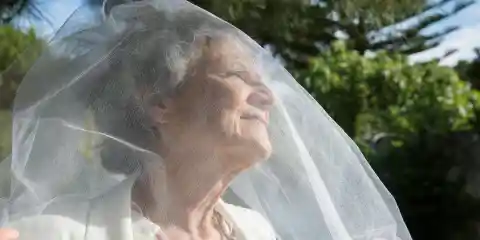
Evie was seventy-one.
She was widowed, kind, and lived alone in a beautiful blue house with white shutters and flower boxes beneath every window.
I was exhausted from being cold.
Exhausted from collection agencies.
Exhausted from washing up in gas station restrooms before job interviews.
So when she asked me to marry her, I said yes.
Not because I loved her.
Because I needed somewhere to stay.
The first person I told was my friend Jesse.
We were sitting in a bar nursing cheap beers when I broke the news.
“I’m getting married.”
Jesse nearly choked.
“To who?”
“Evie.”
“The widow?”
“Keep your voice down.”
He leaned back and laughed.
“Damon, that’s not marriage. That’s homelessness with paperwork.”
I forced a smile.
“It’s a roof.”
“It could be a lot more than a roof if you play your cards right.”
I should have walked away.
Instead, I stared into my beer and said nothing.
Because part of me had already started wondering the same thing.
Two weeks before our wedding, Evie placed a folder on the kitchen table.
“A prenuptial agreement,” she said.
I looked at her in disbelief.
“You don’t trust me?”
She adjusted her reading glasses.
“Lonely doesn’t mean foolish.”
The agreement protected everything.
The house.
Her savings.
Her investments.
Her will.
Nothing automatically became mine.
“You think I’m after your money?”
Evie studied me quietly.
“I think fear makes people do things they normally wouldn’t.”
My face burned.
She wasn’t accusing me.
That somehow made it worse.
I signed anyway.
At the time, I convinced myself things could change later.
People rewrote wills all the time.
Everyone called her Evelyn.
Only I called her Evie.
She liked it because it made her feel younger.
That was who she was.
She found joy in little things.
The smell of fresh coffee.
Flowers blooming after rain.
Conversations with neighbors.
Meanwhile, I noticed entirely different things.
The stocked pantry.
The warm house.
The medical appointments written on the refrigerator calendar.
The growing collection of prescription bottles.
Every appointment caught my attention.
Every new medication made me wonder how much time she had left.
Looking back, I’m ashamed of that.
But at the time, I was keeping score.
The strange thing was that Evie never treated me like a burden.
She treated me like family.
One day I came home to find a pair of new work boots by the door.
The next week there was a winter coat waiting for me.
“I don’t need charity,” I protested.
“Good,” she replied.
“Then consider it an investment in cleaner floors.”
I laughed despite myself.
At the diner in town, everyone knew Evie.
Every waitress greeted her by name.
Every customer stopped to talk.
One afternoon she stirred sugar into her tea and watched me.
“You get uncomfortable when people are kind to me.”
“What?”
“You start tapping your fingers.”
I froze.
She smiled gently.
“Like you’re counting how many people trust me.”
I looked away.
“You imagine things.”
“Maybe.”
But her eyes told me she wasn’t guessing.
She knew more than she let on.
One evening I found her sitting halfway down the staircase in the dark.
For a moment, fear gripped my chest.
“Evie?”
She looked up.
“I’m fine.”
“You’re sitting on the stairs.”
“I was resting.”
I helped her stand.
For a brief second she leaned against me.
Her weight felt surprisingly fragile.
In the kitchen, I tried making tea.
I forgot to turn on the stove.
She laughed so hard she nearly cried.
For a few minutes we felt like an ordinary married couple.
Then my phone buzzed.
A message from Jesse.
“How’s the retirement plan?”
I glanced at Evie.
She was smiling at the tea I’d made.
And I typed something I’ll regret for the rest of my life.
“All good. Once she’s gone, I’m set.”
The guilt lasted maybe two seconds.
Then I buried it.
Three days later, Evie collapsed in the kitchen.
One moment she was reaching for a spoon.
The next she was falling.
I caught her before she hit the floor.
Hours later, a doctor found me in a hospital hallway.
“I’m sorry.”
I stared at him.
“She was eating breakfast.”
“Her heart failed.”
Nothing else registered.
The funeral happened three days later.
I wore the coat she’d bought me.
Claire, Evie’s niece, noticed immediately.
“Of course you wore that.”
“It’s cold.”
“No,” she snapped.
“You just never stopped taking from her.”
I wanted to argue.
Instead, I stayed silent.
Because some part of me knew she wasn’t entirely wrong.
The next morning I sat inside the office of Evie’s attorney, Mr. Carson.
I expected paperwork.
I expected money.
I expected something.
Instead, he looked at me calmly and said:
“The house goes to Claire.”
My stomach dropped.
“What?”
“It’s in the will.”
“What about her savings?”
“They’ve been donated to a community assistance fund.”
The room suddenly felt too small.
“She left me nothing?”
Mr. Carson shook his head.
“She left you one thing.”
He placed an old shoebox on the desk.
My name was written across the lid.
“She said this is what you really wanted.”
Confused, I opened it.
The first thing inside was a printed screenshot.
My text message.
“All good. Once she’s gone, I’m set.”
I felt physically sick.
“Where did she get this?”
“Your phone lit up while she was sitting nearby.”
“And she never confronted me?”
“No.”
The next items were receipts.
Boots.
Coat.
Car repairs.
Dental appointments.
Credit card payments.
On every receipt, Evie had written notes.
“You lied about this one.”
“You thanked me for this one.”
“You almost told me the truth here.”
The final receipt was for the coat I’d worn to her funeral.
On the back she had written:
“You looked embarrassed when I noticed you were cold. That was the first truly honest expression I ever saw on your face.”
I could barely breathe.
Then Mr. Carson handed me a letter.
I unfolded it.
And suddenly Evie was speaking to me one last time.
“Damon,
You probably believe I left you with nothing.
I didn’t.
I left you with the truth.
I knew why you married me.
I knew before the wedding.
I knew every time you watched my medications.
Every time you forced a smile.
Every time fear convinced you that survival mattered more than honesty.
But I also saw something else.
I saw a man who fixed a neighbor’s porch without charging her.
A man who sat beside me in hospitals even when he hated them.
A man who made terrible tea because he was trying to help.
You weren’t honest.
But you weren’t heartless.
That’s why I stayed.
I was lonely.
You were afraid.
For a while, we helped each other.
Now you have a choice.
Walk away with this box.
Or finally tell the truth.
I think that’s what you really wanted all along.
Not my house.
Not my money.
Freedom from fear.
Love,
Evie.”
When I finished reading, tears blurred the page.
Mr. Carson placed two envelopes on the desk.
One meant I could leave and never speak of any of it.
The other meant attending a memorial luncheon where everyone who loved Evie would hear her final message.
The next afternoon, I walked into that room.
People stared.
Claire looked furious.
Mr. Carson read Evie’s final statement.
Then every eye turned toward me.
I could have stayed silent.
Instead, I stood.
“She knew,” I said.
My voice shook.
“I married her because I was scared. Because I was selfish. Because I thought she could save me.”
The room became silent.
I told them everything.
The marriage.
The lies.
The text message.
The shame.
When I finished, nobody applauded.
Nobody forgave me.
But for the first time in years, I wasn’t hiding.
Months later, I was volunteering at the charity Evie had funded.
I handed Claire an envelope containing my first repayment toward everything Evie had spent on me.
“She didn’t ask for this,” Claire said.
“I know.”
“Then why do it?”
I looked toward the building carrying Evie’s name.
“Because she’s not here to remind me anymore.”
That evening, I visited her grave.
In my pocket was a copy of the text message that had haunted me for months.
I tore it into pieces.
Then I stood quietly beside the woman I had once viewed as an opportunity.
“I wanted your life,” I whispered.
The wind moved softly through the cemetery trees.
“But you gave me something better.”
I arrived in her life looking for a house.
She left me with a conscience.
And somehow, that turned out to be worth far more.
{"post":103397,"page":2,"next":[{"id":103394,"title":"I Became a Private Driver for a Wealthy Widow Because I Needed Money \u2013 After She Said I Had Taken Her Diamond Brooch, I Found a Hidden Note in the Car and Was Left Stunned","url":"https:\/\/new24.info\/103394"},{"id":103385,"title":"Real reason Barron Trump missed Don Jr.\u2019s wedding is raising eyebrows","url":"https:\/\/new24.info\/103385"},{"id":103382,"title":"Why Mark Zuckerberg warns against screenshotting Facebook Messenger chats","url":"https:\/\/new24.info\/103382"},{"id":103378,"title":"Donald Trump says new drug has \u201cbrought people back to life\u201d in bizarre announcement","url":"https:\/\/new24.info\/103378"},{"id":103372,"title":"Cemetery is demanding headstone be removed over obscene \u2018hidden message\u2019","url":"https:\/\/new24.info\/103372"},{"id":103367,"title":"\u201cDoctors Were Speechless\u201d: The Truth Behind This Viral Photo","url":"https:\/\/new24.info\/103367"},{"id":103363,"title":"These are the consequences of sleeping with the\u2026","url":"https:\/\/new24.info\/103363"},{"id":103359,"title":"An Urgent Call From Washington Changed Everything Before Crucial International Discussions","url":"https:\/\/new24.info\/103359"},{"id":103352,"title":"Hidden Habits That May Be Affecting Your Most Sensitive Skinm-","url":"https:\/\/new24.info\/103352"},{"id":103354,"title":"The Monkey Test: A Curious Psychology Exercise That May Reveal Narcissistic Traits - Terbv","url":"https:\/\/new24.info\/103354"},{"id":103347,"title":"What Erika Kirk Said About Recent Relationship Rumors Is Getting Attention","url":"https:\/\/new24.info\/103347"},{"id":103343,"title":"Florida student dies in tragic crash","url":"https:\/\/new24.info\/103343"},{"id":103340,"title":"The gravel in Johnny Cash\u2019s voice wasn\u2019t a stylistic choice","url":"https:\/\/new24.info\/103340"},{"id":103337,"title":"The Kitchen Appliance You Must Unplug Before Sleeping to Prevent a Fire","url":"https:\/\/new24.info\/103337"},{"id":103333,"title":"Celine Dion: her journey through health challenges after a legendary career - Terbv","url":"https:\/\/new24.info\/103333"},{"id":103330,"title":"For two decades, my life was a fractured existence, defined entirely by the moment my seven-year-old son, Daniel, vanished from a Route 9 rest stop","url":"https:\/\/new24.info\/103330"},{"id":103320,"title":"Expert shares insight into Melania Trump\u2019s beauty routine","url":"https:\/\/new24.info\/103320"},{"id":103317,"title":"Doctor says Kyle Busch\u2019s tragic death was \u2018totally preventable\u2019 \u2013 details how protocol was ignored","url":"https:\/\/new24.info\/103317"},{"id":103308,"title":"Three Best Friends, One Uniform","url":"https:\/\/new24.info\/103308"},{"id":103298,"title":"David Letterman\u2019s question that left Jennifer Aniston very uncomfortable","url":"https:\/\/new24.info\/103298"}]}