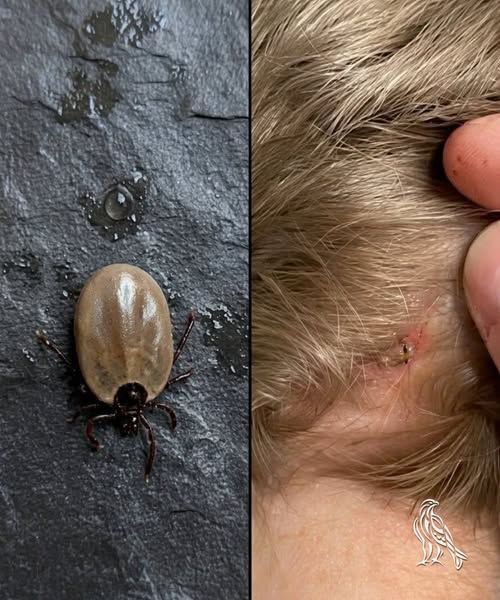
Children commonly pick up ticks during everyday outdoor activities, particularly in warmer months when ticks are most active.
Common exposure can happen during:
– playing in grass or near wooded edges
– hiking or camping
– outdoor sports
– time around leaf piles, brush, or overgrown vegetation
Because ticks are small and hair can hide them easily, the scalp is a common place for them to go unnoticed for a while.
One reassuring point often emphasized by healthcare professionals is that tick-borne disease transmission typically requires time.
A tick generally needs to be attached for a period before certain infections can be transmitted. Because of that, finding and removing a tick promptly can significantly reduce the chance of complications.
The recommended first response is careful removal.
Medical guidance commonly advises using fine-tipped tweezers to grasp the tick as close to the skin as possible, then pulling upward with slow, steady pressure. Twisting, squeezing, or jerking is generally discouraged because it can make removal harder or increase skin irritation.
After removal, washing the area with soap and water is usually recommended, followed by basic antiseptic cleaning if available.
Health professionals also advise avoiding popular home remedies such as applying petroleum jelly, oils, nail polish, or trying to burn the tick off. These methods are generally not recommended because they may irritate the tick or surrounding skin without improving removal.
Once the tick is removed, many experts suggest monitoring rather than panicking.
Mild redness at the bite site can happen and does not automatically indicate illness. More important is watching for changes over the following days or weeks.
Symptoms that typically warrant medical follow-up may include:
– fever or chills
– fatigue or body aches
– headache
– joint pain or swelling
– swollen lymph nodes
– spreading rash or unusual skin changes
– any symptoms that seem unusual or concerning for the child
Doctors often note that most tick bites do not lead to serious illness, but early evaluation can be helpful if symptoms develop.
Prevention is another common focus.
Parents are often encouraged to check areas where ticks tend to hide, including the scalp, behind the ears, neck, underarms, waistline, behind the knees, and groin after outdoor play.
Other practical prevention steps may include:
– quick tick checks after time outside
– keeping grass and brush trimmed around play spaces
– showering after outdoor activity when practical
– checking pets regularly, since animals—especially dogs—can bring ticks indoors from yards or walks
One point many pediatric experts emphasize is that finding a tick does not mean a parent missed something obvious.
Ticks are tiny, easy to overlook, and often attach without causing immediate pain or itching. What matters most is not whether one was found—but how it’s handled afterward.
In that sense, calm removal, simple cleaning, and sensible monitoring are usually the most protective next steps.
{"post":103266,"page":2,"next":[{"id":103261,"title":"FDA approves many drugs that predictably increase heart and stroke risk","url":"https:\/\/new24.info\/103261"},{"id":103257,"title":"Young woman puts both babies inside the fir\u2026 See more","url":"https:\/\/new24.info\/103257"},{"id":103240,"title":"You would watch the clip, your heart thudding dully against your ribs like a trapped bird","url":"https:\/\/new24.info\/103240"},{"id":103237,"title":"The life and career of Brian Connolly: from fame to later years - Terbv","url":"https:\/\/new24.info\/103237"},{"id":103234,"title":"Terrifying moment gunshots rang out outside White House captured on camera","url":"https:\/\/new24.info\/103234"},{"id":103231,"title":"The Case That Still Leaves One Painful Question No One Can Fully Answer","url":"https:\/\/new24.info\/103231"},{"id":103226,"title":"These are the consequences of sleeping with the\u2026See more","url":"https:\/\/new24.info\/103226"},{"id":103222,"title":"Police Arrest Suspect in Unusual Wildlife Case in U.S. Woodland Region","url":"https:\/\/new24.info\/103222"},{"id":103217,"title":"20 Minutes ago in New York City, Kelly Ripa was confirmed as\u2026See more","url":"https:\/\/new24.info\/103217"},{"id":103215,"title":"kaylestore.net","url":"https:\/\/new24.info\/103215"},{"id":103212,"title":"Why Stretching Your Ring Finger Might Feel Surprisingly Good","url":"https:\/\/new24.info\/103212"},{"id":103209,"title":"Former AG Pam Bondi diagnosed with cancer weeks after being fired by Trump: report","url":"https:\/\/new24.info\/103209"},{"id":103203,"title":"Here\u2019s what the sticker says. What do you think??\u2026\u2026","url":"https:\/\/new24.info\/103203"},{"id":103199,"title":"Valerie Bertinelli Opens Up About Emotional Career Change and What Comes Next","url":"https:\/\/new24.info\/103199"},{"id":103190,"title":"After My Father Hid My Grandmother Away for Four Years and Lied That She Had Forgotten Me","url":"https:\/\/new24.info\/103190"},{"id":103188,"title":"Millionaire CEO Came to Buy an Engagement Ring for Another Woman\u2014Until the Jeweler Said, \u201cThat Design Belongs to the Baby You Abandoned\u201d.... Then Saw His Ex Behind the Counter Holding a Child - News","url":"https:\/\/new24.info\/103188"},{"id":103179,"title":"The seven-hour drive from Minneapolis to Chicago felt like I was crossing the entire country with a jagged blade pressed against my ribs","url":"https:\/\/new24.info\/103179"},{"id":103174,"title":"At 10:03 p.m., ninety-three days after Luke Mercer signed the divorce papers and told Elena he no longer loved her, the phone","url":"https:\/\/new24.info\/103174"},{"id":103172,"title":"The contraction hit like a freight train, splitting my world into jagged shards of agony","url":"https:\/\/new24.info\/103172"}]}