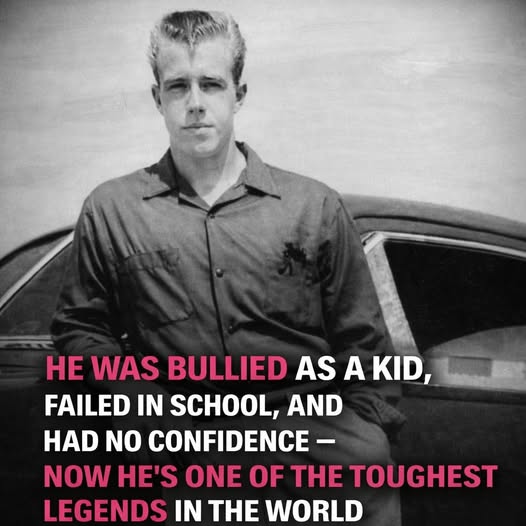
What began in pain eventually transformed into a legacy that would span generations. Born into a world of uncertainty, the boy who would become Chuck Norris spent his early years shrinking from the world. He was the kid who didn’t speak up, the one who navigated school hallways like a ghost, hoping to avoid the gaze of those who sought to tear him down. When his parents eventually split and his family relocated to California, the geography changed, but the internal void remained. He was a young man without a compass, drifting through life with no clear destination.
Seeking structure in a life that had offered him none, he joined the Air Force. It wasn’t a choice born of grand ambition, but rather a necessity—a place to go when there was nowhere else to turn. It was in the unfamiliar landscape of South Korea that the trajectory of his life shifted forever. Stationed far from home, he encountered a discipline that would become his salvation: Tang Soo Do.
For the man who had spent his life apologizing for his own existence, martial arts offered more than just physical defense. It provided a framework for self-respect. Every kick, every block, and every hour spent on the mat was a brick in the foundation of a new identity. He wasn’t just learning to fight; he was learning to occupy space. He was learning that he had the right to stand his ground.
This newfound discipline didn’t just stay in the dojo. It bled into every facet of his life, fueling a competitive fire that led him to dominate tournament circuits. That intensity eventually caught the eye of Hollywood, leading to an iconic showdown against Bruce Lee in The Way of the Dragon. It was a moment that etched his name into the cultural consciousness, setting the stage for a career defined by stoic strength and unwavering resolve.
From the silver screen to the legendary role of Walker, Texas Ranger, he became a global symbol of unbreakable spirit. Yet, the true power of his story isn’t found in the roundhouse kicks or the high-octane action sequences. It is found in the quiet, transformative realization that the toughest warriors are not born in comfort, but are forged in the fires of their own early struggles. He proved that no matter how invisible you feel today, the strength to define your own future is already waiting within you, ready to be claimed.