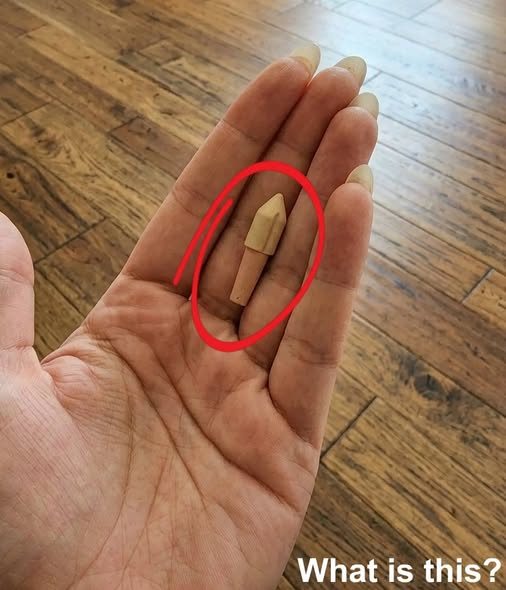
…or was I losing my grip on reality? When I confronted him, his reaction was infuriatingly casual. He simply shrugged, claiming he had no idea how it got there or what it even was. That lack of concern didn’t soothe me; it ignited a fire of paranoia. If it wasn’t his, whose was it? And why was it tucked away in the dark, forgotten corner of his pocket, waiting to be discovered?
For the next hour, I sat in the dim light of the laundry room, turning the object over in my hand. It was engineered with a strange, clinical precision—a threaded base, a tapered point, and a finish that looked like it had been designed for impact. Every time I looked at it, my imagination conjured up scenarios of betrayal. I thought of secret meetings, hidden hobbies, or perhaps something far more sinister that he was keeping from me. The silence in the house felt heavy, punctuated only by the rhythmic ticking of the wall clock, which seemed to mock my growing anxiety.
I began to scrutinize every detail. The metal was cool to the touch, and there was a faint, almost imperceptible scratch near the tip. It wasn’t just a random piece of junk; it was a deliberate object. I felt like a detective in my own home, investigating a crime that hadn’t happened yet, or perhaps one that had been unfolding right under my nose for months. I was ready to demand answers, ready to tear down the walls of his indifference, when a tiny, almost microscopic detail caught the light.
I squinted, bringing the object closer to my face. There, etched into the base, were subtle markings I hadn’t noticed before. Suddenly, the tension in my chest snapped. The mystery didn’t unravel—it evaporated. It wasn’t a weapon, a key to a secret apartment, or evidence of a double life. It was a field point—a practice tip for an archery arrow. It was designed for a target, not a person.
The realization hit me with the force of a physical blow, but it wasn’t the relief I expected. It was a profound sense of shame. My husband wasn’t a criminal; he was a man who had found a quiet, solitary hobby—a way to focus his mind and escape the noise of our daily life—and he had been too shy or perhaps too private to share it with me. He hadn’t been hiding a secret; he had been protecting a sanctuary.
As I sat there, the cold metal now feeling harmless and small in my palm, I realized how easily we can build monsters out of the unknown. We project our fears onto the people we love, turning their silence into suspicion and their privacy into betrayal. I had spent an hour tearing down the foundation of our marriage over a piece of steel meant for a foam target. It was a humbling lesson in the fragility of trust and the dangerous power of our own assumptions. Sometimes, the most frightening things we find are not the secrets of others, but the shadows of our own insecurities.