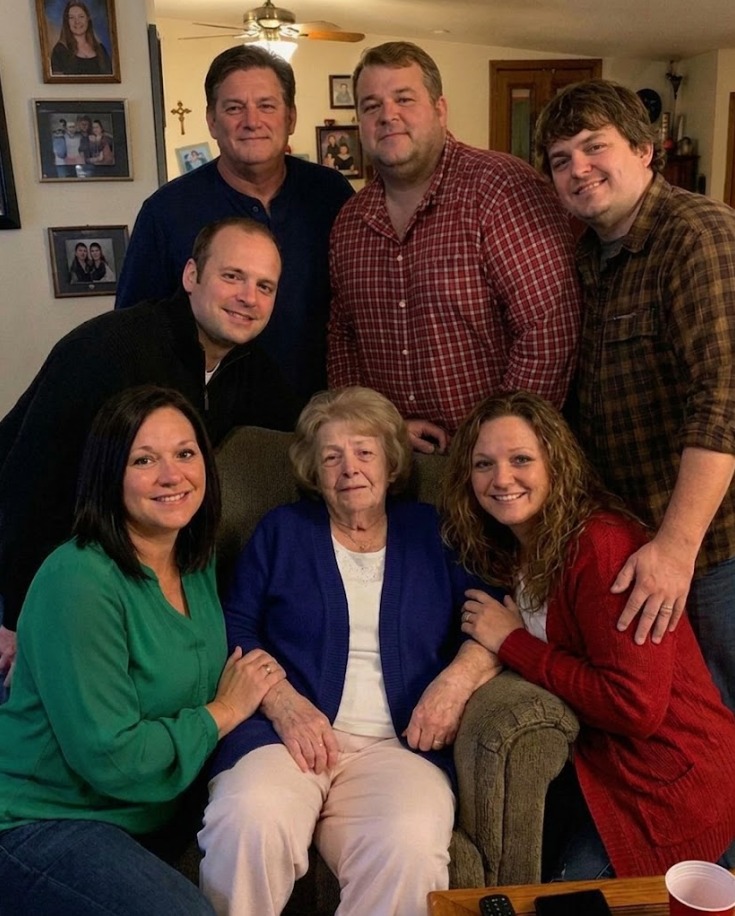
Back then, their home overflowed with life.
Daniel was twelve when they buried his father. Carol was ten. Michael was eight. Lisa six. Thomas four. Little Ben still climbed into Margaret’s lap and fell asleep with his fist tangled in her sweater.
The years moved quickly after that.
Her children grew older, moved away, built careers, marriages, and families of their own. At first they still visited often. They called regularly. Holidays were loud and crowded.
But slowly, almost invisibly, things changed.
The calls became shorter.
The visits became rushed.
There was always another obligation, another dinner, another soccer practice, another work emergency.
Margaret told herself this was normal. She had raised independent adults. This was success.
Still, the silence inside the house grew heavier every year.
One evening, while standing alone in her kitchen washing dishes no one else would use, Margaret realized she could not remember the last time all six of her children had been together under the same roof.
That realization cracked something open inside her.
She leaned against the counter and cried harder than she had cried in years.
Not because she blamed them for having lives.
But because she missed her family.
Not the polite holiday versions of them. Not the rushed phone calls squeezed between errands.
She missed the loud, messy, chaotic family that once filled every room with laughter and arguments and life.
So she made a decision she was not proud of.
She sent all six children the exact same message.
“My health has gotten worse. I don’t know how much time I have left. Please come see me before it’s too late.”
It was a lie born from loneliness.
But it worked.
Within twenty-four hours, her house was full again.
Her daughters cooked meals in the kitchen while music played softly in the background. Her sons repaired broken cabinet hinges, changed light bulbs, cleaned gutters, and carried boxes from the basement she had been unable to move herself.
For two beautiful days, Margaret felt alive again.
She listened to laughter drifting down hallways.
She watched her children tease each other over dinner.
She stood quietly in the doorway more than once simply admiring them together.
For the first time in years, the house felt like home again.
Then came the third night.
Margaret woke around midnight thirsty and headed downstairs for water.
Halfway down the hallway, voices stopped her cold.
“The house should be split equally,” Daniel said firmly.
“That’s ridiculous,” Lisa snapped. “Mom promised me her savings years ago.”
“She barely remembers anything now,” Carol muttered. “We can convince her to sign.”
Margaret froze in place.
For one horrible moment, she honestly believed she had misunderstood.
Then Michael added quietly, “We need to figure this out before things get messy.”
Her stomach turned.
They continued discussing her house, jewelry, savings, furniture — calmly dividing her life while she was still upstairs breathing.
Ben hesitated once.
“Maybe we shouldn’t do this right now,” he said softly.
But he stayed in the room.
None of them walked away.
Something inside Margaret hardened.
Not loudly.
Not dramatically.
Quietly.
She returned upstairs without making a sound and stared at the ceiling until sunrise.
By morning, her decision had already been made.
At seven o’clock sharp, her lawyer sent an email to all six children requesting mandatory attendance at a family estate meeting over dinner that evening.
Panic swept through the house immediately.
Daniel pounded on her bedroom door holding his phone. “Mom! What have you done?”
Margaret adjusted her robe calmly and opened the door.
“I invited everyone to dinner,” she said.
“You changed your will?” Daniel demanded.
“I made a few decisions.”
The warmth inside the house disappeared instantly after that.
Conversations stopped when Margaret entered rooms. Her children exchanged nervous glances throughout the day.
By six o’clock, they all sat stiffly around the dining room table while Margaret served pot roast, butter rolls, and sweet potato casserole — the same Christmas dinner she had made when they were children.
No one touched the food.
Finally, Daniel cleared his throat. “Mom… what exactly is this?”
Margaret folded her napkin into her lap carefully.
“Last night,” she said calmly, “I heard my children discussing how to divide my belongings before I am even dead.”
Silence swallowed the room.
Carol crossed her arms defensively. “Mom, you shouldn’t have been listening.”
“I was getting water,” Margaret replied evenly. “In my own house.”
No one spoke.
“I heard every word.”
Lisa looked down first. Michael rubbed his forehead. Thomas refused to meet her eyes. Ben looked sick with guilt.
Only Daniel still tried to regain control.
“We were worried about you,” he argued. “People discuss practical things when someone is sick.”
Margaret nodded slowly.
“Loving families usually wait until the person is actually gone.”
The words landed heavily.
Her lawyer quietly opened his folder.
“Margaret has updated her estate plan,” he announced. “All remaining financial assets will be placed into educational trusts for all current and future grandchildren.”
Disappointment flashed openly across the table.
Then Daniel asked the question Margaret already knew mattered most.
“What about the house?”
Not “Are you okay?”
Not “Why are you doing this?”
Only the house.
Margaret looked at him for a long moment.
“I’m selling it.”
Michael pushed back his chair violently. “What?”
“You’re selling our family home?” Carol snapped.
Margaret’s expression never changed.
“No,” she corrected softly. “I’m selling my home.”
Then she looked at every one of her children.
“I stayed here because I believed eventually you would come back to it. I convinced myself life was simply busy. I thought one day the visits would become longer again.”
Her voice trembled slightly.
“But hearing you divide my jewelry while I was upstairs trying to sleep changed something inside me.”
Lisa burst into tears.
Daniel’s jaw hardened. “So this is punishment.”
“No,” Margaret answered quietly. “This is clarity.”
The room fell silent again.
“I found a senior community across town,” she continued. “They have gardens, walking paths, music nights, and shared dinners. People sit together there. They laugh together.” Her eyes glistened. “I want laughter around me again.”
Lisa wiped her face desperately. “Mom, I came because I was scared of losing you.”
“You came because I said I was dying,” Margaret replied gently. “Then you argued over my sapphire pendant.”
No one could deny it.
She turned toward Michael.
“When was the last time you called just to talk?”
He stared down at the table. “I don’t know.”
“Exactly.”
Daniel tried once more. “We have lives, Mom.”
“I know,” she said softly. “I raised you to have them.”
Then Margaret folded her hands together and spoke the truth she had carried silently for years.
“This house already gave you your inheritance. It gave you Christmas mornings, birthday parties, safety, warm meals, and a porch light left on whenever you came home late. It gave you somewhere safe to fall apart.”
Her eyes locked onto Daniel’s.
“It does not owe you a reward simply for surviving me.”
That finally broke him.
The anger disappeared from his face, replaced with shame.
One by one, her children apologized quietly.
Margaret accepted every apology with grace.
But she did not change her decision.
Because for the first time in years, she realized something important:
She no longer wanted to spend the rest of her life waiting beside the phone for people too busy to remember her until inheritance entered the conversation.
She wanted peace.
She wanted companionship.
She wanted laughter.
And this time, she was finally choosing herself.
{"post":102700,"page":2,"next":[{"id":102695,"title":"People are just learning the dark meaning behind the five-dot tattoo on people\u2019s hands","url":"https:\/\/new24.info\/102695"},{"id":102689,"title":"Last night, I went into the garage, turned on the light, and saw this on the wall.","url":"https:\/\/new24.info\/102689"},{"id":102686,"title":"My 4-Year-Old Daughter Suddenly Passed Away at Daycare \u2013 Then Her Teacher Called and Said, \u0027I Sent You the Security Footage. Your Husband Is Lying\u0027","url":"https:\/\/new24.info\/102686"},{"id":102680,"title":"Bombshell claim about Erika Kirk\u0027s fortune confirms the rumours were true","url":"https:\/\/new24.info\/102680"},{"id":102675,"title":"I walked through freezing snow with my newborn because my parents said we were broke. Suddenly, my wealthy grandpa pulled up. \u201cWhy aren\u2019t you driving the Mercedes","url":"https:\/\/new24.info\/102675"},{"id":102672,"title":"For 15 Years, Our Stepmom Made My Twin Sister and Me Believe Our Mom Left Us \u2013 Until One Day I Accidentally Overheard the Shocking Truth","url":"https:\/\/new24.info\/102672"},{"id":102669,"title":"I Thought My Daughter Was Ashamed of Our Poor Family \u2013 Until I Overheard Her Rich Husband Explaining Why I Was Never Invited Into Their House","url":"https:\/\/new24.info\/102669"},{"id":102666,"title":"BREAKING: Hollywood Actor Dead, Sudden Tragedy Shocks Fans","url":"https:\/\/new24.info\/102666"},{"id":102660,"title":"No President Ever Tried This. Trump Just Did","url":"https:\/\/new24.info\/102660"},{"id":102656,"title":"Details of desperate 911 call made by suspected San Diego mosque shooter\u2019s mom before deadly attack come to light","url":"https:\/\/new24.info\/102656"},{"id":102653,"title":"Search Results for \u201cDetails of desperate 911 call made by suspected San Diego mosque shooter\u2019s mom before deadly attack come to light\u201d \u2013 Tbdig Divaxo","url":"https:\/\/new24.info\/102653"},{"id":102650,"title":"Psychotherapist issues chilling prediction that Donald Trump will \u2018kill more people than Hitler\u2019","url":"https:\/\/new24.info\/102650"},{"id":102647,"title":"Dennis Rush, known for his roles in Man of a Thousand Faces and The Andy Griffith Show, has died at 74 - Terbv","url":"https:\/\/new24.info\/102647"},{"id":102644,"title":"30 Minutes ago in Ohio., JD Vance was confirmed as\u2026See more in comment","url":"https:\/\/new24.info\/102644"},{"id":102639,"title":"He Had No Home, No Family\u2014except for the Cat That Slept on His Chest Every Night. \u201cshe Chose Me,\u201d He Said. \u201cthat\u2019s All That Matters.\u201d","url":"https:\/\/new24.info\/102639"},{"id":102635,"title":"The Flat Tire That Rewrote My Future How One Highway Detour Gave My Daughter and Me a New Life","url":"https:\/\/new24.info\/102635"},{"id":102629,"title":"A Little Girl\u2019s Cry That Changed Everything How One Moment Exposed Judgement Fear and an Unbreakable Bond","url":"https:\/\/new24.info\/102629"},{"id":102622,"title":"He has issued a serious warning that is drawing attention - Terbv","url":"https:\/\/new24.info\/102622"},{"id":102604,"title":"gallery2.greensmartmobility.com","url":"https:\/\/new24.info\/102604"}]}