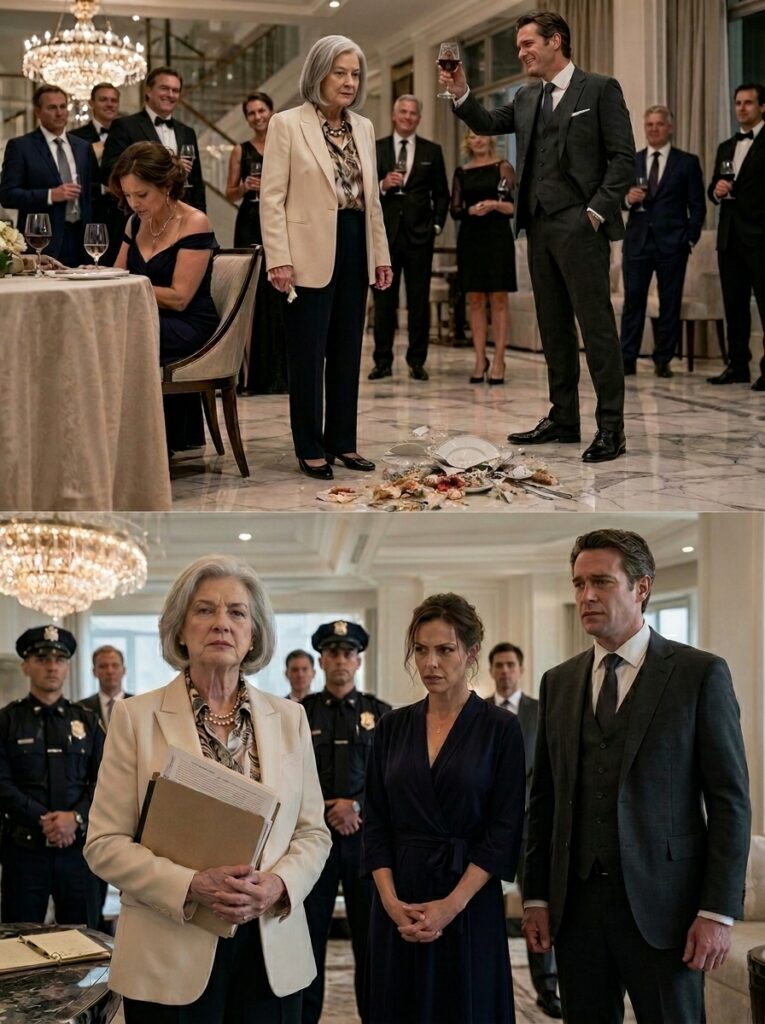
My daughter Claire lowered her eyes instantly. Not toward me. Not toward the broken porcelain scattered beside my chair.
Toward her lap.
Her fingers twisted the linen napkin so tightly it looked like a rope cutting into her skin.
Around the table, Victor’s business friends smirked inside expensive tailored suits. His mother covered her mouth with one jeweled hand, though I still saw the smile hiding beneath her diamonds.
The evening had supposedly been a celebration.
Victor had just announced another “expansion” of his luxury real estate company. He stood at the head of my late husband’s dining table inside my late husband’s home, drinking wine from my late husband’s cellar while wearing the watch Claire bought him using money I had given her after the wedding.
And now he had slapped my plate from my hands because I refused to raise a toast in his honor.
“Come on, Margaret,” he said smoothly, poison hidden beneath charm. “Don’t be dramatic. You live here rent-free. You eat food I pay for.”
I looked down at the roast scattered across the white marble floor. At the dark wine spreading through the gravy like blood.
Then I looked at my daughter’s pale face.
“I paid for this house,” I said quietly.
Victor leaned forward in his chair.
“Not anymore.”
Soft laughter circled the table.
For two years, Victor had been dismantling Claire piece by piece.
Tiny comments.
Tiny manipulations.
Tiny emergencies.
First he convinced her I was lonely. Then forgetful. Then emotional. Then unstable. Recently, Claire had begun bringing me documents “to make things easier.”
I smiled politely every time.
And signed absolutely nothing.
Victor believed grief had weakened me.
He believed old age had turned me harmless.
He believed a widow wrapped in black coats could be cornered quietly and forgotten there.
I stood slowly beside the shattered plate. My knees ached, but my spine remained perfectly straight. I folded my napkin carefully and laid it beside the broken porcelain.
Victor’s grin widened.
“Leaving already?”
I looked directly into his eyes.
Then I said three words.
“You’re under investigation.”
The wineglass slipped in his hand.
Red wine splashed down the front of his shirt.
For the first time all evening, Victor looked frightened.
I turned and walked out before anyone could stop me.
Behind me, Claire whispered softly, “Mom?”
I didn’t turn around.
Not yet.
The next morning, Victor called seventeen times.
I ignored every single one.
By lunchtime, the text messages started arriving.
You misunderstood.
Don’t upset Claire.
We should talk like family.
That last message made me laugh out loud.
Family.
Victor used that word like a weapon.
Family meant silence.
Family meant pretending not to notice young assistants leaving his office in tears.
Family meant ignoring company files hidden inside my home office.
Family meant surrendering quietly while he tightened his grip around Claire’s life.
But before I became a widow dressed in black, I spent thirty-two years as a forensic accountant.
I tracked stolen money through shell corporations, fake invoices, offshore transfers, and men who believed confidence was intelligence.
Men like Victor always thought cruelty made them powerful.
It didn’t.
Cruelty was noise.
Paper was power.
And I had paper.
Three months earlier, I discovered a hidden folder behind a loose wall panel in my late husband’s study. Victor had been moving money through fraudulent renovation contracts using Claire’s signature. My daughter believed she was approving routine household paperwork.
Instead, he had chained her to financial fraud without her realizing it.
That was the moment I stopped being a grieving widow.
And became a witness.
I copied everything.
Bank transfers.
Emails.
Security footage Victor forgot existed.
Recordings from the driveway cameras.
One audio file captured him telling his attorney:
“Once the old woman signs, we control the trust.”
The old woman.
I remember hearing those words and calmly walking into the kitchen to make tea.
My hands never shook once.
At three that afternoon, Victor arrived at my guesthouse without knocking.
Two men followed him inside.
“Margaret,” he said with a tight smile, “you’ve embarrassed yourself enough.”
“I’m busy.”
He stepped farther into the room anyway. “You’re confused. Angry. Claire says you’ve been behaving strangely.”
I tilted my head.
“She told you that?”
Something flickered across his face before disappearing.
Interesting.
One of the men opened a leather folder.
“Mrs. Hale,” he began professionally, “we’ve prepared paperwork for a medical guardianship review.”
Victor’s smile returned instantly.
“For your own safety.”
There it was.
The next step.
Declare me incompetent.
Take the house.
Control the trust.
Blame everything on dementia.
I almost admired how quickly he moved.
Almost.
“You should leave,” I said calmly.
Victor stepped closer. His cologne filled the room like smoke.
“Listen carefully,” he murmured. “You’re old. Claire is weak. I’m the only person in this family who knows how to win.”
I glanced toward the bookshelf behind him where a tiny camera sat hidden beside a ceramic dove.
“You always talk too much,” I replied.
His expression hardened.
“What did you say?”
I stood slowly and opened my coat.
Pinned inside was my federal consultant badge, renewed six weeks earlier through a financial crimes task force.
Victor stared at it.
I smiled faintly.
“You targeted the wrong woman.”
By sunset, the dining room was crowded again.
But not with guests.
With lawyers.
Victor stormed inside dragging Claire behind him like an accessory he was no longer sure he owned. His mother followed close behind, wrapped in pearls and panic. Two police officers stood near the doorway.
My attorney sat calmly at the table with three neatly organized folders in front of him.
Victor stopped cold.
“What is this?”
“A family meeting,” I answered.
Claire looked exhausted, her eyes swollen red from crying.
“Mom,” she whispered, “what’s happening?”
I reached across the table and gently took her hand.
She flinched first.
Then held on tightly.
Victor pointed at me immediately.
“She’s manipulating you.”
“No,” I said softly. “You did that.”
My attorney opened the first folder.
“Mr. Cole, we possess evidence connecting you to forged investor disclosures, fraudulent renovation contracts, and financial transfers executed through your wife’s accounts.”
Victor laughed once.
“That’s ridiculous.”
Then the second folder opened.
Emails.
Transfers.
Dates.
Signatures.
His laughter vanished.
His mother whispered shakily, “Victor…”
Then I pressed play on the recording.
“Once the old woman signs, we control the trust.”
Silence crushed the room.
Claire’s hand shook violently inside mine.
“You used me?”
Victor turned toward her instantly.
“Don’t be stupid. Everything I did was for us.”
“No,” I said quietly. “Everything you did was for yourself.”
He lunged toward the table, but one of the officers stepped forward immediately.
My attorney continued calmly.
“Mrs. Hale’s trust has already filed civil claims to recover losses. Your business accounts have been frozen pending investigation. Your largest investor withdrew this morning. Your licensing board received evidence earlier today.”
Victor’s face drained white.
“You can’t do this,” he whispered.
I glanced toward the faint stain still visible on the marble floor where my dinner had fallen the night before.
“I did something worse,” I replied.
His eyes snapped toward mine.
“I protected my daughter before you could destroy her.”
Claire started crying softly.
But this time she didn’t lower her head.
Instead, she slid her wedding ring from her finger and placed it gently on the table.
Victor stared at it like it was a bullet aimed directly at his chest.
“You’ll regret this,” he hissed.
Claire lifted her chin.
“No,” she said, her voice trembling but steady. “I already regret marrying you.”
That was when he finally broke.
Not from anger.
From fear.
Real fear.
The kind arrogant men feel when the world suddenly stops bending around them.
Two weeks later, Victor was arrested for fraud and coercive financial abuse.
His company collapsed before the month ended.
His mother sold her diamonds trying to pay attorneys who still couldn’t save him.
The friends who laughed while he humiliated me vanished faster than smoke.
Six months later, Claire and I sat together in the same dining room eating soup and warm bread beneath quiet chandeliers.
No strangers.
No cruelty disguised as charm.
No poisoned smiles.
Just peace.
Claire reached across the table and squeezed my hand gently.
“I should’ve listened,” she whispered.
I looked at my daughter — truly looked at her — and saw color returning to her face for the first time in years.
“You’re listening now,” I said softly.
Outside, the garden had started blooming again.
Inside, the marble floor shone spotless and bright.
And this time, nothing in that house was broken anymore.
{"post":102252,"page":2,"next":[{"id":102245,"title":"My Daughter, 8, Found a Newborn Baby near Our Barn \u2013 When My Husband Asked, \u0027Who Would Do This?\u0027 She Looked at Him and Said, \u0027Daddy\u2026 I Saw You\u0027","url":"https:\/\/new24.info\/102245"},{"id":102242,"title":"My Husband Passed Away on Our Wedding Day \u2013 A Week Later, He Sat Down Next to Me on a Bus and Whispered, \u0027Don\u0027t Scream, You Need to Know the Whole Truth\u0027","url":"https:\/\/new24.info\/102242"},{"id":102235,"title":"This photo has never been edited \u2013 take a closer look try not to gasp when you see this M*A*S*H blooper...","url":"https:\/\/new24.info\/102235"},{"id":102227,"title":"The Secret Fortune in Your Pocket Why One Rare Penny Is Now Worth Over Three Hundred Thousand Dollars","url":"https:\/\/new24.info\/102227"},{"id":102221,"title":"The Wedding Gift That Exposed A Monster Why One Bridezilla Revenge Became A Survival Story For The Ages","url":"https:\/\/new24.info\/102221"},{"id":102217,"title":"Tiny Detail Under Baby Sock Reveals Danger That Doctors Missed Entirely","url":"https:\/\/new24.info\/102217"},{"id":102205,"title":"echodrama.org","url":"https:\/\/new24.info\/102205"},{"id":102201,"title":"\u2018American Idol\u2019 Season 24 Finale Sparks Debate After Unexpected Elimination Shocks Fans i\u00e7in arama yapt\u0131n\u0131z - Likya","url":"https:\/\/new24.info\/102201"},{"id":102199,"title":"Young woman puts both daughters inside the ..","url":"https:\/\/new24.info\/102199"},{"id":102192,"title":"The Hidden Truth Behind Caitlyn Jenner Courageous Transformation and the Secret That Kept Her Family Together","url":"https:\/\/new24.info\/102192"},{"id":102182,"title":"The Deadly Warning Signs Your Skin Is Sending You That You Should Never Ignore","url":"https:\/\/new24.info\/102182"},{"id":102184,"title":"20 Minutes ago in New York, Donald Trump Jr. was confirmed as\u2026See more","url":"https:\/\/new24.info\/102184"},{"id":102179,"title":"The Forgotten Children Of The American Justice System Why 79 Minors Are Serving Life Sentences Without Any Hope Of Escape","url":"https:\/\/new24.info\/102179"},{"id":102175,"title":"My Husband Asked for a Divorce the Same Night I Found Out I Was Pregnant\u2014But When Our Daughter Walked Into the Gala Two Years Later, His Mistress Finally Understood What He Had Lost\u2026","url":"https:\/\/new24.info\/102175"},{"id":102172,"title":"I Became a Dad at 18 After My Mom Abandoned My Twin Sisters \u2013 7 Years Later, She Returned with a Shocking Demand","url":"https:\/\/new24.info\/102172"},{"id":102170,"title":"I Noticed My 65-Year-Old Neighbor Hadn\u2019t Left Her House in 5 Days \u2014 One Day, I Decided to Check If She Was Okay","url":"https:\/\/new24.info\/102170"},{"id":102167,"title":"My Twelve Year Old Son Carried His Disabled Best Friend Through A Dangerous Trail And The Next Morning The School Called Me In A Panic","url":"https:\/\/new24.info\/102167"},{"id":102164,"title":"My mother threw scalding soup in my face for saying no to her stepdaughter. \u0022Give her all your things \u2014 or get out!\u0022","url":"https:\/\/new24.info\/102164"},{"id":102158,"title":"The Tragic Loss Of A Screen Legend Jennifer Harmon Dies At 82 Leaving Fans And Broadway In Total Devastation","url":"https:\/\/new24.info\/102158"},{"id":102153,"title":"How Spotting An Old Patched Jacket Led Me To My Missing Son","url":"https:\/\/new24.info\/102153"}]}