Riverside Memorial Hospital.
Inside was a short note.
Mr. Davidson, your ex-wife Rebecca listed you as her emergency contact. She has been admitted and is asking for you.
I read it three times before my legs finally remembered how to move.
Three months had passed since our divorce became final. Three months since I walked out of the courthouse believing I had escaped a marriage that had slowly emptied both of us. By the end, Rebecca and I had become strangers sharing legal paperwork, furniture lists, and cold conversations about who would take what.
I thought the story was over.
But that morning, holding the hospital note in my hand, I realized the past had not finished with me.
The drive to Riverside felt like traveling backward through every version of us I had tried to forget.
Rebecca laughing on our first date.
Rebecca waking me with coffee and terrible singing.
Rebecca staring silently out of our bedroom window during the last year of our marriage while I stood behind her, angry because I thought she simply didn’t care anymore.
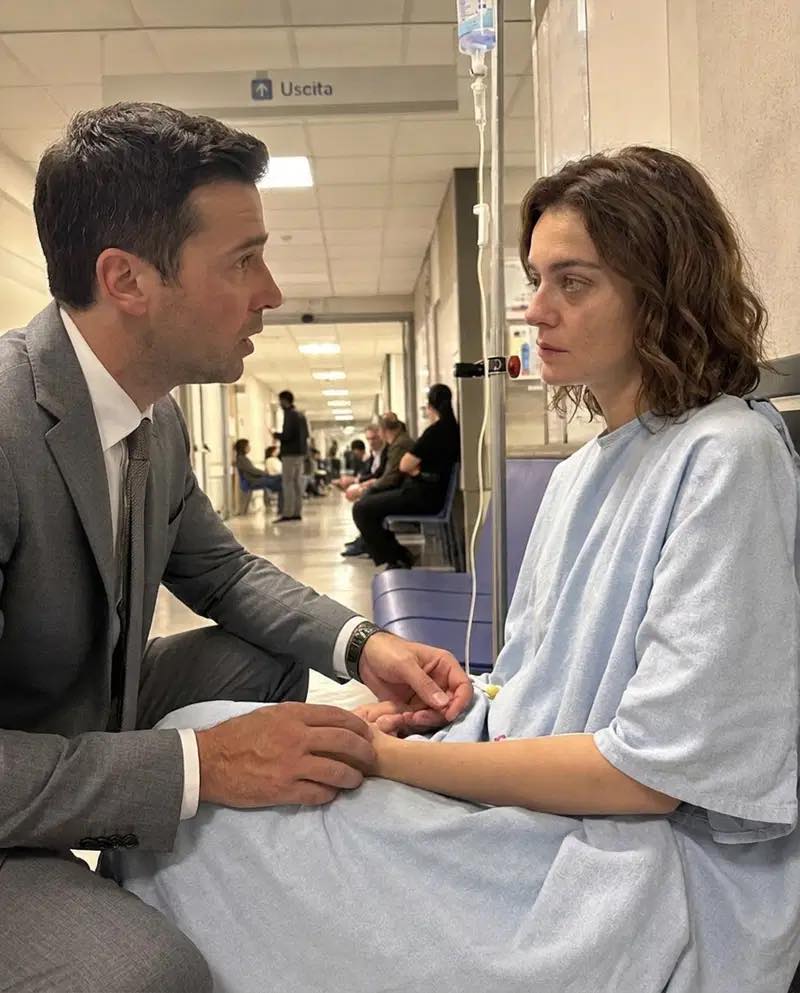
I found her in the cardiac unit.
She sat near the window in a hospital gown that made her look smaller than I remembered. Her dark hair hung loose around her shoulders. The confidence that had once drawn me toward her seemed dimmed, replaced by exhaustion and something painfully close to fear.
She looked up when I entered.
“You came.”
Her voice carried both relief and surprise.
“The hospital contacted me,” I said. “They told me you were asking for me.”
I stayed near the door, unsure if I had any right to move closer.
Rebecca lowered her eyes to the blanket.
“I didn’t know who else to list,” she said softly. “My parents are gone. My sister lives across the country. I guess old habits stay longer than we expect.”
Awkward silence stretched between us.
We had once shared a bed, a kitchen, a future.
Now we barely knew how to share a room.
“What happened?” I asked finally.
Rebecca didn’t answer right away.
When she did, her voice was almost a whisper.
“My heart stopped, David.”
I stared at her.
“The doctors think it was connected to the way I’d been using my prescriptions.”
“What prescriptions?”
She looked out the window.
“Different ones. Too many. They’re still sorting everything out.”
Over the next hour, Rebecca began telling me pieces of her life I had never known, even when I had been living beside her.
At first, every sentence seemed painful for her to say. Then the words came faster, like they had been trapped for years.
She told me about anxiety that began in college and slowly grew into something bigger than she could manage. Panic attacks at work. Nights without sleep. Mornings when her mind was exhausted before the day even started.
She told me how the medication helped at first.
Then how the fear kept returning.
“When one thing stopped working,” she said, “I kept looking for another answer.”
I listened in shock as she described doctors, prescriptions, secrecy, and shame. What had nearly taken her life had not been one dramatic collapse. It was years of fear hidden beneath ordinary routines.
“The morning I collapsed, I was already overwhelmed,” she said. “I kept thinking about the divorce. About how I failed at the most important relationship in my life. I made a terrible choice because I didn’t know how to stop the panic.”
Her calmness made it worse.
This was not the Rebecca I thought I had known.
This was a woman who had been quietly breaking while I stood beside her and called it distance.
“Why didn’t you tell me?” I asked before I could stop myself. “Why did you go through that alone?”
Rebecca finally looked at me.
In her eyes, I saw years of pain I had never learned how to read.
“Because I was afraid you would leave,” she said. “Then I was afraid you would stay only because you felt sorry for me. Either way, I thought I would lose you.”
As she spoke, our marriage began rearranging itself in my memory.
The mornings she stayed in bed and said she felt sick.
I had thought she was avoiding responsibility.
The dinners she canceled.
I had thought she no longer cared.
The friends she stopped seeing.
I had thought she was becoming distant from everyone, including me.
Now I wondered how many ordinary moments had felt impossible to her.
“There were signs,” I said quietly. “I just didn’t know how to read them.”
Rebecca gave a sad smile.
“I got good at hiding it. Too good, maybe. I thought if I looked normal long enough, eventually I’d feel normal.”
That was the cruelest part.
She had hidden her pain to protect our marriage.
But hiding it helped destroy us.
I had lived with someone who was drowning, and she had learned to sink quietly enough that I never reached for her.
Sitting in that hospital room, guilt settled over me like a weight.
I remembered our fights during the final year. I had accused her of giving up, pulling away, refusing to try. She became defensive and quiet, and I mistook that silence for proof that love had faded.
Now I understood something I should have understood sooner.
Her withdrawal had not always meant she stopped loving me.
Sometimes it meant she was trying to survive.
“I kept hoping you would notice,” she admitted softly. “Part of me wanted you to ask the right question. But another part of me was relieved when you didn’t, because then I didn’t have to admit how bad it was.”
That sentence cut deeper than anything else.
Later, Dr. Patricia Chen explained that Rebecca was extremely lucky to be alive. The medical team was treating both the cardiac crisis and the consequences of medication misuse. Her recovery would require careful supervision, mental health treatment, and a support system strong enough to hold her through the difficult parts.
“Does she have family or close friends nearby?” Dr. Chen asked.
I realized I didn’t know.
During our marriage, Rebecca had drifted away from almost everyone. I had called it personality change. Now I understood it had been illness and shame.
That night, I slept badly in the hospital’s family waiting area.
I had no legal reason to stay.
We were divorced.
She was no longer my responsibility.
But the woman in that hospital bed was not simply my ex-wife. She was someone I had loved. Someone whose pain I had failed to recognize while it was happening right in front of me.
Over the next few days, as Rebecca grew physically stronger, we began having the conversations we should have had years earlier.
She told me about her first panic attack during our second year of marriage. She had convinced herself it was stress. Then ordinary things slowly became mountains. Answering phone calls. Going to stores. Attending gatherings. Keeping plans.
“I kept telling myself I just had to get through one more day,” she said. “Then one more week. I thought if I held on long enough, whatever was wrong with me would fix itself.”
But it hadn’t.
And the longer she hid it, the harder it became to ask for help.
Her recovery became an education for both of us.
I attended therapy sessions where I learned about anxiety disorders, dependency, shame, and the way untreated mental health struggles can quietly damage relationships from the inside out.
Dr. Michael Roberts helped me see patterns I had missed.
“Fear of judgment can keep people from seeking help,” he explained. “Then the condition worsens, and the fear grows stronger. Rebecca was trapped in that cycle.”
I also had to face my part.
My frustration had turned into criticism.
My criticism had made her more afraid.
Without meaning to, I had helped create a home where she felt she had to hide even more.
That was hard to admit.
But it was true.
Rebecca’s recovery was not quick or clean. There were setbacks. Hard days. Moments when she wanted relief more than progress. But there were victories too.
A full night of sleep with proper support.
A calm conversation without panic.
A walk down the hospital corridor without stopping halfway.
I became her advocate in ways I had not known how to be as her husband.
I went to appointments. Helped her organize questions. Learned the difference between support and control. Learned that loving someone does not mean rescuing them from every hard thing, and leaving someone alone with shame is not the same as giving them space.
Six months after that first hospital visit, Rebecca and I had built something neither of us expected.
Not a repaired marriage.
That chapter had ended too completely.
What grew instead was quieter, stranger, and in some ways more honest: a friendship built on truth, compassion, and a shared commitment to her healing.
She found a therapist who specialized in anxiety disorders. She joined support meetings where she met people who understood the kind of fear she had carried in silence. Slowly, pieces of the Rebecca I remembered returned.
But she was different too.
More honest.
Less willing to perform wellness just so other people would feel comfortable.
“I spent years afraid people would think I was broken,” she told me one afternoon as we walked through the park near her apartment. “Now I think pretending to be fine when you’re falling apart is what really breaks you.”
Some days were still hard.
Anxiety still came.
But now she had tools, treatment, and people who knew the truth. She no longer had to pretend herself into isolation.
I changed too.
I ask better questions now.
When someone’s behavior shifts, I try to wonder what might be happening beneath the surface before deciding what it means. I listen differently. I pay attention to silence instead of assuming I understand it.
The guilt I once felt did not disappear.
It became a responsibility.
Not to punish myself forever, but to become more present, more compassionate, and more willing to speak openly about mental health.
Rebecca and I are still friends.
She has been in recovery for more than a year. She manages her anxiety through therapy, medical guidance, and a support system that knows the truth. She returned to work slowly and rebuilt relationships she once pushed away.
The end of our marriage was necessary.
We had been too damaged by silence and misunderstanding to rebuild a healthy romantic life together.
But learning the truth taught me something I never expected.
Love does not always return in the form we want.
Sometimes it becomes a hand on a hospital bed rail.
A ride to therapy.
A quiet text after a hard appointment.
A friendship where a marriage used to stand.
That hospital room changed both of us.
It was where I learned that the woman I thought I understood had been fighting battles I never saw. It was where Rebecca stopped hiding from the truth. And it was where I realized relationships can fail not because love disappears, but because pain goes unnamed for too long.
We still wonder sometimes what might have happened if we had spoken this honestly while we were married.
Maybe we could have saved something.
Maybe not.
Maybe we were both too busy pretending to admit how badly we were hurting.
But the divorce I believed was the end of our story became only one chapter in something larger.
Healing.
Forgiveness.
Awareness.
A different kind of love.
Sometimes understanding arrives too late to protect the life you wanted.
But sometimes, it arrives just in time to protect something even more important: your humanity, your capacity to grow, and your willingness to care for someone without needing the old story back.
{"post":101946,"page":2,"next":[{"id":101937,"title":"Cult actor Donald Gibb, famous for \u2018Revenge of the Nerds\u2019 dies at 71","url":"https:\/\/new24.info\/101937"},{"id":101927,"title":"My phone vibrated against the mahogany table in London with a sound so small it felt impossible that it could split a life in half","url":"https:\/\/new24.info\/101927"},{"id":101924,"title":"Police make disturbing discovery at Brandon Clarke\u2019s home after NBA star dies at 29","url":"https:\/\/new24.info\/101924"},{"id":101921,"title":"Search Results for \u201cAuthorities Respond After Serious Incident at Children\u2019s Event Leaves Community in Shock\u201d \u2013 Tbdig","url":"https:\/\/new24.info\/101921"},{"id":101915,"title":"Major Law Enforcement Breakthrough in Arizona Missing Person Investigation Triggers Massive Shockwave Across Entire Nation","url":"https:\/\/new24.info\/101915"},{"id":101911,"title":"VALERIE BERTINELLI BLOWS FANS AWAY WITH A HEARTWRENCHING INSTAGRAM UPDATE AS HER ICONIC TELEVISION ERA COLLAPSES WITHOUT WARNING","url":"https:\/\/new24.info\/101911"},{"id":101907,"title":"When Small Changes at Home Revealed a Bigger Lesson About Boundaries","url":"https:\/\/new24.info\/101907"},{"id":101900,"title":"Between the ages of 70 and 75: 5 aspects that can make this stage more challenging.","url":"https:\/\/new24.info\/101900"},{"id":101896,"title":"THE UNTOLD TRUTH BEHIND TIM WALZ RISE TO THE NATIONAL STAGE THAT LEFT MINNESOTANS ABSOLUTELY STUNNED","url":"https:\/\/new24.info\/101896"},{"id":101892,"title":"Arrogant Husband Burned My Dress So I Ruined His Promotion Party","url":"https:\/\/new24.info\/101892"},{"id":101888,"title":"Brother Replaced My Daughter But Our Father Delivered Ultimate Public Justice","url":"https:\/\/new24.info\/101888"},{"id":101884,"title":"Secret Brass Key Revealed How My Stepfather Stole My True Family Identity","url":"https:\/\/new24.info\/101884"},{"id":101880,"title":"Escort, 73, reveals the main reason married men use her services as she shares advice for other women","url":"https:\/\/new24.info\/101880"},{"id":101877,"title":"My grandfather di:ed alone in a small Ohio hospital while my parents called him \u201cdifficult\u201d and stayed home. I was the only one at his funeral, and I thought his old ring was the last piece of him I had\u2014until a general saw it at a military ceremony, went pale, and asked a question that changed everything.","url":"https:\/\/new24.info\/101877"},{"id":101872,"title":"Why Underwear Discoloration Can Be a Sign of Health Changes","url":"https:\/\/new24.info\/101872"},{"id":101869,"title":"My Sister Passed Away at My Wedding \u2013 A Week Later, Her Coworker Called and Said, \u0027She Left a Phone for You. Come Immediately!\u0027","url":"https:\/\/new24.info\/101869"},{"id":101865,"title":"Chris Pratt\u2019s Mother\u2019s Day post sparks controversy \u2013 fans furious: \u201cLost all respect for you\u201d","url":"https:\/\/new24.info\/101865"},{"id":101860,"title":"Legendary Mad Max Daredevil Cheats Death For Decades Only To Perish In Tragic Highway Crash That Stunningly Ends Legendary Career","url":"https:\/\/new24.info\/101860"},{"id":101858,"title":"Search Results for \u201cLegendary Mad Max Daredevil Cheats Death For Decades On\u201d \u2013 Tbdig","url":"https:\/\/new24.info\/101858"},{"id":101853,"title":"DEADLY VIRUS OUTBREAK ON LUXURY CRUISE SHIP TRIGGERING GLOBAL PANIC AS INFECTED PASSENGERS ARE FLEEING ACROSS TWENTY COUNTRIES","url":"https:\/\/new24.info\/101853"}]}