
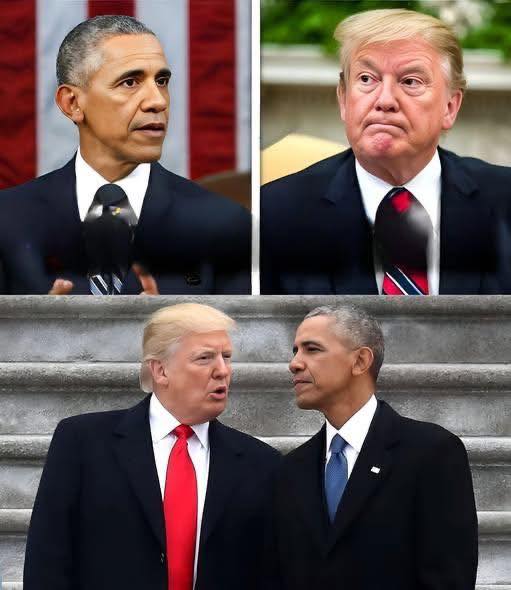
ered into a thousand jagged pieces. What unfolded on that stage was less a traditional interview and more a public unmasking of America’s deepest fractures. As Trump pivoted from policy debate to a direct, personal indictment, he didn’t just challenge the Obama legacy—he exposed how fragile the concept of a shared reality has become in the digital age.
The reaction was instantaneous. Across the country, supporters and detractors retreated into their respective digital trenches, arming themselves with curated clips, viral captions, and righteous outrage. The broadcast was chopped into bite-sized segments, each side weaponizing the footage to validate their own pre-existing worldview. In the ensuing chaos, nuance evaporated, replaced entirely by the visceral pull of spectacle. It was a masterclass in modern polarization, where a single moment of television could be stretched, distorted, and molded into a million parallel narratives.
Yet, beneath the deafening noise of the pundits and the endless scroll of social media commentary, something much more profound was revealed. This confrontation served as a stark mirror to the current state of our democracy, illustrating how politics has morphed into pure performance. We are no longer watching leaders debate the mechanics of governance; we are witnessing a high-stakes theater where the primary objective is to dominate the screen.
The shift in how we judge our leaders is perhaps the most unsettling takeaway. The modern voter is no longer asking, “Is this policy sound?” or “Is this statement factually accurate?” Instead, the metric has shifted to a more primal question: “Does this hit?” It is a culture of impact over intelligence, where the loudest voice in the room is granted the authority to write the first draft of history.
As the dust settles on this historic clash, we are left to grapple with a darker truth. If the loudest moment is now the only one that matters, we have entered an era where the substance of our national conversation is being sacrificed on the altar of engagement. That night will be remembered not because one man emerged victorious, but because it confirmed that we have reached a point where the performance has become the reality, and the reality is becoming increasingly difficult to find.