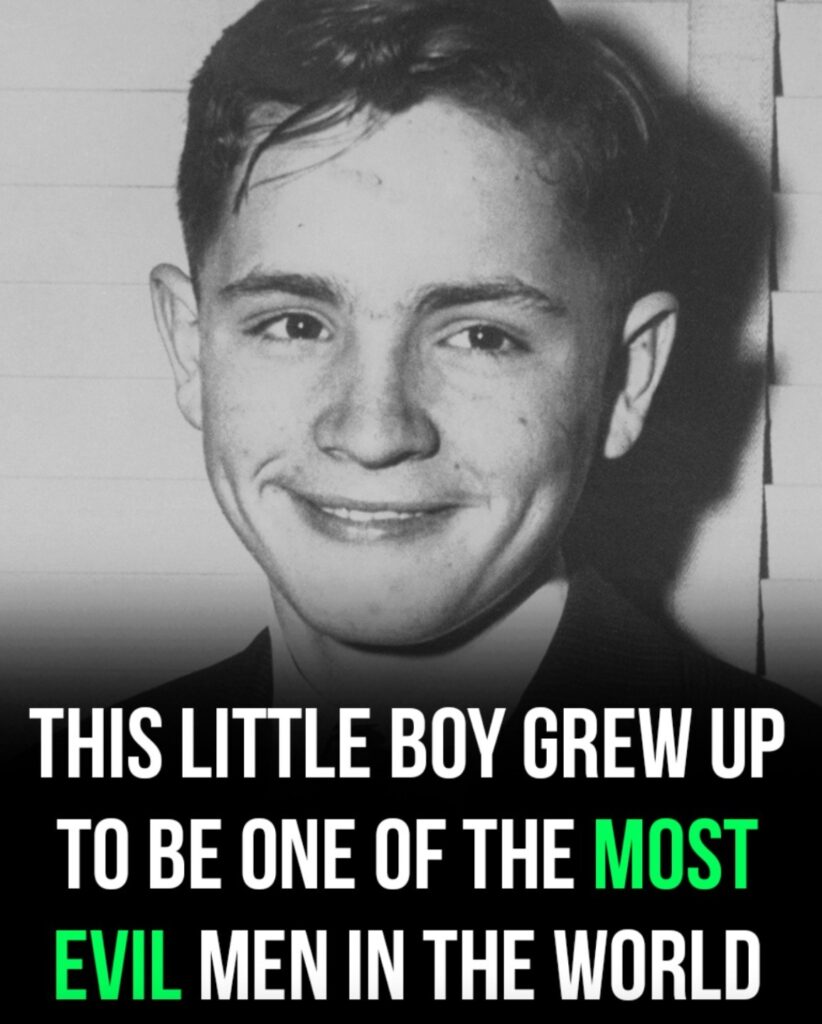
Even the most unassuming child can grow into something deeply troubling when shaped by instability, neglect, and repeated exposure to violence. Few figures illustrate that trajectory more starkly than Charles Manson, whose name became permanently linked to one of the most notorious crime cases in modern American history.
A Childhood Marked by Instability
Born in 1934 in Cincinnati, Ohio, Manson was the son of a 16-year-old mother. His biological father was absent, and his early years were defined by frequent moves, inconsistent caregivers, and limited supervision.
When his mother was imprisoned for robbery during his childhood, Manson was placed with relatives and in temporary homes. Records and later accounts suggest that discipline was harsh and emotional stability was scarce. By his preteen years, he had been accused of truancy, theft, and other petty crimes.
Reform schools and juvenile detention facilities became a recurring presence in his adolescence. Rather than redirecting his behavior, these institutions often reinforced patterns of manipulation and defiance. Psychological evaluations during his youth described antisocial tendencies and difficulty conforming to authority.
A Cycle of Incarceration
As a young adult, incarceration became routine. He was convicted of offenses including theft, fraud, and assault. Much of his early adulthood was spent in prison.
During those years, Manson developed a capacity to influence and persuade others. Fellow inmates and later observers noted his ability to read vulnerabilities and exploit them. He studied religious texts, philosophy, and popular culture, weaving fragments into a worldview that later formed the foundation of his ideology.
The Formation of the “Manson Family”
By the late 1960s, after his release, Manson gathered a small group of followers in California. The group, later known as the “Manson Family,” lived communally, including at Spahn Ranch outside Los Angeles.
Manson promoted an apocalyptic belief system he referred to as “Helter Skelter,” borrowing the phrase from a song by The Beatles. He claimed it foretold a coming societal collapse and race war — interpretations that bore no connection to the song’s intent but became central to his rhetoric.
His followers, many of them young and impressionable, became increasingly devoted.
The 1969 Murders
In August 1969, members of the group carried out a series of brutal killings in Los Angeles.
Victims included actress Sharon Tate and four others at her home, followed the next night by the murders of Leno and Rosemary LaBianca.
While Manson did not physically carry out the killings, prosecutors argued successfully that he orchestrated them through manipulation and direction. In 1971, he was convicted of first-degree murder and conspiracy.
He was initially sentenced to death. When California temporarily abolished capital punishment in 1972, his sentence was commuted to life imprisonment.
Legacy and Cultural Impact
Manson spent decades in prison, becoming a figure of enduring notoriety. He gave occasional interviews that further fueled public fascination, though he never demonstrated remorse for the crimes associated with his influence.
He died in 2017 while incarcerated.
His case remains studied not only for its violence, but for what it revealed about coercive control, cult dynamics, and the vulnerability of individuals seeking belonging. It also reshaped public perception of the 1960s counterculture, casting a shadow over an era often associated with peace and social change.
A Cautionary Reflection
The life of Charles Manson does not offer simple explanations. Childhood instability does not predetermine violence. Nor does hardship excuse it.
His story stands instead as a cautionary reminder of how manipulation, ideology, and unchecked influence can converge with devastating consequences.
The victims’ names endure alongside his — a necessary balance in remembering a chapter of history defined not only by infamy, but by profound loss.