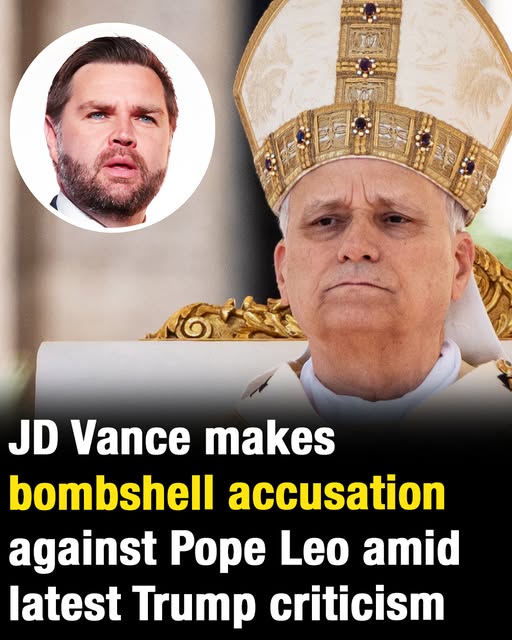
The growing tension between political leadership and religious authority often surfaces quietly, but at certain moments it becomes visible enough to prompt wider reflection. What we are seeing now is less about a single disagreement and more about a deeper question that has existed for a long time: where does moral guidance end, and where does political responsibility begin?
At the center of this discussion are figures like Donald Trump and Pope Leo XIV, whose public remarks on global conflict have highlighted contrasting approaches. Their differences are not simply about policy details, but about the lens through which decisions are viewed—one grounded in governance and national interest, the other in moral evaluation and human consequence.
The conversation has been further shaped by voices like JD Vance, who has argued that religious institutions should remain focused on spiritual and ethical teaching, while elected leaders carry the burden of making practical decisions about war, diplomacy, and security. This perspective reflects a belief in clearly defined roles, where authority is separated to preserve accountability.
Yet from the religious side, that separation is not always so clean. Institutions such as the Catholic Church have long considered issues like war, peace, and human dignity to be central to their moral mission. Speaking on these matters is not seen as stepping into politics, but as fulfilling a responsibility that cannot be set aside simply because the subject overlaps with state decisions.
What makes this moment particularly noticeable is not only the disagreement itself, but the way it has been expressed and received. Symbolic gestures, public remarks, and even the tone of communication have all contributed to a broader reaction. Some interpret these actions as necessary expressions of conviction during uncertain times, while others see them as unnecessarily sharp, risking division where restraint might be more constructive.
Public response has mirrored this divide. There are those who prioritize strong, decisive leadership in the face of global instability, and others who emphasize the need for moral reflection and caution, especially when decisions carry human cost. Neither position is entirely separate from the other, yet they often appear in tension when placed side by side.
Direct and visible friction between U.S. political figures and the papacy is relatively uncommon, which is part of why this situation has drawn so much attention. But the rarity of the moment should not obscure its underlying nature. This is not an isolated conflict—it is an expression of a structural reality. Political authority and moral authority operate in overlapping spaces, and when the stakes are high, their differences become more pronounced.
At its core, the issue is not about who is right in a narrow sense. It is about understanding the limits and responsibilities of each role. Political leaders are accountable for decisions that affect national security and governance. Religious leaders speak to the ethical weight of those decisions and the human lives involved. When these perspectives meet, tension is not a failure—it is almost inevitable.
The question, then, is not how to eliminate that tension, but how to hold it responsibly. Whether one leans toward clear separation or meaningful overlap often depends on personal belief and experience. What remains constant is the need for both clarity and restraint, so that disagreement does not turn into unnecessary division.
In the end, this moment serves as a reminder that leadership is rarely confined to one dimension. Power and principle, policy and conscience—they intersect more often than we might prefer. And how that intersection is managed will continue to shape not only political outcomes, but the broader sense of direction that societies follow.