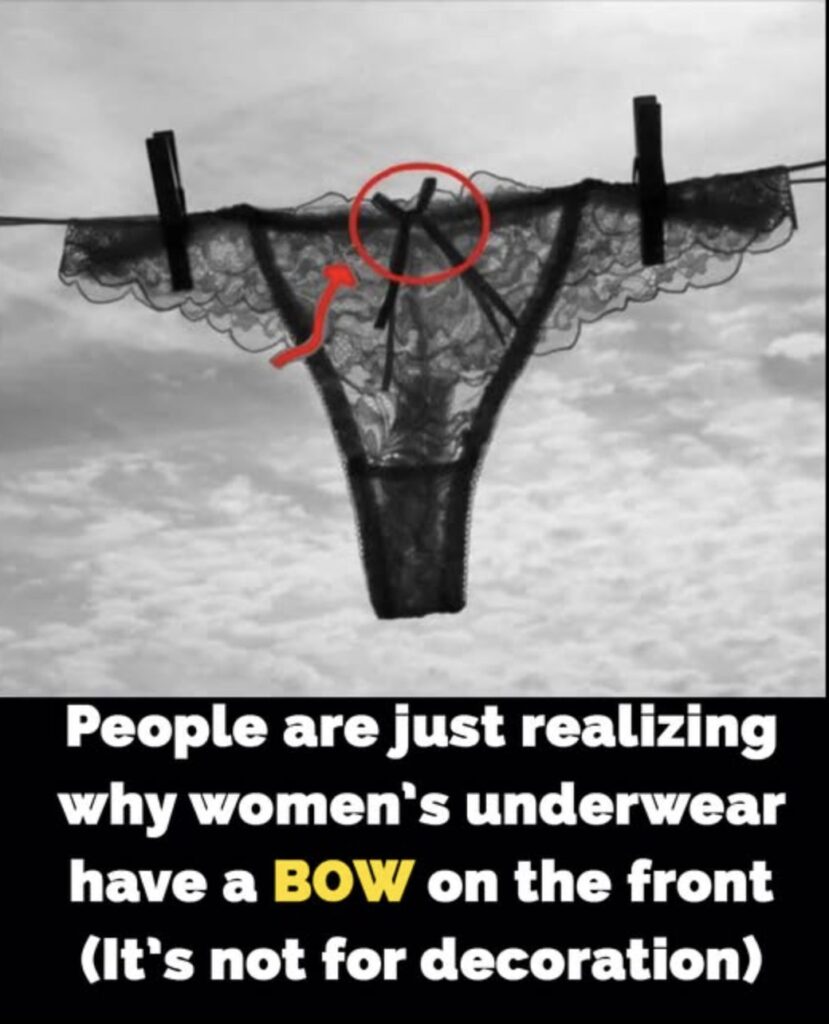
Why Women’s Underwear Has a Tiny Bow: The Surprising History Behind It
Have you ever noticed the small bow on the front of women’s underwear and wondered why it’s there? For many people, it seems like nothing more than a cute design choice — a decorative detail added for style.
But according to fashion historians, that tiny bow carries a story that stretches back centuries. Long before elastic waistbands and modern lingerie, it played a practical role in how women dressed.
What looks like a simple embellishment today is actually a quiet reminder of how clothing once worked.
A Detail Most People Never Question
For decades, the bow has appeared on briefs, panties, and lingerie across brands and styles.
Many wearers admit they never noticed it — until someone pointed it out.
Others assumed it was:
-
A purely decorative feature
-
A symbol of femininity
-
A branding choice
-
A random design tradition
In reality, its origins are far more functional.
Life Before Elastic Waistbands
Before elastic became standard in clothing, women’s underwear relied on ribbons and strings to stay in place.
Early undergarments, often called “drawers,” were made from two separate pieces of fabric connected at the waist with a tie.
That tie was usually secured at the front — and finished in a bow.
The bow served two purposes:
-
It hid the knot
-
It added a neat, elegant appearance
What we see today is a symbolic version of that original fastening system.
A Practical Tool in the Dark
One of the most surprising explanations involves lighting.
Before electricity became widespread, many people dressed in low light — using candles, oil lamps, or moonlight.
In those conditions, it was not always easy to tell the front of clothing from the back.
The bow acted as a tactile marker.
By feeling for it, wearers could quickly identify the correct orientation of their underwear without needing light.
In other words, the bow was once a practical navigation tool.
From Function to Fashion
As elastic waistbands became common in the 20th century, ribbons and ties disappeared.
Underwear no longer needed front knots.
Yet the bow remained.
Designers kept it as a visual reference to tradition — a way of preserving a familiar detail even after its original purpose faded.
Over time, it evolved into a symbol of:
-
Softness
-
Femininity
-
Playfulness
-
Classic lingerie style
Function slowly gave way to fashion.
Modern Reactions: Love It or Remove It
Today, opinions about the bow are mixed.
Some people love it, seeing it as charming and nostalgic.
Others cut it off, calling it unnecessary or outdated.
Online discussions show that many are surprised to learn its origin — often describing the discovery as “mind-blowing.”
Even critics admit that knowing the history makes the detail more meaningful.
A Window Into Clothing History
Fashion experts say small details like this reveal how clothing evolves.
What begins as a necessity often becomes tradition.
What becomes tradition often turns into style.
The underwear bow is a perfect example of how:
-
Technology changes clothing
-
Habits shape design
-
History leaves visible traces
It shows how modern garments still carry echoes of the past.
Why Designers Still Keep It
Despite changing trends, the bow continues to appear in many collections.
Designers say it remains popular because it:
-
Adds visual balance
-
Softens the garment’s look
-
Signals the “front” intuitively
-
Feels familiar to consumers
In a world of fast-changing fashion, familiar details create comfort and continuity.
Reflection: Small Details, Big Stories
The tiny bow reminds us that everyday objects often hold hidden histories.
What seems decorative today may once have been essential.
It reflects human creativity — finding ways to combine usefulness with beauty.
In subtle ways, it connects modern life to earlier generations who solved practical problems with simple, elegant solutions.
Conclusion: More Than Just a Cute Accessory
The bow on women’s underwear is not just decoration.
It is a centuries-old remnant of how garments were once tied, worn, and navigated in low light.
From hiding knots to guiding hands in the dark, it once played an important role in daily life.
Today, it survives as a symbol of tradition, design, and continuity.
So next time you notice that tiny loop, remember: it is a small detail with a long memory — proof that even the simplest features can carry remarkable stories.