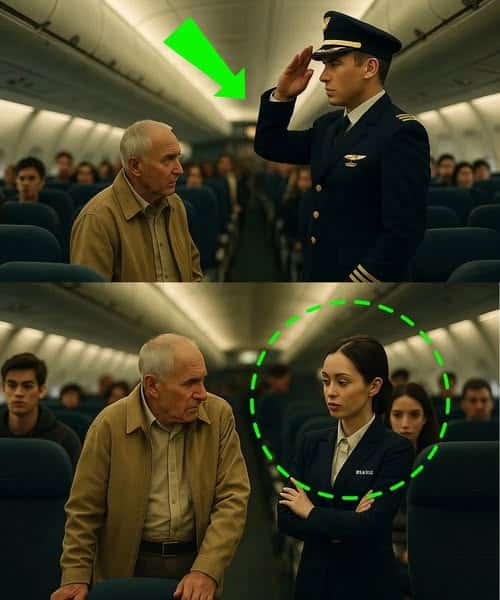
With silent determination, Frank Delaney rose before dawn, his body stiff but his mind steady. At seventy-eight, mornings were not gentle anymore—every joint had to be coaxed awake, every step negotiated with age. Yet discipline, carved into him during his years in the Marine Corps, pulled him forward. He had a flight to catch.
The Denver airport buzzed like a hive already in motion. Business travelers hurried with rolling bags, earbuds sealing them into private worlds. Families corralled children, promising snacks and cartoons once aboard. Frank, in his weathered jacket with a Marine Corps patch still stitched to the sleeve, moved at his own measured pace. His ticket read 14C—an aisle seat with just enough legroom to stretch his bad knee. It wasn’t luxury; it was necessity.
When he settled in, resting his cane against the seat, relief washed through him. He adjusted his cap, let out a long breath, and prepared himself for the hours to Annapolis.
But just before takeoff, a young flight attendant with a polished smile leaned down. “Sir, I’m so sorry to ask this, but we need this row for a family. Would you mind moving to the back so they can sit together?”
Frank’s voice was calm, but firm. “Ma’am, I chose this seat for a reason. My knee doesn’t bend well. I need the space.”
Her smile faltered. She shifted, glanced at the impatient faces of the parents waiting nearby, then back at him. “I understand, but it would mean a lot if you could help us out.”
The murmurs began. Passengers sighed. Someone muttered, “Come on, just move so we can leave already.”
The pressure pressed down like a weight. Frank’s jaw tightened, but his eyes stayed steady. He stood slowly, leaning on the cane. His voice carried just enough to be heard: “Staff Sergeant Frank Delaney, United States Marine Corps. If it keeps this plane on time, I’ll take the middle seat in the back.”
The parents hurried in, grateful but distracted. The attendant gave a quick nod, already looking past him. Frank walked down the narrow aisle toward row 32, shoulders straight, each step echoing the invisible medal pinned to his character.
The middle seat was waiting, cramped and unforgiving. When he lowered himself into 32B, pain flared sharp through his knee. He clenched his hands on his thighs, forced his face neutral, and stared at the seatback inches away. Around him, chatter rose. Bags shifted. He disappeared into the background—stoic, forgotten.
But not by everyone.
Three rows up, Charlotte Hayes watched. A quiet woman in her sixties with silver hair pulled into a neat bun, she had noticed the patch on his sleeve, the way his knuckles whitened when he bent his leg into the narrow space. She didn’t stand up or scold anyone. Instead, she tapped out a message on her phone—an alert to a contact she still had from her years working in aviation. Elderly Marine veteran forced from bulkhead to middle seat—needs attention. She pressed send, then folded her hands in her lap.
In the cockpit, Captain David Miller received the ping. The name stopped him cold. Frank Delaney. Memories flared: a night in the jungle decades ago, chaos in the dark, and a steady hand pulling him to safety. He had been a young lieutenant then, green and scared. Frank had been the calm voice that said, We don’t leave our own.
Without hesitation, Miller unstrapped, left the cockpit, and walked the full length of the aircraft. Conversations dimmed as passengers noticed the captain striding down the aisle. When he reached row 32, he stopped.
There was no announcement, no ceremony—just the crisp motion of a salute, his hand rising to his brow. “Staff Sergeant Delaney,” he said, voice carrying through the cabin.
Frank blinked up, startled. His hand trembled, but instinct overrode age. He returned the salute, sharp despite the years.
“You saved my life once,” Miller said. “And you don’t belong in the back of this plane. Come with me.”
The cabin stilled. People shifted, guilt flickering across faces. Frank rose slowly, helped by the captain himself. Miller led him all the way to the front, to seat 1A. When Frank sat, the leather wide and his leg finally able to stretch, murmurs swept the cabin.
Then, a man two rows back stood abruptly, tears spilling. “Sergeant Delaney,” he choked out. “You saved me, too. In ’69. I never thought I’d see you again.” His sobs broke the silence, and suddenly, the cabin moved with him. Passengers applauded—not the hollow claps of routine, but the raw sound of respect rediscovered.
Captain Miller placed a hand on Frank’s shoulder. “We don’t leave our own behind—not in combat, and not at 30,000 feet.”
The applause grew. Even the flight attendant who had asked him to move dabbed her eyes. Frank simply nodded, lips pressed tight, his dignity intact.
When they landed in Annapolis, the airline met him at the gate. Lifetime priority boarding. A full refund. And, within the week, the Army restored a commendation long lost in paperwork.
In the quiet days after, Frank sat taller. Not because he craved recognition. But because, at last, someone had seen him.
Not forgotten. Not invisible. A Marine, still.
{"post":90265,"page":1,"next":[{"id":90240,"title":"My Mother Hated Me for Looking Like My Biological Father, but Everything Changed When I Finally Found Him","url":"https:\/\/new24.info\/90240"},{"id":90235,"title":"Hollywood has lost one of its most beloved icons, Robert Redford dies at 89","url":"https:\/\/new24.info\/90235"},{"id":90231,"title":"I\u2019ll Never Forget His Words: \u201cThis Honor Belongs To The Farmers And The People \u2014 We Just Carried Their Song\u201d In Austin, 92-Year-Old Willie Nelson Stood With Neil Young, Not Under Stage Lights But In The Sacred Circle Of The Oglala, Ponca, And Omaha Nations, Where Chiefs Prayed And Elders Sang Blessings As He Was Honored For A Lifetime Of Fighting For Family Farmers And Indigenous Communities, A Moment So Powerful It Brought Tears To A Legend\u2019s Eyes And Reminded Us All That Country Music Is About Truth, Grit, And Carrying The Songs Of The People.","url":"https:\/\/new24.info\/90231"},{"id":90227,"title":"Reba McEntire Says \u201cYES\u201d \u2013 The Queen of Country Is Engaged to Rex Linn After 5 Years of Love, Laughter, and a Storybook Romance That Feels Like the Greatest Country Song Ever Written","url":"https:\/\/new24.info\/90227"},{"id":90222,"title":"SHOCKING MOMENT: Alan Jackson pauses concert to dance with his wife and leaves fans in TEARS!","url":"https:\/\/new24.info\/90222"},{"id":90218,"title":"SHOCKING RESEMBLANCE: Toby Keith\u2019s Mini-Me Granddaughter Steals Hearts Online!","url":"https:\/\/new24.info\/90218"},{"id":90212,"title":"Fans GASP: Chris Stapleton\u2019s Super Bowl LVII National Anthem Leaves Millions Speechless!","url":"https:\/\/new24.info\/90212"},{"id":90207,"title":"My Fianc\u00e9 Met a Little Boy on Our Wedding Day and Found Out He Was My Son","url":"https:\/\/new24.info\/90207"},{"id":90201,"title":"My Granddaughter Stole My Retirement Savings to Buy a Luxe Car \u2014 Karma Didn\u0027t Wait Long to Teach Her a Lesson","url":"https:\/\/new24.info\/90201"},{"id":90203,"title":"Turning Point USA Vows to Carry Forward Charlie Kirk\u2019s Legacy as Movement Surges After His Death","url":"https:\/\/new24.info\/90203"},{"id":90198,"title":"Dwayne Johnson\u2019s Daughter Faces Criticism and Stands Firm on Charlie Kirk Comments","url":"https:\/\/new24.info\/90198"},{"id":90192,"title":"My Sister Borrowed My New Car for a Day \u2013 What She Did to It Was Unforgivable","url":"https:\/\/new24.info\/90192"},{"id":90194,"title":"Mysterious Woman Joins Trump in Alaska Meeting, Putin Smiles","url":"https:\/\/new24.info\/90194"},{"id":90189,"title":"GOP Pushes for Inquiry Into Alleged Extremism After Shooting","url":"https:\/\/new24.info\/90189"}]}