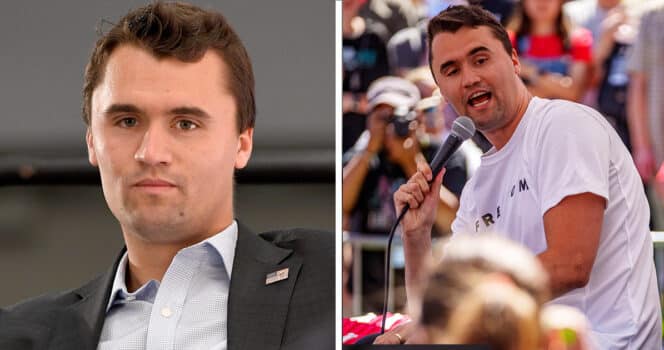
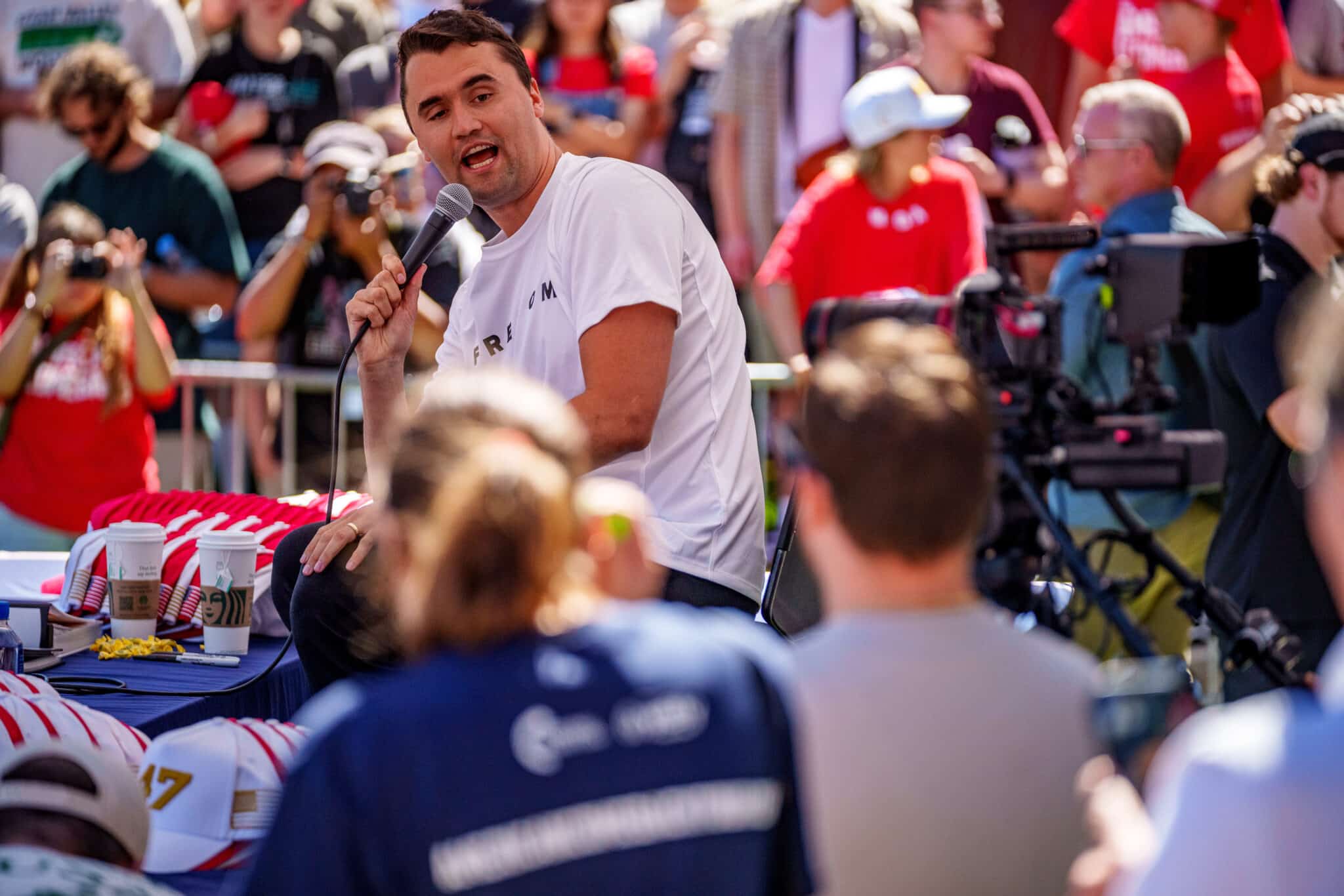
He didn’t plan to speak. He’d come to Utah Valley University to sit near the back, listen, maybe challenge a point or two. But when the mic runner stopped at his row and the crowd parted just a little, the student stood, cleared his throat, and asked a question that had been stuck under his tongue all week: how many mass shooters in the past decade were transgender? Charlie Kirk didn’t hesitate. “Too many,” he said, drawing a swell of applause that rolled like surf across the plaza. The student pressed: how many in total? Kirk cocked his head, half-grin, half-sparring stance. “Counting or not counting gang violence?” They were the last words anyone would hear from him. A single crack split the afternoon. Kirk staggered, a crimson line blooming at his neck, and the quad fell into the kind of silence people only experience when time fractures. YouTube
The student remembers sound in fragments—the metallic clatter of a chair leg, the sizzle of someone’s spilled soda on concrete, a chorus of phones lighting up all at once. He remembers the tent snapping in the wind and then realizing it wasn’t wind at all but a hundred bodies moving in the same direction, low and fast. Security lunged, medics surged, and strangers who’d been arguing ten minutes earlier wordlessly locked arms to clear a path. Someone yelled “rooftop!” and everyone else stared up into hard blue sky. Within minutes, the campus was being emptied building by building, a disorienting swirl of sirens, loudspeaker instructions, and the choked, staccato calls students made to parents who couldn’t get through.
Two people who looked like possible suspects were cuffed and loaded into cruisers as officers tried to make sense of chaos. By nightfall, both had been questioned and released; neither, investigators said, had anything to do with the shot that ended Kirk’s life. The shooter was still out there, the kind of sentence that settles over a town like ash.
The next morning, the student woke to a campus with its breath held. Flowers bled color onto a folding table by the fountain. A handwritten sign leaned against a lamp post: “We heard the question. We heard the answer. We heard the shot.” He opened his phone to a flood he hadn’t asked for—DMs, tags, clipped videos looping his voice, then Kirk’s, then the sound, over and over. He filmed a short message and posted it, not because he wanted attention but because the alternative—silence—felt like a lie. He said the only thing that made sense to say: that what happened was wrong, that violence doesn’t vindicate arguments, it obliterates people. He offered condolences to a family whose faces he’d only ever seen on a screen. He did not try to center himself. He didn’t have any answers.
Investigators worked outward from the stage like a ripple in a pond. They mapped trajectories and line of sight, climbed stairwells, swept rooftops. Federal agents released a clip that froze hearts: a shadowed figure dropping down from a building and sprinting away. Later, search teams combing a wooded strip near campus found a rifle and ammunition tucked where ordinary eyes wouldn’t look. The evidence suggested an ambush crafted for distance and escape. The absence of a suspect suggested something colder: patience.
In the days that followed, the student replayed the exchange in his mind, not because he wanted to relive it but because memory kept looping it anyway. He thought about how public debate is supposed to work—question, answer, rebuttal, repeat—and how fragile it becomes when someone decides to swap a conclusion for a weapon. He thought about the way a crowd can be both adversarial and communal, how people who were booing each other one moment were holding each other’s backpacks the next. He thought about the eerie quiet of the evacuated quad and how, for a few hours, the country’s arguments were reduced to a single, human-scale task: get everyone home.
News traveled fast, faster than facts. Clips were chopped into outrage fuel; rumors tried to outrun press conferences. But some details held steady: Kirk had been 31, a national figure on the right whose campus events drew both fans and critics; he had been answering a pointed question when a sniper’s shot hit him in the neck; he was raced to surgery and didn’t survive. Those are sentences that don’t get easier to read with repetition. They’re just the bones of a story that now belongs to grieving people.
By then, the student had learned the strange logistics of sudden proximity to tragedy. You keep recharging your phone because people you love are checking you’re alive. You accept that strangers will assign you motives and histories you do not have. You remember to drink water. You stop watching the clip. You start setting your notifications to “off.” You remind yourself that being the last person to ask a question does not mean you own the narrative that followed.
Outside, campus routines began to reassemble: professors took attendance, maintenance crews pressure-washed a path that still felt haunted, the library returned to its usual hush. Inside classrooms and dorms, the conversation kept going but it sounded different—sensitized, a little raw, laced with the kind of caution that isn’t about political correctness so much as human tenderness. People argued. People cried. People prayed. In a media culture that often measures conviction by volume, the student found himself preferring whispers.
Authorities kept asking for tips, for doorbell footage, for the tiny breaks that turn into big ones. They reminded everyone that two men detained in the immediate panic had been ruled out. They pointed anxious eyes to the rooftop clip and the discovery in the woods and said, in so many words: we’re not done. The student, who had asked his question in good faith and then watched the world fracture around him, did the only thing that felt dignified: he went quiet when speculation surged, he spoke when compassion required it, and he waited—like everyone else—for the name that would make the abstract real.
Somewhere in that waiting, he thought about the strange burden of last words. How quickly they’re turned into symbols, how stubbornly they resist meaning anything other than what they were: a line in a debate, offered in the register of a man who made a career of combat over ideas. He thought about how, even in a moment designed to sharpen divisions, the most indelible images were human ones—hands trembling as they tore open gauze, strangers holding back a crowd to make room for help, a woman in tears asking a police officer if she could just go back for her backpack because it had her medication in it, an officer saying yes and walking with her.
Grief has a way of exhausting language. So the student let the footage speak where it needed to—the wide shot that captured the scale, the tight shot that captured the horror—and then he let silence do the rest. He didn’t try to write an epitaph for a political figure he’d challenged and, seconds later, watched die. He didn’t pretend the argument they were having didn’t matter, because it did—policy always does—but he refused to pretend the bullet proved anyone right. It only proved what bullets always prove: that someone chose to end a life instead of continuing a conversation.
On campus, the flowers kept coming. So did the candles, and the prayers, and the vows to be better than this. The investigation pressed on. And the student, whose question now lives inside a moment he would give anything to change, kept repeating the simplest truth he had: that a wife lost a husband, children lost a father, parents lost a son, friends lost a friend—that before platforms and tours and videos and virality, there was a person. Everything else, he figured, could wait until police found the one person whose choice made sure it never would be the same again.