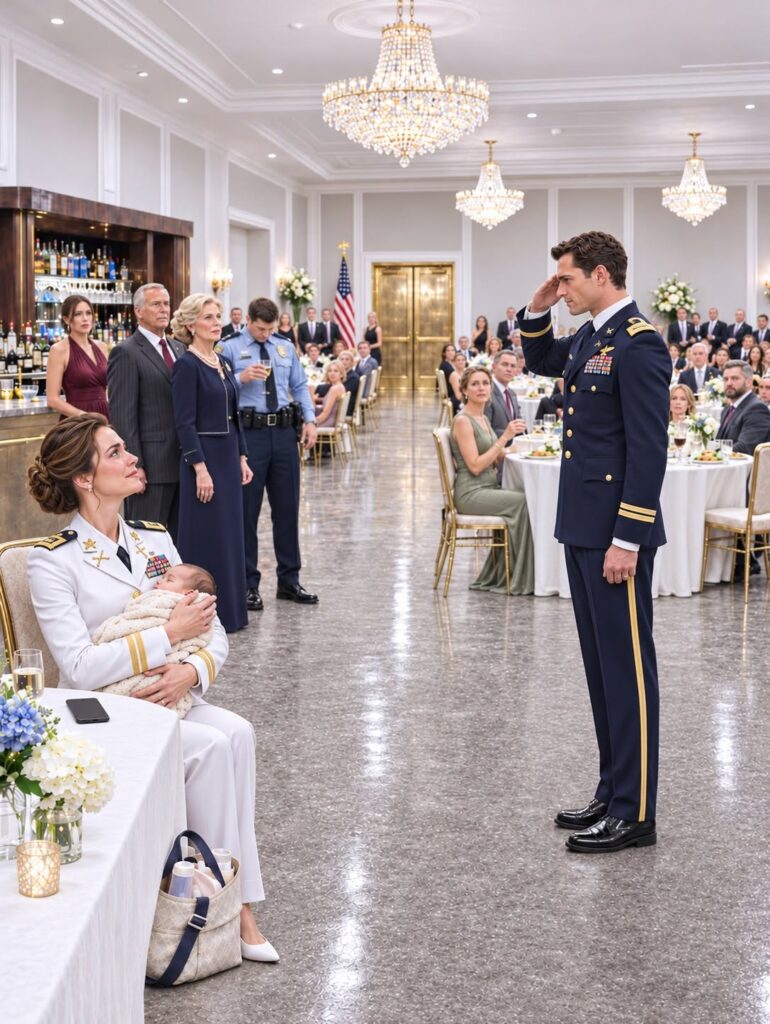
I stood near the entrance of the banquet hall, holding my newborn daughter against my chest.
My mother, Judith, had already warned me not to embarrass the family.
My father, a retired Marine, heard every word.
He simply turned away.
I swallowed my disappointment and found an empty table in the far corner.
Fifteen minutes later, a decorated Navy SEAL would walk across that entire ballroom and salute me in front of everyone.
My name is Colonel Tamsin Pike.
But to my family, I was nothing more than a glorified government secretary.
For years, they’d mocked my career because I couldn’t discuss the classified work I performed.
My brother, a police tactical officer, was constantly praised for his service.
My sister Camille was admired for marrying a successful naval officer.
And I was the daughter everyone contacted when they needed money.
For over a decade, I’d quietly helped cover family debts and emergencies.
Yet when I arrived with my baby girl, Wynne, nobody even asked how she was doing.
The banquet was being held to honor my brother-in-law, Lieutenant Commander Cole Brennan, a highly decorated Navy SEAL.
My mother had spent weeks discussing the event.
She was determined to make an impression.
I’d hoped it might finally be an opportunity to reconnect with everyone and introduce Wynne properly.
Instead, I was sitting alone beneath the chandeliers while my relatives celebrated across the room.
When Wynne became restless, I messaged my husband, Rhys, who was waiting nearby.
He came inside and gently took our daughter.
“We’ll be right outside,” he whispered.
I watched them leave.
Then returned to my empty table.
A few minutes later, the main doors opened.
Cole entered wearing his Navy dress whites, his gold SEAL trident shining beneath the lights.
Guests immediately gathered around him.
My mother hurried forward.
“Now, here’s our real hero!”
Cole acknowledged her briefly.
Then looked across the ballroom.
His eyes found me.
And instead of joining the family, he began walking directly toward my corner table.
People stepped aside.
My mother called his name.
He kept walking.
When he reached me, he stopped three steps away.
His heels came together.
His back straightened.
Then he raised his hand to his forehead.
“Ma’am.”
The entire room fell silent.
I stared at him for a moment before standing.
Then I returned his salute.
“Lieutenant Commander Brennan.”
My father’s mouth opened.
Dillon nearly dropped his drink.
My mother gripped the edge of a nearby table.
Cole lowered his hand.
“I wasn’t sure you’d be here, Colonel. May I sit?”
“Of course.”
He pulled out a chair beside me.
Camille hurried over.
“Cole, you’re sitting here?”
“Of course,” he replied.
Then Dillon approached.
“What kind of joke is this? She’s a glorified secretary!”
Cole slowly turned toward him.
His voice was quiet.
But everyone nearby heard.
“You have no idea what she does. Without her intelligence, my team wouldn’t have come home.”
Dillon stopped smiling.
Cole continued.
“Speak to the Colonel that way again, and you and I will have a very different conversation.”
My brother looked toward Dad.
For once, our father had nothing to say.
I didn’t smile triumphantly.
I didn’t deliver a speech about my accomplishments.
I simply gathered my handbag.
Cole had given me more respect in thirty seconds than my family had shown me in years.
And strangely, that made me realize how little I wanted their approval anymore.
I thanked him, collected my diaper bag, and walked toward the exit.
Outside, Rhys was waiting beside our car with Wynne.
“How was the party?” he asked.
I kissed our daughter’s forehead.
“Over.”
But the evening wasn’t finished.
As we drove home, my phone vibrated.
An unfamiliar number had sent a message.
“Colonel, we need to talk. Your father made a call he shouldn’t have made.”
Moments later, my security officer contacted me.
She explained that Dad had called an old Marine acquaintance who now worked as a Pentagon contractor.
He’d asked the man to investigate my career.
His exact words had been:
“My daughter has been lying to us about what she does.”
The contractor refused to disclose anything and reported the inquiry.
I sat quietly in the passenger seat.
My father hadn’t just dismissed my career.
He’d tried to investigate classified information because he couldn’t accept that his daughter might be more accomplished than he believed.
That night, I made a decision.
No more calls.
No more financial rescues.
No more desperately trying to earn affection from people who treated me like an embarrassment.
My mother left several voicemails suggesting we should forget the unpleasantness.
Dillon posted another photograph of himself in tactical gear, mocking people who supposedly hid behind government titles.
I blocked him.
Then, a month later, Camille sent me a handwritten letter.
She admitted she’d spent years caring more about appearances than treating me fairly.
She apologized for staying silent.
Most importantly, she acknowledged she’d ignored me when I arrived with Wynne.
For the first time, someone in my family had apologized without making excuses.
I called her.
But I established boundaries.
She couldn’t pass messages from our parents.
She couldn’t use my daughter to pressure me into reconciliation.
And if someone insulted me in her presence, I expected her to speak up.
Camille agreed.
Two months later, I received a new assignment at a joint cyber command.
Not long afterward, I was selected to deliver an important briefing on cyber threats at a congressional hearing in Washington, D.C.
I prepared carefully.
On the morning of the hearing, Rhys drove me to the airfield with Wynne.
He kissed my forehead.
“Go show them what you know.”
At the hearing, I approached the podium and arranged my notes.
Then I noticed two familiar faces in the public gallery.
My parents.
I hadn’t seen them since the banquet.
Dad sat rigidly.
Mom looked furious.
Before I could begin, she suddenly stood.
“That’s my daughter! She’s been lying to us for years! She owes this family—”
Security officers immediately intervened.
Mom was escorted from the chamber.
Dad followed.
For several seconds, the room was silent.
Then the chairman looked toward me.
“Colonel, whenever you’re ready.”
I straightened my notes.
“Thank you, sir.”
And began my briefing.
For the next hour, I discussed the security challenges facing military networks and the importance of coordinated responses to cyber threats.
I didn’t stumble.
I didn’t look toward the empty seats.
When I finished, the audience stood and applauded.
Later, as I packed my documents, I heard footsteps behind me.
Dad.
He looked exhausted.
“You looked like a real commander up there,” he said quietly.
“Your mother and I didn’t know.”
I stared at him.
“You knew I was your daughter. That should have been enough.”
His eyes filled with tears.
“I should’ve asked about your life. I should’ve listened.”
I nodded.
“You heard Dillon insult me while I held Wynne. You turned away.”
Dad lowered his head.
Then, for the first time I could remember, he apologized.
“I’m sorry, Tamsin.”
I didn’t hug him immediately.
I explained that rebuilding our relationship would require time and consistent change.
He accepted that.
Over the following months, Dad began writing letters.
He didn’t ask for favors.
He didn’t demand forgiveness.
He simply described what he was learning and how he was trying to change.
Six months later, I invited him to visit.
When he arrived, he waited on the doorstep until I welcomed him inside.
Then he asked whether he could hold Wynne.
I carefully placed her in his arms.
He began crying.
And for the first time, I saw my father looking at his granddaughter without worrying about what anyone else thought.
Mom took longer.
Eventually, she admitted something painful.
“I was jealous of you, Tamsin.”
We began rebuilding our relationship slowly.
Dillon never apologized.
I stopped waiting for him to.
By Wynne’s first birthday, Camille had become a welcome part of our lives.
Cole attended the celebration too.
When he greeted me as “Colonel,” I laughed.
“Not today. Today I’m just Wynne’s mom.”
Later that evening, Rhys and I were washing dishes when he asked whether I ever thought about the banquet.
“Sometimes,” I admitted.
“What do you remember?”
I considered the question.
Not my brother’s insult.
Not the salute.
Not even my parents’ shocked expressions.
“I remember finally getting up and leaving when I wanted to.”
Rhys smiled.
“You were always the commander, Tamsin.”
He wrapped his arms around me.
For years, I’d believed that if I accomplished enough, sacrificed enough, or helped my family enough, they’d finally see my worth.
But I was wrong.
I didn’t need a Navy SEAL’s salute to become someone deserving of respect.
I needed to understand that I had deserved it all along—even before anyone in that ballroom knew who I really was.
{"post":118091,"page":2,"next":[{"id":118087,"title":"A Woman\u2019s MIL Painted Over Her Three-Month Mural Project in Her Daughter\u2019s Bedroom, Calling It \u2018Completely Worthless\u2019 \u2013 But Security Footage Revealed Her MIL Was Covering Up Something Much Bigger","url":"https:\/\/new24.info\/118087"},{"id":118082,"title":"My Ex-Husband\u2019s Family Invited Me to His Wedding, Hoping to Humiliate Me for Being \u201cInfertile.\u201d But I Arrived With Triplets\u2014and Their Perfect Wedding Turned Into a Nightmare\u2026","url":"https:\/\/new24.info\/118082"},{"id":118078,"title":"\u201cToss My Wife\u2019s Stuff Out and Let My Pregnant Mistress Move In!\u201d My Husband Ordered the Butler. But the Butler Coldly Replied, \u201cMadam Has Filed for Divorce, Withdrawn Billions, and Owns This House\u201d\u2026","url":"https:\/\/new24.info\/118078"},{"id":118074,"title":"A Woman\u2019s Soon-to-Be Ex-Husband Removes Their Kids from His Health Insurance When They Are Sick to Show Her How Much She Needs Him \u2013 So She Does One Thing, and Two Hours Later, He Comes to Her House, Shouting, \u2018Do You Have Any Idea What You\u2019ve Just Done?!\u2019","url":"https:\/\/new24.info\/118074"},{"id":118070,"title":"My Husband Rushed Our Divorce So He Could Marry His Pregnant Mistress. He Signed The Agreement Without Reading Page Seven, Unaware Of The Maine Lobster Business He Was Leaving Behind","url":"https:\/\/new24.info\/118070"},{"id":118065,"title":"Injured Army Captain Overhears Husband Plotting Her Future And Calls Her Father","url":"https:\/\/new24.info\/118065"},{"id":118061,"title":"A Woman Told Her Father She Was Engaged to His Best Friend of over 20 Years \u2013 Instead of Congratulating Her, He Looked at Her Ring and Asked, \u2018Did He Ever Tell You Why He Never Married?\u2019","url":"https:\/\/new24.info\/118061"},{"id":118056,"title":"A Grandma\u2019s Greedy Grandkids Put Her in a Storage Closet at a Luxury Resort on Her Dime \u2013 But at Breakfast, the Manager Tells Them, \u2018Your Grandma Thinks It\u2019s Time You Learn a Lesson\u2019","url":"https:\/\/new24.info\/118056"},{"id":118051,"title":"Navy Officer Discovers Devastating Betrayal After Arriving At Empty Wedding Venue","url":"https:\/\/new24.info\/118051"},{"id":118046,"title":"I raised my grandson after the snowstorm that took my family away: twenty years later he gave me a note","url":"https:\/\/new24.info\/118046"},{"id":118042,"title":"Neighbor Melts a Woman\u2019s Trash Can with Charcoal on Thanksgiving \u2013 So the Woman Brings Her Something Other than Turkey","url":"https:\/\/new24.info\/118042"},{"id":118036,"title":"Husband Returns Home Early to Discover a Shocking Secret Hidden by Family","url":"https:\/\/new24.info\/118036"},{"id":118032,"title":"If your feet and hands are swollen, here\u2019s what your body is trying to tell you\u2026 See more","url":"https:\/\/new24.info\/118032"},{"id":118028,"title":"Russell Brand Issues \u2018Disturbing\u2019 Statement From Prison After 10-Year Sentence","url":"https:\/\/new24.info\/118028"},{"id":118024,"title":"With heavy hearts, we announce the passing of this beloved actress at 65 \ud83d\ude2d\ud83c\udf39Check the comments.","url":"https:\/\/new24.info\/118024"},{"id":118020,"title":"Doctors reveal that eating beets causes\u2026 See details in \ud83d\udcac \u2b07\ufe0f","url":"https:\/\/new24.info\/118020"},{"id":118016,"title":"People Are Noticing a Strange Detail in This Old Photo of Princess Diana and King Charles","url":"https:\/\/new24.info\/118016"},{"id":118012,"title":"My friends grandparents passed and he grabbed these but has no idea what that are, maybe cocktail stirs. Any idea?\u2b07\ufe0fSee more in 1st comment\u2b07\ufe0f","url":"https:\/\/new24.info\/118012"},{"id":118008,"title":"My husband and I booked a room during our vacation. In the hotel room, I discovered this. I\u2019ve been looking at it for half an hour now, but I still can\u2019t figure out what it is. Does anyone know? Check the first comment for the answer","url":"https:\/\/new24.info\/118008"},{"id":118004,"title":"I found this in a flooded ditch and managed to catch it, bringing it home in a jar. I honestly have no idea what it is\u2014does anyone know? The answer is in the first comment","url":"https:\/\/new24.info\/118004"}]}