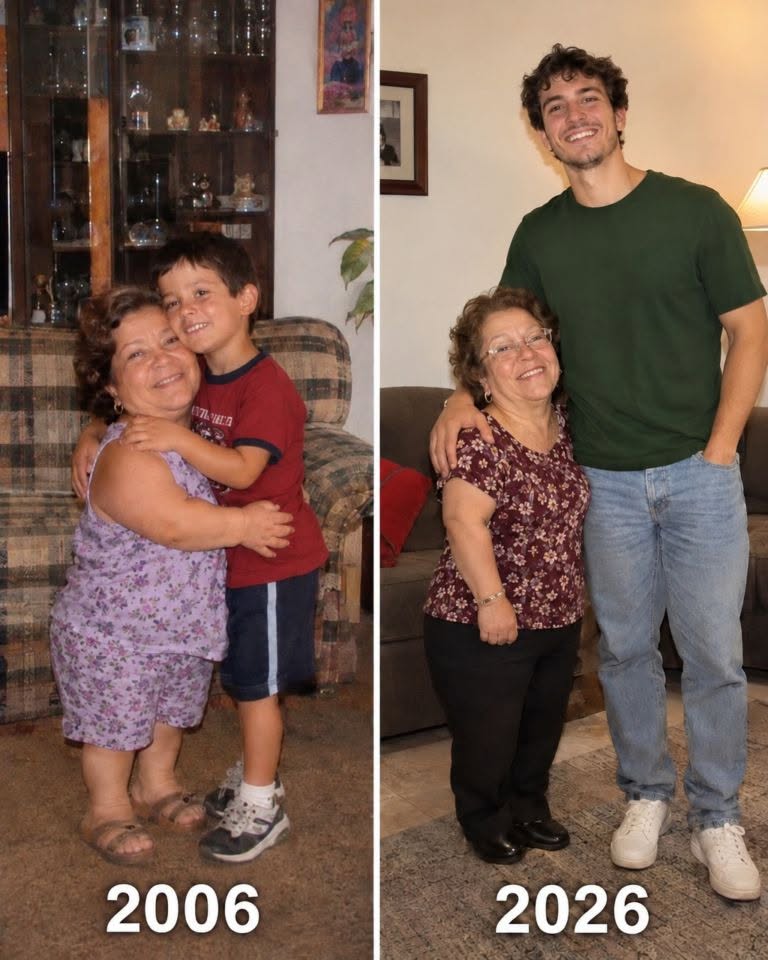
Then he handed me a folded piece of paper.
I stared at him, unable to speak.
For twenty years, I’d believed my daughter had died because of terrible weather and poor visibility.
The police had investigated. The insurance company had completed its reports. Eventually, our family had learned to live with an explanation that offered no comfort but at least seemed final.
Now Mateo was telling me everything we’d believed might be wrong.
My name is Elvira, and losing my daughter was the hardest thing I’ve ever survived.
After her death, I helped raise Mateo, who was still a little boy.
Sometimes, the way he smiled reminded me so much of his mother that I had to turn away.
He grew into a thoughtful, determined young man.
But that Sunday, something was different.
He barely touched his coffee.
“Grandma, I’ve been looking into Mom’s accident for months.”
I unfolded his note.
“Someone made a terrible decision that night. I found evidence, and I didn’t want you to hear the truth from anyone else.”
My hands began trembling.
Mateo explained that he’d reviewed old police files, insurance documents, and witness statements.
One document stood out.
A truck driver had reported seeing a white van drift into the opposite lane.
My daughter had swerved to avoid it.
Her car crashed.
The van never stopped.
Yet the accident had ultimately been attributed to weather conditions.
“Are you saying another driver forced her off the road?” I whispered.
Mateo nodded.
“And Grandma, I found him.”
The man’s name was Leandro.
He was now in his seventies, living roughly two hundred kilometers away.
Mateo had visited him without telling me.
When Leandro opened his door, he reportedly went pale after noticing how much Mateo resembled his mother.
Then he invited him inside.
What he confessed made my stomach turn.
Leandro had been driving home after working a double shift. Exhausted, he’d briefly fallen asleep at the wheel.
His van crossed into the oncoming lane.
My daughter swerved.
And instead of stopping to help, he panicked and drove away.
For twenty years, he’d kept quiet.
But Mateo discovered something else.
Every Christmas, Leandro had written a letter to our family.
Twenty letters.
Twenty apologies.
Twenty opportunities to tell us the truth.
He had never mailed a single one.
“Why?” I asked.
Mateo looked down.
“He said he was afraid.”
I stared at my daughter’s photograph on the mantel.
Afraid.
I’d spent two decades grieving a tragedy I believed nobody could have prevented.
Meanwhile, the man who knew what happened had gone on living his life.
“Did he admit everything to you?”
Mateo nodded.
“He gave me a written confession.”
I began crying.
Mateo reached across the table and held my hand.
“I didn’t do this because I wanted revenge, Grandma.”
“Then why?”
“Because Mom deserves the truth. And so do you.”
The following week, we visited an attorney.
We brought the police reports, the forgotten witness statement, and Leandro’s confession.
The lawyer explained that because twenty years had passed, legal action might be complicated or limited.
However, the new evidence could justify asking authorities to review the case again.
Leandro eventually agreed to give a formal statement.
When he appeared before a prosecutor, his hands shook.
He admitted falling asleep, crossing the center line, and fleeing after the crash.
He also admitted he’d concealed his involvement for two decades.
Afterward, he approached me.
He looked smaller than I’d imagined.
Older. Frightened.
“I don’t expect forgiveness,” he said quietly.
I didn’t answer.
“There hasn’t been a day when I haven’t thought about what happened to your family.”
I wanted to scream.
“Then why didn’t you tell us? Why did you leave us believing a lie for twenty years?”
But the words wouldn’t come.
I simply walked away.
Some people believe forgiveness must follow every apology.
I don’t.
I wasn’t ready to forgive him.
Perhaps I never would be.
And for the first time in my life, I didn’t feel obligated to pretend otherwise.
Over the following weeks, I struggled with the revelation.
Some mornings, anger consumed me.
Other days, the sadness felt as fresh as the day the police came to my door.
Then one evening, Mateo visited.
“Grandma, I hope you’re not upset that I investigated without telling you.”
I shook my head.
He looked relieved.
“I just didn’t want everyone to remember Mom’s death the wrong way.”
I pulled him close.
“Thank you,” I whispered.
“For what?”
“For refusing to stop searching. For doing something I never knew needed to be done.”
His eyes filled with tears.
We held each other for a long time.
Months have passed since that Sunday.
We still don’t know whether the investigation will bring every consequence we once might have hoped for.
But something inside our family has changed.
We talk about my daughter more openly now.
We remember her laughter, her kindness, and the life she should have been able to live.
We no longer avoid mentioning her because we’re afraid of making each other cry.
And I no longer believe that staying silent is the same as healing.
Last Sunday, snow began falling outside my window.
Mateo sat beside me, drinking coffee.
He looked at his mother’s photograph.
“She would have wanted us to know, wouldn’t she?”
I smiled through my tears.
“I think she would have wanted you to live without carrying this burden alone.”
He reached for my hand.
For twenty years, I’d believed the story of my daughter’s final moments was complete.
It wasn’t.
The truth couldn’t bring her back. It couldn’t return the years we’d lost. And it couldn’t erase what Leandro had done.
But my grandson had given me something I never expected to receive.
The truth about the night I lost my daughter.
And proof that even after twenty years, someone who loved her was still willing to fight for her memory.
Sometimes, the greatest act of love isn’t protecting someone from a painful truth. It’s having the courage to uncover it, no matter how long it has been buried.
{"post":118046,"page":2,"next":[{"id":118042,"title":"Neighbor Melts a Woman\u2019s Trash Can with Charcoal on Thanksgiving \u2013 So the Woman Brings Her Something Other than Turkey","url":"https:\/\/new24.info\/118042"},{"id":118036,"title":"Husband Returns Home Early to Discover a Shocking Secret Hidden by Family","url":"https:\/\/new24.info\/118036"},{"id":118032,"title":"If your feet and hands are swollen, here\u2019s what your body is trying to tell you\u2026 See more","url":"https:\/\/new24.info\/118032"},{"id":118028,"title":"Russell Brand Issues \u2018Disturbing\u2019 Statement From Prison After 10-Year Sentence","url":"https:\/\/new24.info\/118028"},{"id":118024,"title":"With heavy hearts, we announce the passing of this beloved actress at 65 \ud83d\ude2d\ud83c\udf39Check the comments.","url":"https:\/\/new24.info\/118024"},{"id":118020,"title":"Doctors reveal that eating beets causes\u2026 See details in \ud83d\udcac \u2b07\ufe0f","url":"https:\/\/new24.info\/118020"},{"id":118016,"title":"People Are Noticing a Strange Detail in This Old Photo of Princess Diana and King Charles","url":"https:\/\/new24.info\/118016"},{"id":118012,"title":"My friends grandparents passed and he grabbed these but has no idea what that are, maybe cocktail stirs. Any idea?\u2b07\ufe0fSee more in 1st comment\u2b07\ufe0f","url":"https:\/\/new24.info\/118012"},{"id":118008,"title":"My husband and I booked a room during our vacation. In the hotel room, I discovered this. I\u2019ve been looking at it for half an hour now, but I still can\u2019t figure out what it is. Does anyone know? Check the first comment for the answer","url":"https:\/\/new24.info\/118008"},{"id":118004,"title":"I found this in a flooded ditch and managed to catch it, bringing it home in a jar. I honestly have no idea what it is\u2014does anyone know? The answer is in the first comment","url":"https:\/\/new24.info\/118004"},{"id":118001,"title":"Doctors reveal that eating avocado causes\u2026 See more","url":"https:\/\/new24.info\/118001"},{"id":117997,"title":"Hollywood Mourns Beloved Actor \u2026., Dead at 93\u2026.","url":"https:\/\/new24.info\/117997"},{"id":117993,"title":"-Doctors reveal that drinking coffee every morning causes\u2026 See more","url":"https:\/\/new24.info\/117993"},{"id":117989,"title":"Legendary \u2018Star Trek\u2019 and \u2018X-Men\u2019 Actor Sir Patrick Stewart Dies at 86, Leaving Behind an Unforgettable Hollywood Legacy","url":"https:\/\/new24.info\/117989"},{"id":117985,"title":"Bringing Back the Magic: The Heartwarming Return of an American Icon","url":"https:\/\/new24.info\/117985"},{"id":117981,"title":"You\u2019ve Seen One Before\u2014But Do You Know What It Really Meant?","url":"https:\/\/new24.info\/117981"},{"id":117978,"title":"Shania Twain catched heat for blonde look at awards show","url":"https:\/\/new24.info\/117978"},{"id":117974,"title":"Outside the courthouse, my ex and his mistress threw divorce papers at me, shouting, \u201cWithout me, you\u2019re nothing!\u201d Suddenly, two black SUVs arrived. An elderly man stepped out and mentioned my father\u2019s name, leaving them both speechless\u2026","url":"https:\/\/new24.info\/117974"},{"id":117969,"title":"My Sister Called My Daughter: \u201cThe Family\u2019s Little Embarrassment.\u201d When I Stood Up for Her, Mom Said: \u201cLook At You. Still Begging Us To Accept Her.\u201d","url":"https:\/\/new24.info\/117969"},{"id":117963,"title":"I Paid Cash for a Beachfront Condo for My In-Laws\u2019 Retirement\u2014Six Months Later, My Husband\u2019s First Love Opened the Door Wearing His Shirt! He Threatened Me When I Said I\u2019d Sell It\u2026","url":"https:\/\/new24.info\/117963"}]}