Next door, my neighbor Denise was hosting a barbecue.
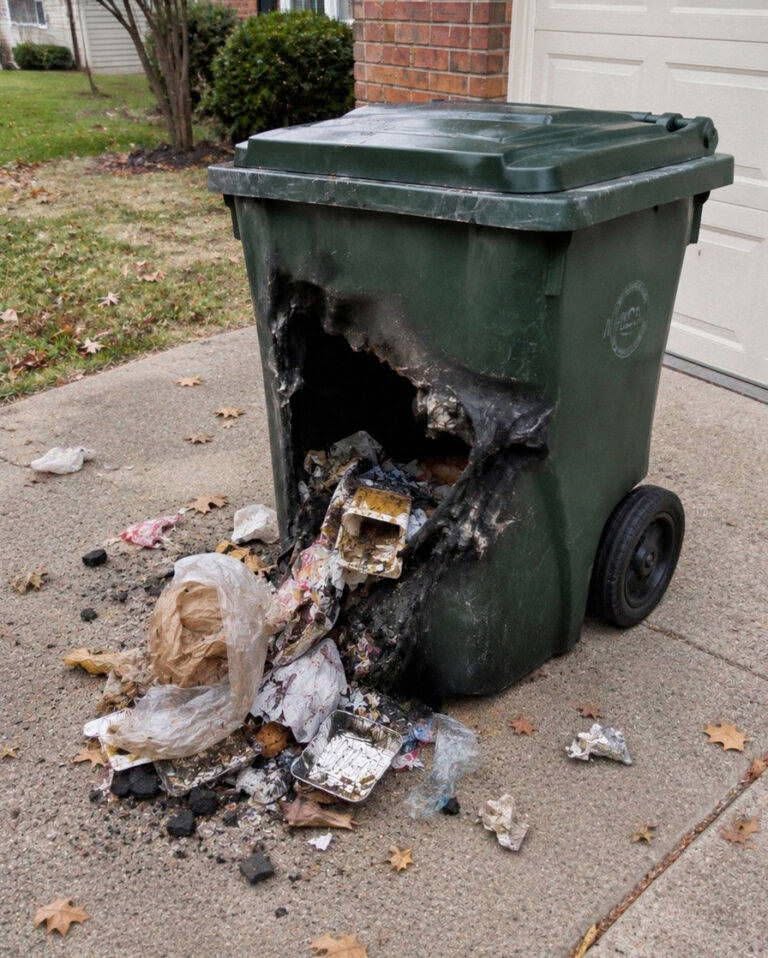
And I knew exactly where the hot charcoal had come from.
My name is Ruth. I’m seventy-six, and my husband Frank and I have lived in our neighborhood for years.
Denise had moved in recently.
At first, I wanted to be welcoming.
But apparently, she interpreted kindness as permission to take whatever she wanted.
It started when I found her inside our garage carrying two flowerpots and our rake.
“What’s the big deal?” she asked. “I’ll return them later.”
I let it go.
Then our lawn mower disappeared.
Frank checked our security camera.
There was Denise, pushing our mower out of the garage without asking.
I retrieved it myself.
Soon, she was connecting her garden hose to our outdoor faucet to fill her swimming pool.
Then she started cutting roses from my garden.
And finally, she began filling our garbage cans with her household trash.
“Denise, please use your own bins,” I asked politely.
She rolled her eyes.
“Mine are full. You two are retired! How much garbage could you possibly have?”
I didn’t want trouble with a neighbor.
So I kept tolerating it.
Until Thanksgiving.
When I confronted Denise about the melted trash can, she barely looked concerned.
“Oh, I emptied the grill. I thought the charcoal had cooled.”
“Then you need to replace my bin.”
She laughed.
“You’re such a cheapskate! Use some of your retirement money and buy another one!”
One of her guests chuckled.
Then Denise slammed the door.
I stood there shaking.
And the worst part?
I almost offered to split the replacement cost, simply to avoid an argument.
Back home, Frank helped me collect the scattered garbage.
Then I opened our security camera recordings.
What I saw changed everything.
Denise had approached her own garbage can first.
She opened the lid.
Looked inside.
Closed it.
Then walked across the lawn and emptied her charcoal into mine.
She’d deliberately chosen my property because she didn’t want to risk damaging her own.
I saved the video.
Then found the earlier footage showing her taking our lawn mower.
I also searched for the exact replacement trash can and printed its price.
That evening, after our family Thanksgiving dinner, I gathered everything onto a large serving platter.
I covered it with a decorative lid.
Then walked next door.
Denise opened the door while her guests chatted behind her.
When she saw the platter, she smiled.
“Oh! You brought us something?”
I lifted the lid.
Her smile vanished.
On top was an appointment confirmation for a Monday consultation with our community mediation center.
Beneath it was a signed letter requesting payment for the damaged trash can.
And two photographs.
One showed her dumping charcoal into my bin.
The other showed her taking our lawn mower from the garage.
Denise turned pale.
“Are you kidding me? Cancel that appointment!”
I remained calm.
She lowered her voice.
“Fine. I’ll buy the trash can. Just cancel everything.”
Earlier that day, I would have accepted immediately.
But now I understood.
This wasn’t just about one damaged bin.
It was about months of disrespect.
“I’ll attend the consultation on Monday,” I replied.
Then I went home.
At mediation, Denise insisted she’d believed the charcoal was cold.
“I believe you,” I said.
She looked surprised.
Then I played the recording.
We watched her inspect her own garbage can before crossing into our yard.
“Why did you use mine?” I asked.
“Mine was full. I thought yours had space.”
“I’d already asked you not to.”
She looked away.
Then came the lawn mower footage.
Denise argued that she’d assumed we were the kind of neighbors who shared things.
I asked a simple question.
“If we’re sharing, why am I always the one who has to retrieve my belongings?”
For once, she had no answer.
With the mediator’s assistance, we reached a written agreement.
Denise would pay for the replacement bin, dispose of the damaged one, and return our missing gardening tools.
She would stop entering our garage, using our faucet, cutting our roses, and filling our garbage cans.
Most importantly, she agreed to ask permission before borrowing anything.
The following Saturday, Denise arrived with an envelope containing the full replacement cost.
She returned our tools and removed the melted bin.
A week later, she knocked again.
“Ruth, could I borrow your pruning shears?”
I looked toward the garage.
They were sitting on the workbench.
For a moment, I nearly agreed out of habit.
Then I smiled.
“I’m using them this afternoon.”
Denise nodded.
“Okay. See you later.”
And she walked home.
That afternoon, I went outside to prune my roses.
For the first time in months, my tools were exactly where I’d left them.
My neighbor thought she could take my belongings, use my water, damage my property, and laugh whenever I complained.
But Thanksgiving finally taught me something important.
Being a good neighbor doesn’t mean allowing someone to take advantage of you.
And sometimes, the most satisfying victory isn’t making someone pay for what they broke.
It’s finally learning that saying “no” doesn’t make you unkind.
{"post":118042,"page":2,"next":[{"id":118036,"title":"Husband Returns Home Early to Discover a Shocking Secret Hidden by Family","url":"https:\/\/new24.info\/118036"},{"id":118032,"title":"If your feet and hands are swollen, here\u2019s what your body is trying to tell you\u2026 See more","url":"https:\/\/new24.info\/118032"},{"id":118028,"title":"Russell Brand Issues \u2018Disturbing\u2019 Statement From Prison After 10-Year Sentence","url":"https:\/\/new24.info\/118028"},{"id":118024,"title":"With heavy hearts, we announce the passing of this beloved actress at 65 \ud83d\ude2d\ud83c\udf39Check the comments.","url":"https:\/\/new24.info\/118024"},{"id":118020,"title":"Doctors reveal that eating beets causes\u2026 See details in \ud83d\udcac \u2b07\ufe0f","url":"https:\/\/new24.info\/118020"},{"id":118016,"title":"People Are Noticing a Strange Detail in This Old Photo of Princess Diana and King Charles","url":"https:\/\/new24.info\/118016"},{"id":118012,"title":"My friends grandparents passed and he grabbed these but has no idea what that are, maybe cocktail stirs. Any idea?\u2b07\ufe0fSee more in 1st comment\u2b07\ufe0f","url":"https:\/\/new24.info\/118012"},{"id":118008,"title":"My husband and I booked a room during our vacation. In the hotel room, I discovered this. I\u2019ve been looking at it for half an hour now, but I still can\u2019t figure out what it is. Does anyone know? Check the first comment for the answer","url":"https:\/\/new24.info\/118008"},{"id":118004,"title":"I found this in a flooded ditch and managed to catch it, bringing it home in a jar. I honestly have no idea what it is\u2014does anyone know? The answer is in the first comment","url":"https:\/\/new24.info\/118004"},{"id":118001,"title":"Doctors reveal that eating avocado causes\u2026 See more","url":"https:\/\/new24.info\/118001"},{"id":117997,"title":"Hollywood Mourns Beloved Actor \u2026., Dead at 93\u2026.","url":"https:\/\/new24.info\/117997"},{"id":117993,"title":"-Doctors reveal that drinking coffee every morning causes\u2026 See more","url":"https:\/\/new24.info\/117993"},{"id":117989,"title":"Legendary \u2018Star Trek\u2019 and \u2018X-Men\u2019 Actor Sir Patrick Stewart Dies at 86, Leaving Behind an Unforgettable Hollywood Legacy","url":"https:\/\/new24.info\/117989"},{"id":117985,"title":"Bringing Back the Magic: The Heartwarming Return of an American Icon","url":"https:\/\/new24.info\/117985"},{"id":117981,"title":"You\u2019ve Seen One Before\u2014But Do You Know What It Really Meant?","url":"https:\/\/new24.info\/117981"},{"id":117978,"title":"Shania Twain catched heat for blonde look at awards show","url":"https:\/\/new24.info\/117978"},{"id":117974,"title":"Outside the courthouse, my ex and his mistress threw divorce papers at me, shouting, \u201cWithout me, you\u2019re nothing!\u201d Suddenly, two black SUVs arrived. An elderly man stepped out and mentioned my father\u2019s name, leaving them both speechless\u2026","url":"https:\/\/new24.info\/117974"},{"id":117969,"title":"My Sister Called My Daughter: \u201cThe Family\u2019s Little Embarrassment.\u201d When I Stood Up for Her, Mom Said: \u201cLook At You. Still Begging Us To Accept Her.\u201d","url":"https:\/\/new24.info\/117969"},{"id":117963,"title":"I Paid Cash for a Beachfront Condo for My In-Laws\u2019 Retirement\u2014Six Months Later, My Husband\u2019s First Love Opened the Door Wearing His Shirt! He Threatened Me When I Said I\u2019d Sell It\u2026","url":"https:\/\/new24.info\/117963"},{"id":117959,"title":"Abandoned at a Bus Stop Revealed a Hidden Truth About My Husband","url":"https:\/\/new24.info\/117959"}]}