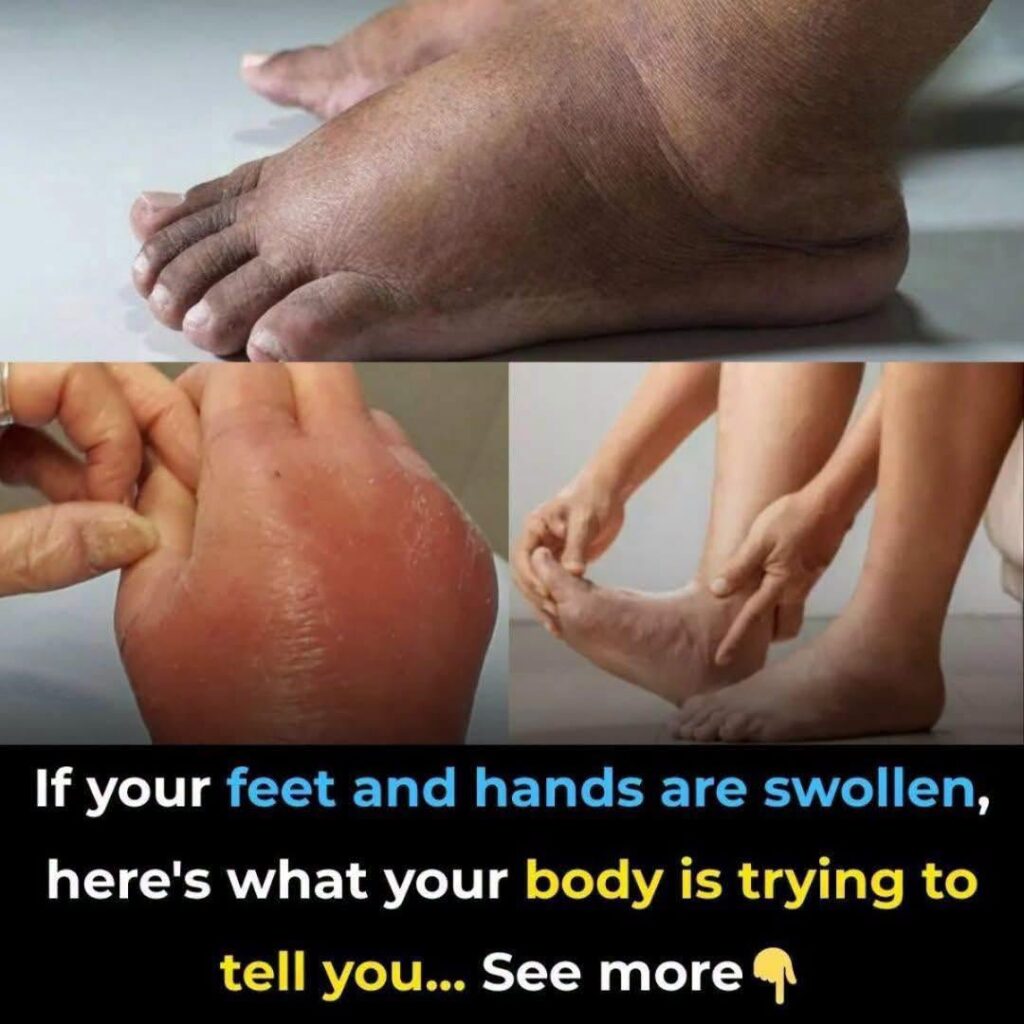
Edema is the medical term for swelling caused by excess fluid accumulating in the body’s tissues.
Normally, the circulatory and lymphatic systems work together to regulate how fluid moves between blood vessels and surrounding tissues.
When that balance is disrupted, fluid can collect beneath the skin.
The swelling most commonly affects the feet, ankles, and lower legs, although it can also appear in the hands, arms, and face.
Edema isn’t a disease by itself. It’s a symptom that can have several different causes.
Some are relatively harmless and temporary.
Others require medical evaluation and treatment.
1. Your rings and shoes suddenly feel tighter
One of the earliest signs of fluid retention can be a subtle change in how everyday items fit.
A wedding ring may become difficult to remove.
Shoes that usually feel comfortable may begin squeezing the feet.
Socks may leave deeper marks around the ankles.
These changes can occur even before the swelling becomes especially obvious.
Occasional mild puffiness can happen after prolonged standing, during hot weather, or following a particularly salty meal.
However, swelling that keeps returning or gradually worsens shouldn’t automatically be dismissed.
2. Pressing your skin leaves a temporary indentation
Another recognizable sign is called pitting edema.
This occurs when pressure applied to swollen tissue leaves a small depression that remains visible briefly after the pressure is removed.
It commonly affects the lower legs, ankles, and feet.
The indentation happens because excess fluid has accumulated within the tissues.
However, not all edema is pitting edema.
Some forms of swelling, including certain lymphatic conditions, may feel firmer and leave little or no indentation.
The appearance of swelling alone cannot establish its underlying cause.
3. Poor circulation in the leg veins may be responsible
One possible explanation for recurring ankle and leg swelling is chronic venous insufficiency.
This condition develops when the valves inside the leg veins don’t work efficiently.
Normally, these valves help blood move back toward the heart.
When they become weakened or damaged, blood can accumulate in the lower legs, increasing pressure and encouraging fluid to leak into surrounding tissues.
Possible symptoms include swollen ankles, aching or heavy legs, varicose veins, and skin discoloration around the lower legs.
Swelling caused by venous insufficiency often becomes worse after standing or sitting for long periods and may improve when the legs are elevated.
A healthcare professional can assess whether this condition is responsible.
4. Certain medications can cause swelling
Edema can also develop as a side effect of medications.
Some blood-pressure treatments, particularly certain calcium channel blockers, can cause ankle swelling.
Other possible contributors include corticosteroids, anti-inflammatory medicines, and some hormone treatments.
If swelling begins after starting a new medication, speak with the prescribing clinician.
Don’t stop prescribed treatment without medical guidance.
5. Persistent swelling may signal an underlying medical condition
Although many cases of swelling are relatively mild, persistent edema can sometimes be associated with conditions affecting the heart, kidneys, liver, or lymphatic system.
For example, impaired heart function may cause fluid to accumulate in the legs and other tissues.
Kidney problems can interfere with the body’s ability to regulate salt and fluid.
Certain liver conditions may also contribute to fluid retention.
This is why recurring swelling deserves attention, especially when it is accompanied by fatigue, unexplained weight changes, reduced urination, or other new symptoms.
When should you seek medical help?
Some types of swelling require urgent medical assessment.
Sudden swelling in one leg, particularly when accompanied by pain, warmth, or redness, may indicate a blood clot and should be assessed promptly.
Swelling associated with chest pain, sudden difficulty breathing, or fainting requires emergency medical care.
New, unexplained swelling that persists or worsens should also be evaluated by a healthcare professional.
During an examination, a clinician may review medications, assess circulation, and recommend blood tests, urine tests, or imaging when appropriate.
What can help with mild swelling?
The best approach depends on the cause.
For temporary swelling related to prolonged sitting or standing, gentle movement, walking, and elevating the legs may provide relief.
Reducing excessive sodium intake can also help some people.
Compression stockings may be useful for certain venous conditions, but they should be selected with medical guidance, particularly when circulation problems are suspected.
Most importantly, don’t attempt to treat persistent unexplained edema solely with home remedies.
The bottom line
Swollen fingers, tight rings, puffy ankles, and heavy legs can seem like minor everyday annoyances.
Sometimes, they are.
But when swelling becomes persistent, unexplained, or progressively worse, it may be an important clue about what is happening inside the body.
The key is remembering that edema is a symptom—not a diagnosis.
Recognizing the warning signs and seeking appropriate medical advice can help identify the cause before more serious complications develop.
And sometimes, something as ordinary as a wedding ring suddenly feeling too tight is the first reason to pay closer attention to your health.
{"post":118032,"page":2,"next":[{"id":118028,"title":"Russell Brand Issues \u2018Disturbing\u2019 Statement From Prison After 10-Year Sentence","url":"https:\/\/new24.info\/118028"},{"id":118024,"title":"With heavy hearts, we announce the passing of this beloved actress at 65 \ud83d\ude2d\ud83c\udf39Check the comments.","url":"https:\/\/new24.info\/118024"},{"id":118020,"title":"Doctors reveal that eating beets causes\u2026 See details in \ud83d\udcac \u2b07\ufe0f","url":"https:\/\/new24.info\/118020"},{"id":118016,"title":"People Are Noticing a Strange Detail in This Old Photo of Princess Diana and King Charles","url":"https:\/\/new24.info\/118016"},{"id":118012,"title":"My friends grandparents passed and he grabbed these but has no idea what that are, maybe cocktail stirs. Any idea?\u2b07\ufe0fSee more in 1st comment\u2b07\ufe0f","url":"https:\/\/new24.info\/118012"},{"id":118008,"title":"My husband and I booked a room during our vacation. In the hotel room, I discovered this. I\u2019ve been looking at it for half an hour now, but I still can\u2019t figure out what it is. Does anyone know? Check the first comment for the answer","url":"https:\/\/new24.info\/118008"},{"id":118004,"title":"I found this in a flooded ditch and managed to catch it, bringing it home in a jar. I honestly have no idea what it is\u2014does anyone know? The answer is in the first comment","url":"https:\/\/new24.info\/118004"},{"id":118001,"title":"Doctors reveal that eating avocado causes\u2026 See more","url":"https:\/\/new24.info\/118001"},{"id":117997,"title":"Hollywood Mourns Beloved Actor \u2026., Dead at 93\u2026.","url":"https:\/\/new24.info\/117997"},{"id":117993,"title":"-Doctors reveal that drinking coffee every morning causes\u2026 See more","url":"https:\/\/new24.info\/117993"},{"id":117989,"title":"Legendary \u2018Star Trek\u2019 and \u2018X-Men\u2019 Actor Sir Patrick Stewart Dies at 86, Leaving Behind an Unforgettable Hollywood Legacy","url":"https:\/\/new24.info\/117989"},{"id":117985,"title":"Bringing Back the Magic: The Heartwarming Return of an American Icon","url":"https:\/\/new24.info\/117985"},{"id":117981,"title":"You\u2019ve Seen One Before\u2014But Do You Know What It Really Meant?","url":"https:\/\/new24.info\/117981"},{"id":117978,"title":"Shania Twain catched heat for blonde look at awards show","url":"https:\/\/new24.info\/117978"},{"id":117974,"title":"Outside the courthouse, my ex and his mistress threw divorce papers at me, shouting, \u201cWithout me, you\u2019re nothing!\u201d Suddenly, two black SUVs arrived. An elderly man stepped out and mentioned my father\u2019s name, leaving them both speechless\u2026","url":"https:\/\/new24.info\/117974"},{"id":117969,"title":"My Sister Called My Daughter: \u201cThe Family\u2019s Little Embarrassment.\u201d When I Stood Up for Her, Mom Said: \u201cLook At You. Still Begging Us To Accept Her.\u201d","url":"https:\/\/new24.info\/117969"},{"id":117963,"title":"I Paid Cash for a Beachfront Condo for My In-Laws\u2019 Retirement\u2014Six Months Later, My Husband\u2019s First Love Opened the Door Wearing His Shirt! He Threatened Me When I Said I\u2019d Sell It\u2026","url":"https:\/\/new24.info\/117963"},{"id":117959,"title":"Abandoned at a Bus Stop Revealed a Hidden Truth About My Husband","url":"https:\/\/new24.info\/117959"},{"id":117955,"title":"Abandoned At A Cemetery He Uncovered Their Plot And Took Everything","url":"https:\/\/new24.info\/117955"},{"id":117950,"title":"Why My Arrogant Husband Regretted Mocking My Quiet Father That Saturday","url":"https:\/\/new24.info\/117950"}]}