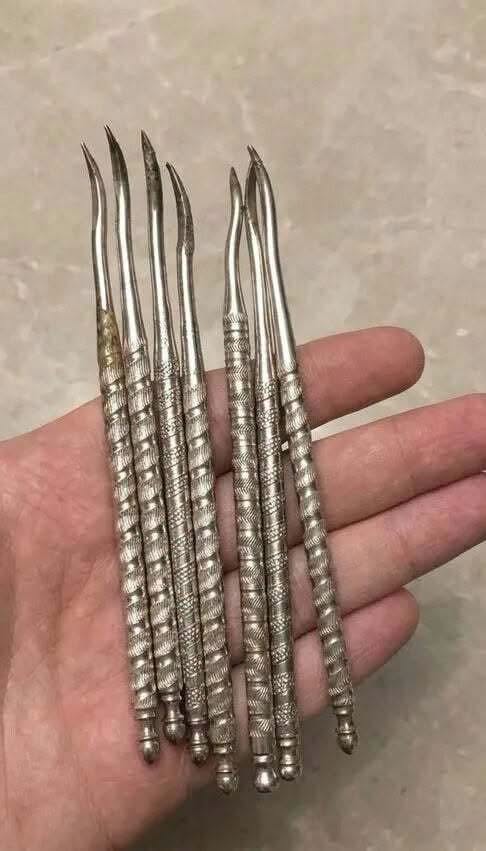
During the mid-twentieth century, wooden nut bowls were popular additions to dining rooms and living rooms across the United States.
Often crafted from walnut, maple, or other durable hardwoods, these bowls were designed to hold whole nuts still inside their shells.
Some featured a built-in metal nutcracker, while others came with a separate cracking tool.
The accompanying metal picks were essential to completing the process.
Before ready-to-eat packaged nuts became widely available, families frequently purchased walnuts, pecans, hazelnuts, almonds, and other varieties in their shells.
Preparing them required a little effort.
But that effort became part of the enjoyment.
What were those sharp metal picks actually for?
The pointed instruments found alongside antique nut bowls are called nut picks.
Their purpose was surprisingly simple.
After someone cracked open a nut’s hard outer shell, small pieces of edible nut meat often remained trapped inside narrow grooves and compartments.
The nut pick allowed people to carefully extract those pieces without crushing them or wasting the food.
This was particularly useful with walnuts and pecans, whose irregular shells could make removing every piece difficult.
Some picks featured slightly curved or flattened tips to help reach awkward spaces.
What looks like a mysterious antique instrument was actually an ingenious tool for enjoying a simple snack.
And unlike many single-use modern kitchen accessories, these sturdy metal picks could last for decades.
When cracking nuts was a family tradition
For many households, cracking nuts wasn’t simply a kitchen task.
It was an evening activity.
Families would gather around the dining table or fireplace with a bowl of whole nuts, a nutcracker, and several picks.
Adults talked about their day while children practiced opening shells.
Grandparents passed along tricks for cracking walnuts without scattering fragments everywhere.
The activity required patience, but that was part of its appeal.
Rather than grabbing a handful of pre-shelled nuts from a package, everyone participated in preparing their own snack.
During holidays, particularly Thanksgiving and Christmas, decorative nut bowls were sometimes placed alongside fruit, sweets, and other treats.
They became familiar parts of seasonal gatherings.
Today, finding one in an attic or antique store can bring back vivid memories for people who grew up with them.
Why are these vintage nutcracker sets attracting attention again?
Several factors help explain their continuing appeal.
First, many vintage sets were made from durable materials, including solid hardwood and sturdy metal.
Unlike disposable kitchen accessories, well-maintained examples can remain useful for generations.
Second, collectors appreciate their craftsmanship.
Some wooden nut bowls feature elegant shapes, decorative carvings, or clever built-in cracking mechanisms.
They can serve as both practical tools and attractive tabletop decorations.
Finally, interest in whole foods and traditional food preparation has encouraged some people to reconsider older kitchen practices.
Nuts themselves provide useful nutrients, including unsaturated fats, protein, fiber, and minerals.
However, cracking nuts by hand doesn’t automatically make them healthier than properly stored, unsalted, pre-shelled nuts.
The appeal is more about freshness, control over preparation, and the experience of enjoying food at a slower pace.
Are antique nut bowls still useful today?
Absolutely.
If you discover an old wooden nut bowl with its original tools, it may still be perfectly functional.
Before using it, inspect the wood for cracks, check the metal parts for corrosion, and clean everything appropriately.
Older finishes or coatings of uncertain composition should be evaluated before the bowl is used for direct food contact.
Some collectors prefer keeping their vintage sets as decorative objects, while others enjoy bringing them back to the dinner table.
Either approach preserves a small piece of household history.
A simple object with a surprisingly meaningful past
The wooden nut bowl might seem unremarkable compared with modern kitchen appliances.
It doesn’t require electricity, complicated instructions, or expensive replacement parts.
Its purpose has remained essentially unchanged for generations.
Yet what makes it special isn’t just its usefulness.
It’s the memories attached to it.
Those mysterious little metal picks once helped families turn an ordinary handful of nuts into an evening spent talking, laughing, and sharing time together.
So if you find one of these vintage sets tucked away in an attic, don’t be too quick to dismiss it as outdated clutter.
You may be holding a small reminder of an era when even the simplest household activities created opportunities for people to gather around the same table.
{"post":118012,"page":2,"next":[{"id":118008,"title":"My husband and I booked a room during our vacation. In the hotel room, I discovered this. I\u2019ve been looking at it for half an hour now, but I still can\u2019t figure out what it is. Does anyone know? Check the first comment for the answer","url":"https:\/\/new24.info\/118008"},{"id":118004,"title":"I found this in a flooded ditch and managed to catch it, bringing it home in a jar. I honestly have no idea what it is\u2014does anyone know? The answer is in the first comment","url":"https:\/\/new24.info\/118004"},{"id":118001,"title":"Doctors reveal that eating avocado causes\u2026 See more","url":"https:\/\/new24.info\/118001"},{"id":117997,"title":"Hollywood Mourns Beloved Actor \u2026., Dead at 93\u2026.","url":"https:\/\/new24.info\/117997"},{"id":117993,"title":"-Doctors reveal that drinking coffee every morning causes\u2026 See more","url":"https:\/\/new24.info\/117993"},{"id":117989,"title":"Legendary \u2018Star Trek\u2019 and \u2018X-Men\u2019 Actor Sir Patrick Stewart Dies at 86, Leaving Behind an Unforgettable Hollywood Legacy","url":"https:\/\/new24.info\/117989"},{"id":117985,"title":"Bringing Back the Magic: The Heartwarming Return of an American Icon","url":"https:\/\/new24.info\/117985"},{"id":117981,"title":"You\u2019ve Seen One Before\u2014But Do You Know What It Really Meant?","url":"https:\/\/new24.info\/117981"},{"id":117978,"title":"Shania Twain catched heat for blonde look at awards show","url":"https:\/\/new24.info\/117978"},{"id":117974,"title":"Outside the courthouse, my ex and his mistress threw divorce papers at me, shouting, \u201cWithout me, you\u2019re nothing!\u201d Suddenly, two black SUVs arrived. An elderly man stepped out and mentioned my father\u2019s name, leaving them both speechless\u2026","url":"https:\/\/new24.info\/117974"},{"id":117969,"title":"My Sister Called My Daughter: \u201cThe Family\u2019s Little Embarrassment.\u201d When I Stood Up for Her, Mom Said: \u201cLook At You. Still Begging Us To Accept Her.\u201d","url":"https:\/\/new24.info\/117969"},{"id":117963,"title":"I Paid Cash for a Beachfront Condo for My In-Laws\u2019 Retirement\u2014Six Months Later, My Husband\u2019s First Love Opened the Door Wearing His Shirt! He Threatened Me When I Said I\u2019d Sell It\u2026","url":"https:\/\/new24.info\/117963"},{"id":117959,"title":"Abandoned at a Bus Stop Revealed a Hidden Truth About My Husband","url":"https:\/\/new24.info\/117959"},{"id":117955,"title":"Abandoned At A Cemetery He Uncovered Their Plot And Took Everything","url":"https:\/\/new24.info\/117955"},{"id":117950,"title":"Why My Arrogant Husband Regretted Mocking My Quiet Father That Saturday","url":"https:\/\/new24.info\/117950"},{"id":117946,"title":"At Dinner, My Sister-in-Law Smirked As My Husband Said, \u201cI think we should get a divorce.\u201d","url":"https:\/\/new24.info\/117946"},{"id":117942,"title":"A Woman\u2019s Father Teased Her Husband for Refusing to Remove His Gloves at Family Dinner, Calling Him \u2018Rude and Ridiculous\u2019 \u2013 But When Her Husband Finally Took One Off, Her Father Dropped His Fork and Asked, \u2018How Is This Possible?\u2019","url":"https:\/\/new24.info\/117942"},{"id":117938,"title":"How My Arrogant Former Husband Discovered My Secret Life Five Years Later","url":"https:\/\/new24.info\/117938"},{"id":117934,"title":"My Fianc\u00e9 Held His Childhood Friend\u2019s Waist During Our Engagement Toast While 400 Guests Laughed at Me. I Calmly Took Off My $90,000 Ring and Canceled Everything. He Mocked Me as a Nobody\u2014Until My Lawyer Walked In\u2026","url":"https:\/\/new24.info\/117934"},{"id":117930,"title":"My Husband Told Me to Stay Home Washing Dishes While He Took His Mistress to an Exclusive Manhattan Gala, Where He Intended to Beg a Mysterious Billionaire to Rescue His Failing Business. He","url":"https:\/\/new24.info\/117930"}]}