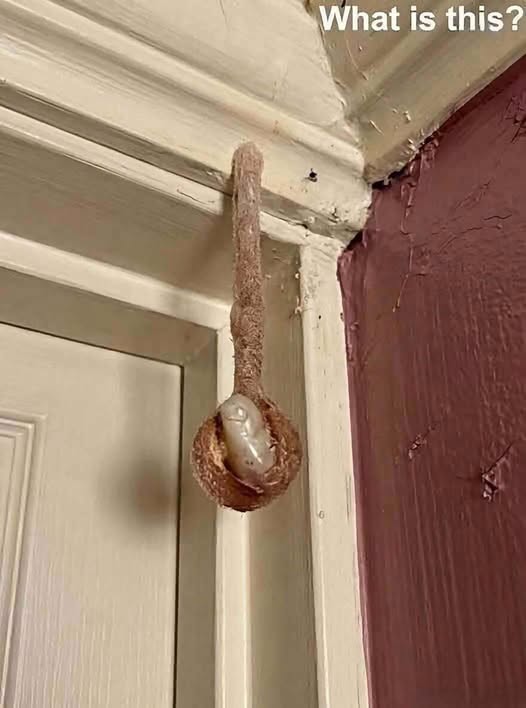
Mud daubers are a group of solitary wasps known for constructing distinctive nests from mud.
Unlike social wasps that live in large colonies, female mud daubers typically build and provision their own nests.
They collect small amounts of damp soil and shape the material into compartments that gradually harden.
Depending on the species, the finished nest may resemble a cluster of narrow tubes, small rounded chambers, or an irregular patch of dried mud attached to a surface.
These nests are often found beneath roof overhangs, inside garages, in sheds, and around other sheltered structures.
A quiet corner of a building can provide exactly the kind of protection a mud dauber needs to construct its nest.
That helps explain why one might occasionally appear somewhere unexpected, including inside a hotel room.
Why do these wasps build nests from mud?
The process is surprisingly intricate.
A female mud dauber gathers moist soil, carries it to her chosen nesting location, and gradually builds a protective chamber.
She then hunts small arthropods, often spiders, which she paralyzes and places inside the nest.
After laying an egg, she seals the chamber.
When the larva hatches, it feeds on the stored prey before eventually developing into an adult wasp.
The hardened mud helps protect the developing offspring.
For such a small insect, the construction process is an impressive example of natural behavior.
Are mud dauber wasps dangerous?
Finding an unfamiliar wasp nest inside a bedroom can understandably cause concern.
However, mud daubers are generally considered less aggressive than many social wasps.
Because they don’t defend large colonies, they are usually less likely to sting unless threatened, trapped, or handled.
That doesn’t mean visitors should attempt to remove an active nest themselves.
Wasp stings can still cause painful reactions, and people with insect-venom allergies may experience serious symptoms.
If you discover a suspected wasp nest in a hotel room, the safest approach is to avoid disturbing it and notify the staff.
How the hotel handled the discovery
In this case, the guests informed hotel employees about the unusual structure on the wall.
The staff responded promptly and arranged for the nest to be safely removed.
The room was restored, and the situation was resolved without further problems.
What could have become an unpleasant experience instead turned into one of the most memorable moments of the trip.
The visitors were fascinated by the discovery and by the fact that such an intricate natural structure could go unnoticed in an otherwise carefully maintained space.
A reminder that nature is closer than we think
Wildlife doesn’t always remain in forests, fields, or remote natural environments.
Many insects have adapted to living alongside humans, using buildings and sheltered spaces as places to rest, feed, or reproduce.
Spiders settle in quiet corners.
Swallows may construct nests beneath roofs.
And mud daubers sometimes choose walls or protected architectural features for their remarkable mud structures.
These encounters are reminders that human spaces are still connected to the natural world.
Even the cleanest, most carefully prepared room can occasionally contain evidence of a tiny visitor.
For the hotel guests, the small mark on the wall initially looked like nothing more than an overlooked cleaning detail.
But closer inspection revealed a miniature structure built with remarkable care by an insect.
The nest was removed safely, and the guests continued their stay.
Yet the unexpected discovery remained one of their most vivid vacation memories.
Sometimes, the smallest things we notice in an unfamiliar place turn out to have the most fascinating stories behind them.
{"post":118008,"page":2,"next":[{"id":118004,"title":"I found this in a flooded ditch and managed to catch it, bringing it home in a jar. I honestly have no idea what it is\u2014does anyone know? The answer is in the first comment","url":"https:\/\/new24.info\/118004"},{"id":118001,"title":"Doctors reveal that eating avocado causes\u2026 See more","url":"https:\/\/new24.info\/118001"},{"id":117997,"title":"Hollywood Mourns Beloved Actor \u2026., Dead at 93\u2026.","url":"https:\/\/new24.info\/117997"},{"id":117993,"title":"-Doctors reveal that drinking coffee every morning causes\u2026 See more","url":"https:\/\/new24.info\/117993"},{"id":117989,"title":"Legendary \u2018Star Trek\u2019 and \u2018X-Men\u2019 Actor Sir Patrick Stewart Dies at 86, Leaving Behind an Unforgettable Hollywood Legacy","url":"https:\/\/new24.info\/117989"},{"id":117985,"title":"Bringing Back the Magic: The Heartwarming Return of an American Icon","url":"https:\/\/new24.info\/117985"},{"id":117981,"title":"You\u2019ve Seen One Before\u2014But Do You Know What It Really Meant?","url":"https:\/\/new24.info\/117981"},{"id":117978,"title":"Shania Twain catched heat for blonde look at awards show","url":"https:\/\/new24.info\/117978"},{"id":117974,"title":"Outside the courthouse, my ex and his mistress threw divorce papers at me, shouting, \u201cWithout me, you\u2019re nothing!\u201d Suddenly, two black SUVs arrived. An elderly man stepped out and mentioned my father\u2019s name, leaving them both speechless\u2026","url":"https:\/\/new24.info\/117974"},{"id":117969,"title":"My Sister Called My Daughter: \u201cThe Family\u2019s Little Embarrassment.\u201d When I Stood Up for Her, Mom Said: \u201cLook At You. Still Begging Us To Accept Her.\u201d","url":"https:\/\/new24.info\/117969"},{"id":117963,"title":"I Paid Cash for a Beachfront Condo for My In-Laws\u2019 Retirement\u2014Six Months Later, My Husband\u2019s First Love Opened the Door Wearing His Shirt! He Threatened Me When I Said I\u2019d Sell It\u2026","url":"https:\/\/new24.info\/117963"},{"id":117959,"title":"Abandoned at a Bus Stop Revealed a Hidden Truth About My Husband","url":"https:\/\/new24.info\/117959"},{"id":117955,"title":"Abandoned At A Cemetery He Uncovered Their Plot And Took Everything","url":"https:\/\/new24.info\/117955"},{"id":117950,"title":"Why My Arrogant Husband Regretted Mocking My Quiet Father That Saturday","url":"https:\/\/new24.info\/117950"},{"id":117946,"title":"At Dinner, My Sister-in-Law Smirked As My Husband Said, \u201cI think we should get a divorce.\u201d","url":"https:\/\/new24.info\/117946"},{"id":117942,"title":"A Woman\u2019s Father Teased Her Husband for Refusing to Remove His Gloves at Family Dinner, Calling Him \u2018Rude and Ridiculous\u2019 \u2013 But When Her Husband Finally Took One Off, Her Father Dropped His Fork and Asked, \u2018How Is This Possible?\u2019","url":"https:\/\/new24.info\/117942"},{"id":117938,"title":"How My Arrogant Former Husband Discovered My Secret Life Five Years Later","url":"https:\/\/new24.info\/117938"},{"id":117934,"title":"My Fianc\u00e9 Held His Childhood Friend\u2019s Waist During Our Engagement Toast While 400 Guests Laughed at Me. I Calmly Took Off My $90,000 Ring and Canceled Everything. He Mocked Me as a Nobody\u2014Until My Lawyer Walked In\u2026","url":"https:\/\/new24.info\/117934"},{"id":117930,"title":"My Husband Told Me to Stay Home Washing Dishes While He Took His Mistress to an Exclusive Manhattan Gala, Where He Intended to Beg a Mysterious Billionaire to Rescue His Failing Business. He","url":"https:\/\/new24.info\/117930"},{"id":117925,"title":"Uncovering A Hidden Family Fortune After A Heartbreaking Betrayal Of Trust","url":"https:\/\/new24.info\/117925"}]}