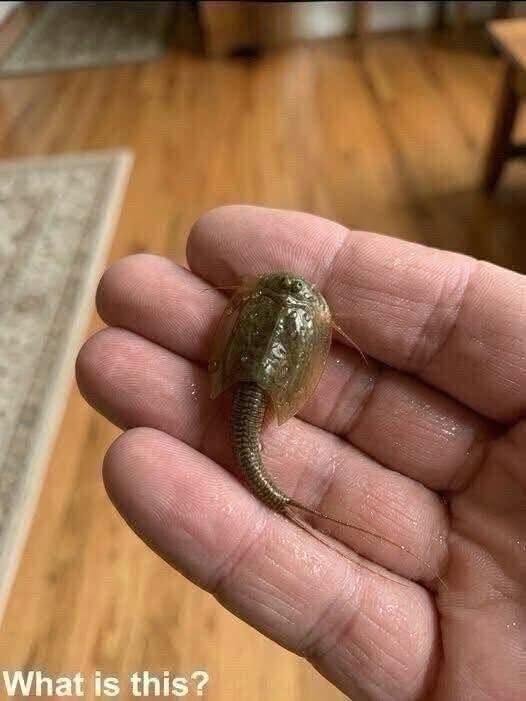
Based on the description, one possible explanation is a freshwater mite, a tiny aquatic arachnid belonging to a group commonly called water mites.
These fascinating creatures inhabit ponds, streams, wetlands, and other freshwater environments.
Although they are related to spiders and ticks, water mites spend much of their lives in water.
Adults typically have eight legs and a compact, rounded body.
Some species move surprisingly quickly, using their legs to paddle through the water.
Their unusual movements can make them appear much larger or stranger than they actually are when observed inside a glass container.
Water mites come in several colors, including red, orange, brown, and greenish shades.
Their tiny size and rapid swimming movements can easily make someone mistake them for an unfamiliar or mysterious insect.
However, without a clear photograph or closer examination, the creature’s exact identity cannot be confirmed.
Why would one appear after heavy rainfall?
Rainstorms can temporarily transform ordinary ditches, depressions, and low-lying areas into small aquatic habitats.
Water moving across the landscape may carry tiny organisms from nearby ponds, soil, vegetation, or established waterways.
Once the water begins settling, these creatures can become easier to notice.
A drainage ditch that looks empty during dry weather may suddenly contain an assortment of tiny living organisms after prolonged rainfall.
Some are aquatic insects.
Others are small crustaceans, mites, or microscopic animals.
Many play important roles in freshwater ecosystems.
Are water mites dangerous?
Their appearance may be unsettling, especially when viewed up close.
But most freshwater mites encountered in ponds and streams are not considered a threat to people.
Many species feed on small aquatic organisms, while certain life stages live temporarily as parasites on aquatic insects.
They also form part of the food web, providing nourishment for other aquatic animals.
Their presence is generally a normal part of freshwater biodiversity.
Still, water collected from storm drains and roadside ditches should be handled carefully.
Even if the creature itself is harmless, stormwater can contain bacteria, chemicals, and other contaminants.
It’s sensible to avoid direct contact with dirty water and wash your hands thoroughly after handling samples.
A miniature world hiding in plain sight
One of the most fascinating things about freshwater environments is how much life they contain that people rarely notice.
A shallow puddle can support an entire miniature ecosystem.
Tiny predators search for food.
Aquatic insects move between submerged leaves.
Microscopic organisms feed on organic material.
And creatures no bigger than a grain of rice navigate through a world that looks completely different from our own.
The homeowner’s discovery is a reminder that even familiar places can contain unexpected surprises.
What appeared to be nothing more than a muddy ditch after a storm became an opportunity to observe a remarkable form of aquatic life.
The mysterious creature may have been a freshwater mite, but identifying it with certainty would require a clearer view of its body and legs.
And perhaps that’s the most interesting part of the discovery.
Sometimes, you don’t need to travel to a rainforest or explore the ocean to encounter unfamiliar wildlife.
An entire world of tiny creatures may be living in the rainwater just outside your home.
{"post":118004,"page":2,"next":[{"id":118001,"title":"Doctors reveal that eating avocado causes\u2026 See more","url":"https:\/\/new24.info\/118001"},{"id":117997,"title":"Hollywood Mourns Beloved Actor \u2026., Dead at 93\u2026.","url":"https:\/\/new24.info\/117997"},{"id":117993,"title":"-Doctors reveal that drinking coffee every morning causes\u2026 See more","url":"https:\/\/new24.info\/117993"},{"id":117989,"title":"Legendary \u2018Star Trek\u2019 and \u2018X-Men\u2019 Actor Sir Patrick Stewart Dies at 86, Leaving Behind an Unforgettable Hollywood Legacy","url":"https:\/\/new24.info\/117989"},{"id":117985,"title":"Bringing Back the Magic: The Heartwarming Return of an American Icon","url":"https:\/\/new24.info\/117985"},{"id":117981,"title":"You\u2019ve Seen One Before\u2014But Do You Know What It Really Meant?","url":"https:\/\/new24.info\/117981"},{"id":117978,"title":"Shania Twain catched heat for blonde look at awards show","url":"https:\/\/new24.info\/117978"},{"id":117974,"title":"Outside the courthouse, my ex and his mistress threw divorce papers at me, shouting, \u201cWithout me, you\u2019re nothing!\u201d Suddenly, two black SUVs arrived. An elderly man stepped out and mentioned my father\u2019s name, leaving them both speechless\u2026","url":"https:\/\/new24.info\/117974"},{"id":117969,"title":"My Sister Called My Daughter: \u201cThe Family\u2019s Little Embarrassment.\u201d When I Stood Up for Her, Mom Said: \u201cLook At You. Still Begging Us To Accept Her.\u201d","url":"https:\/\/new24.info\/117969"},{"id":117963,"title":"I Paid Cash for a Beachfront Condo for My In-Laws\u2019 Retirement\u2014Six Months Later, My Husband\u2019s First Love Opened the Door Wearing His Shirt! He Threatened Me When I Said I\u2019d Sell It\u2026","url":"https:\/\/new24.info\/117963"},{"id":117959,"title":"Abandoned at a Bus Stop Revealed a Hidden Truth About My Husband","url":"https:\/\/new24.info\/117959"},{"id":117955,"title":"Abandoned At A Cemetery He Uncovered Their Plot And Took Everything","url":"https:\/\/new24.info\/117955"},{"id":117950,"title":"Why My Arrogant Husband Regretted Mocking My Quiet Father That Saturday","url":"https:\/\/new24.info\/117950"},{"id":117946,"title":"At Dinner, My Sister-in-Law Smirked As My Husband Said, \u201cI think we should get a divorce.\u201d","url":"https:\/\/new24.info\/117946"},{"id":117942,"title":"A Woman\u2019s Father Teased Her Husband for Refusing to Remove His Gloves at Family Dinner, Calling Him \u2018Rude and Ridiculous\u2019 \u2013 But When Her Husband Finally Took One Off, Her Father Dropped His Fork and Asked, \u2018How Is This Possible?\u2019","url":"https:\/\/new24.info\/117942"},{"id":117938,"title":"How My Arrogant Former Husband Discovered My Secret Life Five Years Later","url":"https:\/\/new24.info\/117938"},{"id":117934,"title":"My Fianc\u00e9 Held His Childhood Friend\u2019s Waist During Our Engagement Toast While 400 Guests Laughed at Me. I Calmly Took Off My $90,000 Ring and Canceled Everything. He Mocked Me as a Nobody\u2014Until My Lawyer Walked In\u2026","url":"https:\/\/new24.info\/117934"},{"id":117930,"title":"My Husband Told Me to Stay Home Washing Dishes While He Took His Mistress to an Exclusive Manhattan Gala, Where He Intended to Beg a Mysterious Billionaire to Rescue His Failing Business. He","url":"https:\/\/new24.info\/117930"},{"id":117925,"title":"Uncovering A Hidden Family Fortune After A Heartbreaking Betrayal Of Trust","url":"https:\/\/new24.info\/117925"},{"id":117919,"title":"Coming Home Sick Exposed My Husband and His Secret Bedroom Plan","url":"https:\/\/new24.info\/117919"}]}