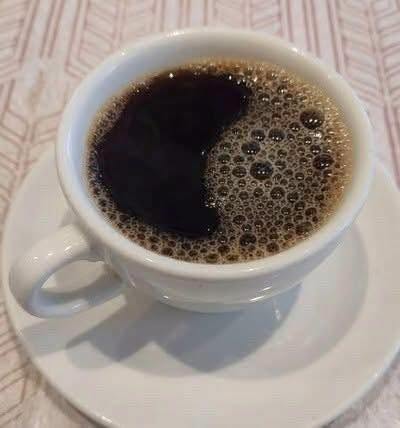
One of coffee’s most noticeable effects is its ability to increase alertness.
Coffee contains caffeine, a natural stimulant that acts on the central nervous system.
Caffeine works primarily by blocking adenosine, a chemical that helps create feelings of sleepiness.
As a result, many people experience improved concentration, greater wakefulness, and reduced feelings of fatigue after drinking coffee.
This is why a morning cup can make studying, working, or completing daily tasks feel easier.
However, the effect is temporary, and individual responses vary.
2. Your body may experience additional health benefits
Coffee contains more than caffeine.
It also provides naturally occurring compounds, including polyphenols, that have antioxidant properties.
Research has associated habitual coffee consumption with a lower risk of certain health conditions, including type 2 diabetes and some liver diseases.
Some large observational studies have also found associations between moderate coffee drinking and better long-term health outcomes.
However, these findings don’t prove that coffee itself prevents disease.
Lifestyle, genetics, diet, and other factors may influence the results.
Still, for many healthy adults, moderate coffee consumption can fit comfortably into a balanced diet.
3. Too much coffee can make you anxious
Although caffeine helps people feel awake, excessive amounts can overstimulate the nervous system.
Possible symptoms include:
- Restlessness or nervousness
- Increased anxiety
- Shaky hands
- A racing heartbeat or palpitations
- Difficulty relaxing
People differ significantly in their sensitivity to caffeine.
Some can comfortably drink several cups, while others experience unpleasant symptoms after a single strong coffee.
If your morning coffee regularly leaves you feeling jittery or uncomfortable, reducing the serving size or choosing a lower-caffeine option may help.
4. Coffee can affect your digestive system
Some people experience stomach discomfort after drinking coffee, particularly if they are prone to acid reflux or heartburn.
Coffee can stimulate gastric acid secretion and may aggravate symptoms in susceptible individuals.
However, drinking coffee on an empty stomach isn’t automatically harmful for everyone.
If you notice discomfort, try drinking it with breakfast or reducing the amount.
The important thing is to pay attention to your body’s response rather than assuming everyone reacts the same way.
5. Your body can become accustomed to caffeine
Have you ever skipped your usual morning coffee and developed a headache by lunchtime?
There’s a reason.
Regular caffeine consumption can lead to physical dependence.
When someone who regularly consumes caffeine suddenly stops, they may experience withdrawal symptoms such as headaches, tiredness, irritability, and difficulty concentrating.
These symptoms are usually temporary, but they can be unpleasant.
This doesn’t necessarily mean you have an addiction. It means your body has adapted to regular caffeine exposure.
Gradually reducing caffeine intake can help minimize withdrawal symptoms.
6. Your morning coffee could affect your sleep later
Caffeine can remain active in the body for hours after consumption.
Its effects on sleep depend on the amount consumed, individual metabolism, and the time of day.
Even if you fall asleep easily, caffeine consumed too late may reduce sleep quality.
Poor sleep can then increase daytime tiredness, encouraging you to drink more coffee.
For people sensitive to caffeine, avoiding it in the afternoon and evening may improve rest.
How much coffee is considered safe?
For most healthy adults, the U.S. Food and Drug Administration cites 400 milligrams of caffeine per day as an amount not generally associated with dangerous negative effects.
That isn’t necessarily equivalent to three cups, because caffeine content varies considerably by serving size, bean, and brewing method.
Pregnant individuals and people with certain medical conditions may need lower limits and should seek personalized medical advice.
Choosing coffee with little added sugar and avoiding excessive high-calorie toppings can also make your daily habit more balanced.
The bottom line
Drinking coffee every morning isn’t inherently unhealthy.
In fact, moderate consumption may provide improved alertness and can be part of a healthy lifestyle.
But problems may arise when caffeine intake becomes excessive, disrupts sleep, worsens anxiety, or aggravates digestive symptoms.
The most important consideration isn’t simply whether you drink coffee every morning—it’s how much you drink and how your body responds.
For many people, that familiar morning cup can remain an enjoyable daily ritual.
The key is knowing when one more cup might be one too many.
{"post":117993,"page":2,"next":[{"id":117989,"title":"Legendary \u2018Star Trek\u2019 and \u2018X-Men\u2019 Actor Sir Patrick Stewart Dies at 86, Leaving Behind an Unforgettable Hollywood Legacy","url":"https:\/\/new24.info\/117989"},{"id":117985,"title":"Bringing Back the Magic: The Heartwarming Return of an American Icon","url":"https:\/\/new24.info\/117985"},{"id":117981,"title":"You\u2019ve Seen One Before\u2014But Do You Know What It Really Meant?","url":"https:\/\/new24.info\/117981"},{"id":117978,"title":"Shania Twain catched heat for blonde look at awards show","url":"https:\/\/new24.info\/117978"},{"id":117974,"title":"Outside the courthouse, my ex and his mistress threw divorce papers at me, shouting, \u201cWithout me, you\u2019re nothing!\u201d Suddenly, two black SUVs arrived. An elderly man stepped out and mentioned my father\u2019s name, leaving them both speechless\u2026","url":"https:\/\/new24.info\/117974"},{"id":117969,"title":"My Sister Called My Daughter: \u201cThe Family\u2019s Little Embarrassment.\u201d When I Stood Up for Her, Mom Said: \u201cLook At You. Still Begging Us To Accept Her.\u201d","url":"https:\/\/new24.info\/117969"},{"id":117963,"title":"I Paid Cash for a Beachfront Condo for My In-Laws\u2019 Retirement\u2014Six Months Later, My Husband\u2019s First Love Opened the Door Wearing His Shirt! He Threatened Me When I Said I\u2019d Sell It\u2026","url":"https:\/\/new24.info\/117963"},{"id":117959,"title":"Abandoned at a Bus Stop Revealed a Hidden Truth About My Husband","url":"https:\/\/new24.info\/117959"},{"id":117955,"title":"Abandoned At A Cemetery He Uncovered Their Plot And Took Everything","url":"https:\/\/new24.info\/117955"},{"id":117950,"title":"Why My Arrogant Husband Regretted Mocking My Quiet Father That Saturday","url":"https:\/\/new24.info\/117950"},{"id":117946,"title":"At Dinner, My Sister-in-Law Smirked As My Husband Said, \u201cI think we should get a divorce.\u201d","url":"https:\/\/new24.info\/117946"},{"id":117942,"title":"A Woman\u2019s Father Teased Her Husband for Refusing to Remove His Gloves at Family Dinner, Calling Him \u2018Rude and Ridiculous\u2019 \u2013 But When Her Husband Finally Took One Off, Her Father Dropped His Fork and Asked, \u2018How Is This Possible?\u2019","url":"https:\/\/new24.info\/117942"},{"id":117938,"title":"How My Arrogant Former Husband Discovered My Secret Life Five Years Later","url":"https:\/\/new24.info\/117938"},{"id":117934,"title":"My Fianc\u00e9 Held His Childhood Friend\u2019s Waist During Our Engagement Toast While 400 Guests Laughed at Me. I Calmly Took Off My $90,000 Ring and Canceled Everything. He Mocked Me as a Nobody\u2014Until My Lawyer Walked In\u2026","url":"https:\/\/new24.info\/117934"},{"id":117930,"title":"My Husband Told Me to Stay Home Washing Dishes While He Took His Mistress to an Exclusive Manhattan Gala, Where He Intended to Beg a Mysterious Billionaire to Rescue His Failing Business. He","url":"https:\/\/new24.info\/117930"},{"id":117925,"title":"Uncovering A Hidden Family Fortune After A Heartbreaking Betrayal Of Trust","url":"https:\/\/new24.info\/117925"},{"id":117919,"title":"Coming Home Sick Exposed My Husband and His Secret Bedroom Plan","url":"https:\/\/new24.info\/117919"},{"id":117915,"title":"Stopping One Hundred Seventy Four Payments Unlocked A Hidden Family Legacy","url":"https:\/\/new24.info\/117915"},{"id":117911,"title":"Executives Laughed at Her Worn Shoes Until She Solved Their Impossible Problem","url":"https:\/\/new24.info\/117911"},{"id":117906,"title":"I Abandoned My Pregnant Wife for My Mistress, Then Came Home to Two Tiny Blue Socks and a Letter That Destr0yed Me","url":"https:\/\/new24.info\/117906"}]}