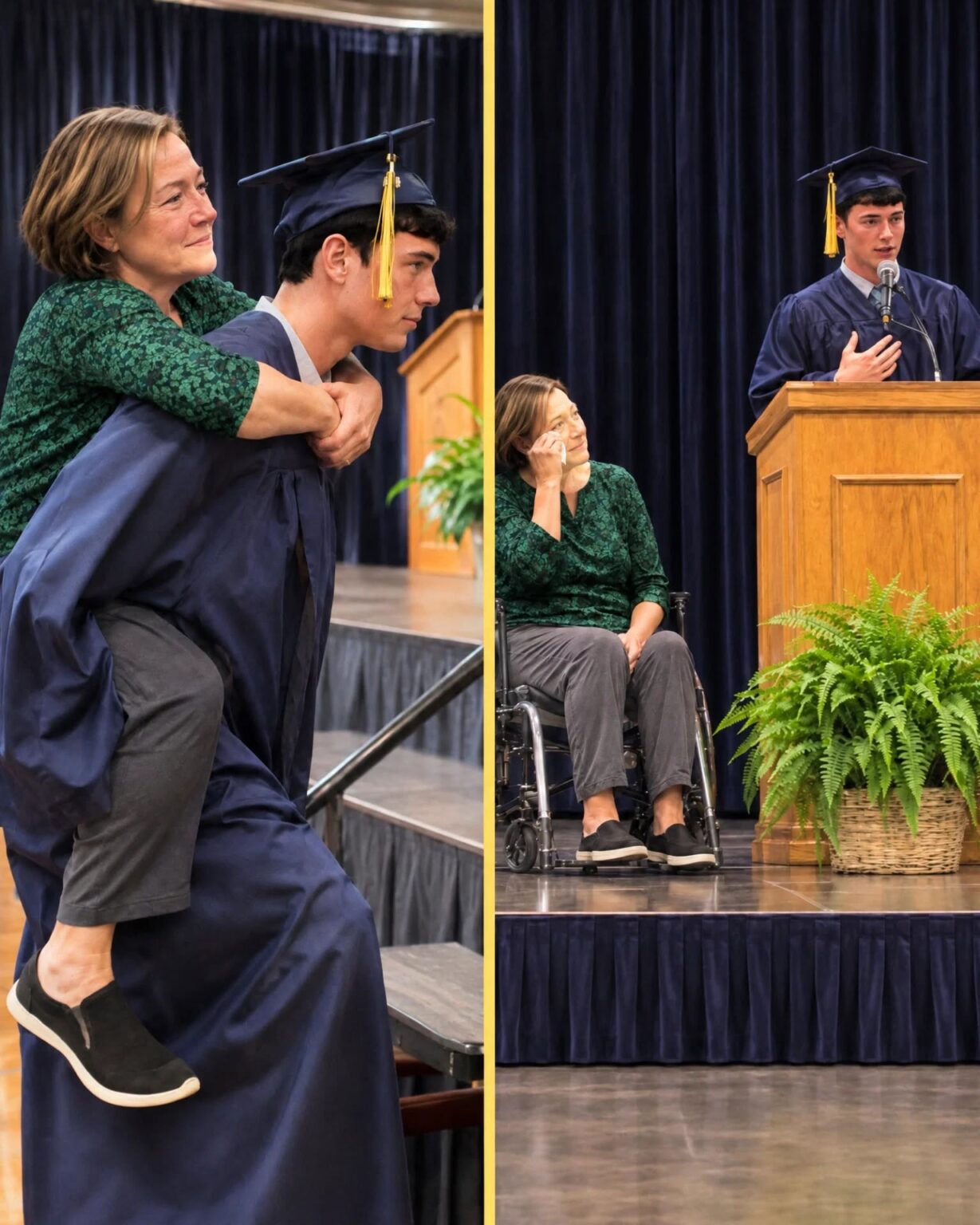
Moments earlier, he’d surprised everyone by lifting me out of my wheelchair and carrying me up the steps.
Now he was looking directly at me, his eyes filling with tears.
“I need to tell you something,” he continued.
I smiled nervously.
“What is it, sweetheart?”
He swallowed.
“Mom, I almost didn’t graduate.”
My smile disappeared.
“What?”
Caleb had always been an excellent student.
He’d earned good grades, worked hard, and dreamed of going to college.
I couldn’t imagine what he meant.
Then he began explaining what he’d been doing for the past year.
And by the time he finished, I was crying so hard I could barely see him.
My name is Margaret.
I’m fifty-one years old, and I’ve used a wheelchair since my son was twelve.
A terrible car accident left me paralyzed from the waist down.
I still remember waking up in the hospital and hearing the doctors explain that I would never walk again.
But losing my ability to walk wasn’t the only thing that changed.
My husband, Daniel, decided he couldn’t handle our new life.
“This isn’t what I signed up for,” he told me.
“I deserve something different.”
Then he left.
Just like that.
I was a newly disabled mother with a twelve-year-old boy and no idea how we would survive.
I had to relearn almost everything.
Cooking.
Cleaning.
Shopping.
Managing our home.
Eventually, I found a remote job handling customer accounts.
The pay wasn’t wonderful, but it allowed me to support us.
Money was always tight.
Some months, I had to decide which bills could wait until my next paycheck.
Caleb occasionally asked why we couldn’t take vacations like his friends.
I’d explain that we needed to save money.
He always smiled.
“That’s okay, Mom. We can have fun at home.”
Then we’d make popcorn and watch movies together.
I thought I was doing a reasonable job of protecting him from our financial worries.
I had no idea he’d been quietly carrying them himself.
By his senior year, Caleb was one of the most responsible students in his class.
He’d started working part-time at a nearby grocery store.
At first, he worked only a few afternoons and weekends.
I wasn’t thrilled.
I wanted him to concentrate on school.
But he insisted.
“Mom, I like earning my own money.”
Then he’d smile and change the subject.
Around October, I noticed he was coming home later.
Sometimes after nine at night.
He’d eat leftovers, open his textbooks, and study for hours.
More than once, I woke up at midnight and found his bedroom light still on.
One morning, I discovered him asleep at the kitchen table.
His head was resting on an open textbook.
“Caleb, sweetheart, you can’t keep exhausting yourself.”
He sat up quickly.
“I’m fine, Mom.”
“You need sleep.”
“I know. I’ve just got college applications and scholarship essays.”
It sounded reasonable.
So I believed him.
But as the months passed, I grew worried.
He lost weight.
Stopped spending much time with friends.
And sometimes looked so tired that I wondered whether he was sick.
I suggested he take a break from work.
He refused.
“My grades are fine, Mom. Please don’t worry.”
A few weeks before graduation, his English teacher, Grace, emailed me.
She wanted to discuss Caleb.
My stomach tightened when I called her.
“Is something wrong?”
She reassured me that Caleb was on track to graduate.
But she also said he’d experienced an unusually difficult year.
“Please make sure he’s getting enough rest,” she added.
I promised I would.
Then graduation day arrived.
It was a beautiful sunny morning.
I wore my favorite blue blouse with tiny white flowers.
When Caleb entered my bedroom in his graduation gown, I almost burst into tears.
“How do I look, Mom?”
I smiled.
“Like someone who’s about to make me incredibly proud.”
He laughed.
“I think I’ve already done that.”
We arrived at the school early.
I found a place near the stage while Caleb joined his classmates.
His friends Ethan and Marcus were sitting beside him.
He seemed nervous, but I assumed it was excitement.
When the ceremony began, I couldn’t stop taking pictures.
Then the principal started calling graduates’ names.
Finally, I heard:
“Caleb!”
I raised my phone.
My son stood and walked toward the stage.
But halfway there, he suddenly changed direction.
He came straight toward me.
“Caleb? What are you doing?”
He knelt beside my wheelchair.
“Mom, I want you up there with me.”
I stared at him.
“Sweetheart, this is your moment.”
He smiled.
“Then we’re sharing it.”
Before I could argue, he carefully helped me onto his back.
I wrapped my arms around his shoulders.
And my son carried me up the stage steps.
His friends followed with my wheelchair.
When we reached the platform, Caleb gently helped me sit down again.
The audience began applauding.
I was laughing and crying at the same time.
Principal Robert handed Caleb his diploma.
Then someone passed him a microphone.
Caleb looked toward the crowd.
“Excuse me, everyone. There’s something I need to say.”
The auditorium grew quiet.
He turned toward me.
“Mom, I haven’t been completely honest with you.”
My heart began racing.
“What happened?”
He took a breath.
“I came dangerously close to not graduating.”
I couldn’t believe it.
He explained that the previous summer, he’d started accepting extra shifts at the grocery store.
At first, just a few hours.
Then several evenings a week.
Sometimes he worked until closing.
“Caleb,” I interrupted, “you told me you only worked weekends.”
He lowered his head.
“I know, Mom. I’m sorry.”
After work, he’d come home and study late into the night.
The exhaustion eventually caught up with him.
He began falling asleep during lessons.
Missing assignments.
Struggling to maintain his grades.
His English teacher, Grace, noticed first.
Then his mathematics teacher, Thomas.
By the time they understood what was happening, Caleb was behind in two subjects and close to missing graduation requirements.
They helped him develop a recovery plan.
But he refused to tell me.
I stared at him.
“Why, sweetheart? Why didn’t you ask me for help?”
He looked down.
Then asked something unexpected.
“Mom, do you remember when Aunt Linda came over last spring?”
I nodded slowly.
My younger sister had visited for coffee.
We’d talked about how expensive college was becoming.
Tuition.
Housing.
Textbooks.
Transportation.
I’d admitted how worried I was about paying for Caleb’s education.
I also told Linda that I wished I could work fewer hours one day.
But I couldn’t see how that would be possible.
I thought Caleb had been upstairs doing homework.
Apparently, he’d heard everything.
“You said you were exhausted,” he whispered.
“And that you couldn’t slow down because you had to help me through college.”
I covered my mouth.
“Caleb…”
He continued.
“Mom, I didn’t want you to spend the rest of your life working yourself to exhaustion because of me.”
His voice broke.
“So I started taking extra shifts.”
I shook my head.
He explained that he wasn’t saving for a new phone.
Or clothes.
Or a car.
He’d been saving for me.
He wanted to give me enough money to reduce my working hours after he left for college.
“I know it’s not enough for you to retire,” he said.
“But maybe you could rest a little more.”
Tears were streaming down my face.
For years, I’d worried that my accident had taken opportunities away from my son.
Now I was discovering he’d nearly sacrificed his health and education trying to protect me.
Then Caleb reached into his graduation gown.
“But that’s not all.”
He unfolded a sheet of paper.
“I knew I couldn’t earn enough money to pay for college, so I started applying for scholarships.”
He paused.
“Actually, I applied to fifty colleges.”
I blinked.
“Fifty?”
He nodded.
He’d spent months researching schools, writing essays, gathering recommendations, and completing applications.
Some colleges rejected him.
Others offered partial financial assistance.
His teachers had helped him organize the process while encouraging him to cut back his work hours.
Then Caleb looked toward Grace and Thomas.
“Thank you for helping me when I didn’t know how to ask for help.”
Grace was already wiping her eyes.
He turned back toward me.
“Mom, I wanted to wait until I knew everything would work out.”
Then he raised the paper.
“Of the fifty colleges I applied to, twenty offered me full scholarships.”
The auditorium fell silent.
I stared at him.
“Twenty?”
He smiled through his tears.
“Twenty, Mom.”
He explained that the scholarships covered tuition, housing, meals, and other major expenses.
I couldn’t speak.
All those years worrying about how we’d afford college.
And now my son was standing on a stage, telling me he had twenty fully funded opportunities.
He still had to choose which offer to accept.
But the enormous financial burden I’d been fearing had suddenly become much smaller.
The audience began applauding.
I was crying uncontrollably.
Then Caleb knelt beside my wheelchair.
“Mom, remember when you came to every school event, even when it was difficult?”
I nodded.
“And when you worked late but still helped me with homework?”
“Of course, sweetheart.”
He squeezed my hand.
“You did all of that for me.”
His voice trembled.
“I know I made mistakes. I should’ve told you how tired I was. I shouldn’t have let my grades suffer.”
Then he stood and addressed the audience.
“My mom raised me alone after my dad left.”
He glanced at me.
“She had to relearn how to do almost everything after her accident. But she never stopped taking care of me.”
He continued.
“She made sure I had food, clothes, school supplies, and someone cheering for me.”
His eyes filled again.
“People congratulate me for working hard.”
He paused.
“But my mom worked hard for years before I even understood what sacrifice meant.”
I covered my face.
Then he turned toward me.
“Mom, you spent your life making sure I had a future.”
He smiled.
“Now I want you to enjoy yours, too.”
And then he said the words I’ll remember forever.
“This isn’t just my graduation. It’s ours.”
For a moment, nobody moved.
Then Grace stood.
Thomas followed.
Principal Robert wiped his eyes and rose.
Within seconds, the entire auditorium was on its feet.
People applauded.
Cheered.
Cried.
Caleb put down the microphone and wrapped his arms around me.
I held him as tightly as I could.
“I’m so proud of you,” I whispered.
He hugged me closer.
“I’m proud of you too, Mom.”
After the ceremony, several teachers approached us.
Grace told me Caleb was one of the most determined students she’d ever taught.
But she also admitted she’d been genuinely frightened by his exhaustion.
I thanked her for helping him recover his grades.
That evening, Caleb and I sat at our kitchen table.
All twenty scholarship offers were spread out in front of us.
We reviewed the details together.
Tuition.
Housing.
Meal plans.
Other expenses.
Every letter seemed more incredible than the last.
Finally, I closed the folder.
“Caleb, I need to tell you something.”
He looked up.
I reached across the table and held his hand.
“I’m grateful beyond words for everything you’ve done.”
He smiled.
“But I never wanted you to make yourself sick trying to take care of me.”
His expression changed.
“I know, Mom.”
“No, sweetheart. Listen.”
I squeezed his hand.
“Your job was never to save me. Your job was to be my son.”
His eyes filled.
“You were supposed to study, spend time with friends, and enjoy being young.”
He looked down.
“I just hated seeing you so tired.”
“I know. And I love you for caring.”
I paused.
“But I’m still your mother. I can make decisions about my own life. And if I need help, I’ll ask.”
Then I added:
“And if you’re struggling, you have to tell me.”
He nodded.
“No more secrets?”
“No more secrets,” I replied.
We spent the next hour comparing universities.
At one point, Caleb hesitated over an excellent college because it was far from home.
“Do you want to go there?” I asked.
He nodded.
“A lot.”
“Then why are you hesitating?”
He looked at my wheelchair.
“I don’t want to leave you alone.”
My heart tightened.
“Caleb, look at me.”
He did.
“You are not responsible for giving up your future to protect mine.”
He started to protest.
I smiled.
“I’m capable of taking care of myself. And you deserve to build a life you’re excited about.”
He finally smiled.
Life hasn’t magically become easy since graduation.
I still work remotely.
We still budget carefully.
And there are days when I feel exhausted.
But knowing that Caleb can attend college without overwhelming debt has changed our future.
More importantly, we’ve learned to be honest with each other about when we need help.
Last weekend, we went out for breakfast.
As we were leaving the restaurant, Caleb instinctively reached for the handles of my wheelchair.
“I’ve got you, Mom.”
I smiled and gently stopped him.
“I’m okay, sweetheart. I can manage.”
He stepped beside me.
“I know.”
Those two words meant more than he probably realized.
Because that was what I’d wanted him to understand all along.
I didn’t need him to sacrifice his own happiness to prove he loved me.
I needed him to know that I was proud of the person he was becoming.
And that he deserved a future filled with possibilities.
Sometimes I still think about graduation day.
The moment Caleb changed direction and walked toward my wheelchair.
The feeling of his arms lifting me carefully onto his back.
The applause when we reached the stage.
And the terrible fear I felt when he admitted he’d almost failed to graduate.
I was proud of his determination.
But I was heartbroken that he’d carried so much pressure alone.
The twenty scholarships were extraordinary.
The money he’d saved was touching.
But neither was the greatest gift he gave me.
The greatest gift was seeing my son step into adulthood with a future he could choose for himself.
I’d spent years believing my accident had limited the life I could give him.
That day, I realized something different.
We’d survived the hardest chapters together.
And now we were both allowed to begin new ones.
He carried me onto the graduation stage because I couldn’t walk.
But the most important thing I could do for him was make sure he knew he didn’t have to carry me through the rest of his life.
That’s what being his mother meant to me.
And that’s why, when I think about that graduation, I don’t just remember the applause.
I remember the moment I looked at my son and realized:
We’d made it. And now we both had a future worth looking forward to.
{"post":117776,"page":2,"next":[{"id":117771,"title":"Returning Home Early Exposes A Shocking Secret Beneath My Family Roof","url":"https:\/\/new24.info\/117771"},{"id":117767,"title":"I Caught My Husband Cheating And Secretly Sold Our Entire Company","url":"https:\/\/new24.info\/117767"},{"id":117763,"title":"Billionaire Husband Left For Two Days And Returned To His Buried Secrets","url":"https:\/\/new24.info\/117763"},{"id":117759,"title":"Discarded Daughter Returns To Expose Her Vain Family At A Luxury Hotel","url":"https:\/\/new24.info\/117759"},{"id":117754,"title":"My Husbands Greedy Family Demanded A Luxury Yacht So I Sold Everything","url":"https:\/\/new24.info\/117754"},{"id":117750,"title":"After my husband Zachary Lexington spent his fifth consecutive night away","url":"https:\/\/new24.info\/117750"},{"id":117746,"title":"Decades After Losing My First Love His Lookalike Returned My Promise Ring","url":"https:\/\/new24.info\/117746"},{"id":117741,"title":"I Broke My Arm and Asked My Husband to Help Care for Our Five-Month-Old Twins. Instead, He Told Me, \u201cMoms don\u2019t get days off. You wanted children, so you handle them.\u201d","url":"https:\/\/new24.info\/117741"},{"id":117737,"title":"\u201cSign over the company, apologize, and maybe we\u2019ll let you keep your job,\u201d My Mother Threatened. She and Dad Believed a Forged Agreement Would Let Them Seize My $1.2 Billion Business.","url":"https:\/\/new24.info\/117737"},{"id":117732,"title":"The Entertainment World Has Lost A Veteran Actor\u2026 See more","url":"https:\/\/new24.info\/117732"},{"id":117728,"title":"With Heavy Hearts, A Cherished Fan Favorite Says Goodbye\u2026 See more","url":"https:\/\/new24.info\/117728"},{"id":117724,"title":"The Difference Between Green Onions, Scallions, Spring Onions, and Chives Explained","url":"https:\/\/new24.info\/117724"},{"id":117719,"title":"The Kitchen Mystery","url":"https:\/\/new24.info\/117719"},{"id":117715,"title":"Look Closely \ud83d\ude31 The photographer recognized he had captured something strange after taking this picture. He didn\u2019t know how unique the photograph was until he checked it\u2026check the first comment","url":"https:\/\/new24.info\/117715"},{"id":117711,"title":"5 Items You Should Never Put Under the Sink in Your Kitchen","url":"https:\/\/new24.info\/117711"},{"id":117707,"title":"One Pizza, A Thousand Acts of Kindness","url":"https:\/\/new24.info\/117707"},{"id":117703,"title":"Easy Ooey Gooey Butter Cake \u2013 A Rich, Buttery Dessert Everyone Will Love!","url":"https:\/\/new24.info\/117703"},{"id":117698,"title":"Can You Spot the Hidden Man in This Zebra Picture? Look Closely!","url":"https:\/\/new24.info\/117698"},{"id":117694,"title":"MY HUSBAND INTRODUCED HIS SECRETARY AS HIS \u201cREAL WIFE\u201d DURING A LIVE BROADCAST. I QUIETLY MADE ONE DECISION THAT LEFT THEM STUNNED\u2026","url":"https:\/\/new24.info\/117694"},{"id":117690,"title":"A Woman Caught Her Husband Checking Into a Hotel with Another Woman While He Was Supposed to Be on a Business Trip \u2013 She Planned to Teach Him a Lesson, but Karma Got to Them First","url":"https:\/\/new24.info\/117690"}]}