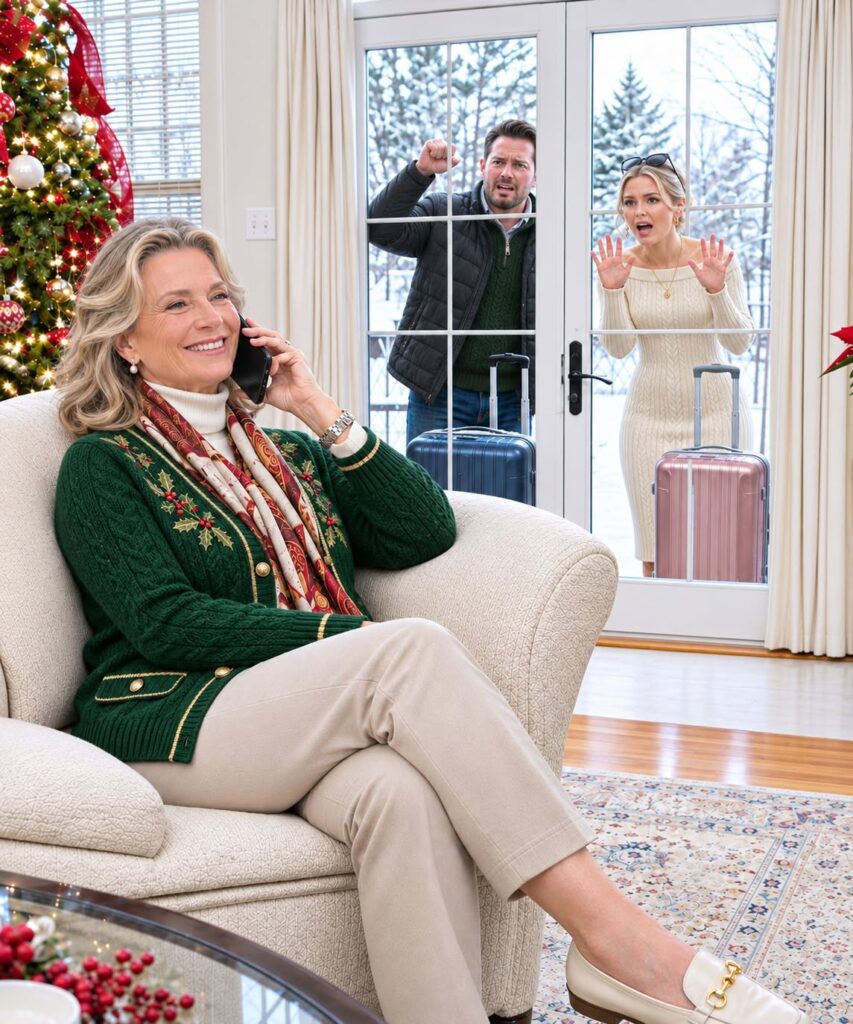
Behind him, I could hear my daughter-in-law arguing with the resort receptionist.
Her parents were apparently standing in the lobby with their luggage.
The children were asking why they couldn’t go to their rooms.
And the luxury mountain lodge I’d paid $12,500 to reserve was no longer available to them.
I took another sip of tea.
“I canceled the reservation, Caleb.”
He went silent.
Then he whispered, “You did WHAT?”
I looked toward the Christmas stockings hanging above my fireplace.
“Answer one question, sweetheart. If I wasn’t welcome on the vacation, why was my money?”
My name is Helena Whitmore.
I’m sixty-eight, a retired elementary-school principal, and I’ve been widowed for six years.
Three years ago, my son Caleb, his wife Sloan, and their two children moved into my home near Pittsburgh.
“Just until we get back on our feet, Mom,” Caleb promised.
I welcomed them.
After my husband Daniel passed away, the house had felt painfully empty.
Having my grandchildren nearby seemed like a blessing.
But three years passed.
They never paid rent.
I covered utilities, property taxes, insurance, and much of the grocery bill.
I babysat whenever they needed help.
Gradually, I noticed something changing.
Sloan began inviting guests without asking me.
Caleb filled my garage with his belongings.
And whenever I mentioned the growing household expenses, they reminded me how expensive raising children had become.
Still, I loved them.
And when Caleb mentioned that the children dreamed of spending Christmas in the mountains, I decided to surprise everyone.
I booked a beautiful seven-night vacation at an upscale mountain resort.
A luxurious chalet.
A stone fireplace.
Snow-covered trees.
Plenty of room for family.
The total cost was $12,500.
When Sloan asked whether her parents, sister, and brother-in-law could join us, I agreed.
I imagined all of us celebrating Christmas together.
But on Christmas Eve, I woke up to a strangely quiet house.
No cartoons.
No footsteps.
No grandchildren shouting for breakfast.
Caleb’s SUV was gone.
So was the rental van that had been parked outside.
Every suitcase had disappeared.
I checked my phone.
Then noticed something disturbing.
I’d been removed from our family group chat.
I called Caleb.
Sloan answered.
“Oh, Helena! We were going to call you.”
“Where is everyone?”
“We’re heading to the mountains. Things got hectic, so we left early.”
I stared at the empty driveway.
“Without me?”
She sighed.
“Please don’t make this difficult. You’ve seemed stressed lately. We thought you’d enjoy some peace and quiet.”
Peace and quiet.
I’d paid $12,500 for a family Christmas vacation.
And apparently, my absence was part of their plan.
After hanging up, I noticed a crumpled paper sticking out of the kitchen trash.
It was the resort’s room assignment list.
Caleb and Sloan had the main suite.
Sloan’s parents had a bedroom.
Her sister and husband occupied another.
The children had the bunk room.
There wasn’t a single bed reserved for me.
I checked the booking confirmation.
The reservation was in my name.
Paid with my credit card.
And because I’d booked directly with the resort, I could cancel before noon and receive a refund.
I opened my laptop.
Clicked Cancel reservation.
Confirmed my decision.
And saved the refund receipt.
Three clicks.
That was all it took.
At 2:47 that afternoon, my phone began ringing.
Caleb called.
Then Sloan.
Then Caleb again.
After fifteen missed calls, I finally answered.
“Mom! The resort says our reservation is canceled!”
“I know.”
“Why would you do that?”
I asked him the question that had been bothering me all morning.
“If you didn’t want me there, why did you expect me to pay?”
Sloan began shouting in the background.
“Tell her to fix it! My parents are standing here with all their luggage!”
Caleb lowered his voice.
“Mom, please. It’s Christmas Eve. The resort is fully booked!”
“Then you’ll need to find somewhere you can afford.”
He sounded stunned.
“But you have plenty of money!”
I closed my eyes.
That sentence told me everything.
To my son, my savings had become something he could rely on without considering my feelings.
I ended the call.
Later, the resort manager sent me an email confirming the cancellation.
But there was something else.
Three weeks earlier, Sloan had contacted the resort and requested changes to the sleeping arrangements.
She’d asked them to remove the sofa bed I’d originally reserved for myself.
When the manager questioned the change, Sloan had replied:
Helena won’t be joining us. She’s decided she’d rather spend Christmas at home.
I stared at the email.
Three weeks.
They’d planned to exclude me three weeks before the holiday.
And nobody had asked what I wanted.
That evening, I discovered another note on the refrigerator.
At the bottom of Sloan’s packing list were four handwritten words.
“Don’t mention trip upstairs.”
I placed the note inside a folder with the resort correspondence.
Then I spent Christmas Eve alone.
I made grilled cheese sandwiches and tomato soup.
The same simple dinner Daniel and I used to enjoy.
The house was quiet.
But something inside me had changed.
For the first time in years, I wasn’t rushing to solve a problem someone else had created.
On Christmas morning, Caleb called again.
He sounded exhausted.
They’d found two motel rooms.
The children were disappointed.
Sloan’s parents were furious.
“Mom, can’t you understand why we’re upset?”
“I understand perfectly,” I replied. “Do you understand why I canceled?”
“Because you felt left out.”
I shook my head.
“Caleb, I wasn’t accidentally left out. I was deliberately excluded.”
Then I told him about Sloan’s email.
He went silent.
“She told the resort you didn’t want to come?”
“Yes.”
“Mom, I didn’t know she’d done that.”
I paused.
“Did you know there wasn’t a room for me?”
He hesitated.
“Yes.”
“Did you know I hadn’t agreed to stay home?”
Another silence.
Then he whispered:
“Yes.”
I felt my heart sink.
“Then you knew enough, Caleb.”
That afternoon, my eight-year-old granddaughter Emma called.
“Grandma, are you mad at us?”
My throat tightened.
“No, sweetheart. Never at you or your brother.”
“Mom said you changed your mind about Christmas.”
I closed my eyes.
“The grown-ups had a disagreement about the vacation. That’s not your fault.”
“Can we still open presents with you?”
“Of course, sweetheart.”
After the call, I sent Caleb a message asking him not to make the children believe I’d rejected them.
He apologized.
But I knew an apology wasn’t enough.
The day after Christmas, I contacted an attorney.
I explained that my son’s family had lived in my house rent-free for three years.
I wanted to end the arrangement.
My attorney explained the legal notice requirements and the importance of giving them proper time to find housing.
I agreed.
I wasn’t going to change the locks or throw their belongings outside.
I simply wanted my home back.
Caleb and Sloan returned on December 28.
The children ran inside, excited to see their presents.
I hugged them, served lunch, and watched them open gifts.
Then, after they went downstairs, Sloan confronted me.
“I hope you’re satisfied,” she snapped.
“With what?”
“You ruined Christmas for my entire family!”
I looked at her.
“You took a vacation I paid for and deliberately excluded me. What did you expect?”
She folded her arms.
“We thought you’d be more comfortable staying home.”
“Then why didn’t you ask?”
Her answer came instantly.
“Because you would’ve insisted on coming!”
The room fell silent.
I nodded slowly.
“Thank you for finally admitting it.”
Then I placed a folder on the kitchen table.
Inside was a formal notice prepared by my attorney.
Caleb stared at it.
“Mom, what’s this?”
“I’m ending our living arrangement. You’ll need to find another place.”
Sloan looked furious.
“You can’t be serious! We have children!”
“I know. That’s why I’m giving you proper notice and time to make arrangements.”
Caleb stared at the document.
“But Mom, this is our home.”
I looked around the kitchen Daniel and I had renovated together.
“It’s the home I’ve allowed you to live in. And now I need it back.”
Sloan stormed out.
Caleb remained sitting at the table.
Later that evening, he knocked on my bedroom door.
“Mom, can we talk?”
He sat in Daniel’s old armchair.
For several minutes, he said nothing.
Then he whispered:
“I think I got used to you always being there.”
I waited.
“After Dad died, you started doing everything for us. I told myself you liked it.”
“I did like having you here,” I answered. “At first.”
He nodded.
“And then we just kept asking for more.”
His eyes filled with tears.
“I’m sorry, Mom.”
I believed him.
But I didn’t withdraw the notice.
Over the following weeks, Caleb and Sloan began searching for a rental.
I offered advice about budgeting and comparing properties.
But I refused to pay their deposit or future rent.
Eventually, they found a modest townhouse twenty minutes away.
They could afford it once they reduced unnecessary spending.
By February, they had moved.
On moving day, Caleb hugged me.
“Mom, would you still come for Sunday dinner sometimes?”
I smiled.
“If I’m invited.”
His expression changed.
“You shouldn’t have to say that.”
“No, sweetheart. I shouldn’t.”
After their moving truck disappeared, I walked through the empty downstairs rooms.
For the first time in three years, the house belonged to me again.
Not just legally.
But in the way I lived inside it.
I found the Christmas stockings packed in a box.
Caleb’s.
Sloan’s.
Emma’s.
Noah’s.
And mine.
The little red stocking with a silver H.
I’d planned to hang it at the mountain resort.
Instead, it had remained in my empty house.
I placed it carefully with my decorations.
Then began making plans I’d postponed for years.
Weekend outings with friends.
Pottery lessons.
And a few home improvements I’d wanted to make.
I was finally enjoying the retirement Daniel and I had worked so hard to build.
The following Christmas, an unexpected invitation arrived.
Caleb and Sloan wanted me to join them for Christmas Eve dinner.
Sloan had written the invitation herself.
Helena, we’d love to have you. We know last year was awful, and we want to do things differently.
I hesitated.
Then accepted.
When I arrived, Emma ran to embrace me.
The townhouse smelled of roast chicken and cinnamon.
Sloan took my coat.
“Helena, I’m glad you came.”
During dinner, she apologized.
“I was wrong about the vacation. I knew you wanted to come, but I told myself it didn’t matter because you could afford it.”
I looked at her.
“It wasn’t the money that hurt the most.”
She nodded.
“I understand that now.”
The dinner was simple.
Nobody asked me to pay for anything.
Nobody requested help with bills.
They simply wanted me at the table.
Afterward, Caleb handed me a photograph of the family standing beside their Christmas tree.
On the back, he’d written:
Thank you for helping us learn how to stand on our own.
Then Emma ran upstairs.
She returned carrying a little red Christmas stocking.
A slightly crooked silver H was embroidered on the front.
“Grandma, I made this for you!”
I pressed it against my chest.
“It’s beautiful, sweetheart.”
Emma smiled.
“So you’ll always have a stocking at our house.”
I began crying.
Not because of the money I’d spent.
Or the trip we’d lost.
But because, for the first time in a long while, someone had included me without expecting anything in return.
That evening, I drove home to my peaceful house.
I hung Emma’s stocking beside the fireplace.
Then settled into Daniel’s favorite chair with a cup of tea.
A year earlier, I’d woken up on Christmas Eve and discovered that my family had taken the vacation I paid for without me.
They’d deleted me from the group chat.
Removed my sleeping arrangements.
And assumed I’d continue financing their lives.
I didn’t scream.
I didn’t beg.
I simply stopped paying for things that required my exclusion.
My son thought I would always be there to provide whatever his family needed, even when they no longer made room for me.
But the lesson wasn’t really about a canceled vacation.
It was about the difference between being loved and being useful.
And as I looked at the little red stocking Emma had made, I finally knew the difference.
For the first time, my family had saved me a place—not because I paid for it, but because they genuinely wanted me there.
{"post":117625,"page":2,"next":[{"id":117621,"title":"I Thought My Grandson Had Forgotten About Me, but His Graduation Speech Left Me Crying in Front of Everyone","url":"https:\/\/new24.info\/117621"},{"id":117616,"title":"Just Hours After Our Wedding, My CEO Husband Walked Into Our Bedroom Carrying His Assistant in His Arms. \u201cShe\u2019s Not Feeling Well. You Can Sleep Next Door,\u201d He Said.","url":"https:\/\/new24.info\/117616"},{"id":117612,"title":"My Husband Left Me With Five Black Babies in 1995\u2014Thirty Years Later, a DNA Test Revealed the Secret His Wealthy Mother Had Hidden for Decades.","url":"https:\/\/new24.info\/117612"},{"id":117608,"title":"My Mother-in-Law Refused Food for Three Days to Pressure Me Into Quitting My Job\u2014Then My Husband Threatened Divorce, and I Calmly Agreed to Sign. One Month Later, He Returned Begging\u2026","url":"https:\/\/new24.info\/117608"},{"id":117603,"title":"\u201cGo to a Public Hospital!\u201d My Husband Shouted While I Was Bleeding During Labor\u2014Then I Learned He\u2019d Borrowed $37,000 Using My Medical Emergency as an Excuse to Pay for His Mistress. Five Days Later, He Returned Home Expecting Me to Forgive Him\u2026","url":"https:\/\/new24.info\/117603"},{"id":117598,"title":"My Husband Took Everything in Our Divorce, Including Our House, While I Sat in Court Eight Months Pregnant, Struggling Not to Cry. His Mistress Smirked as He Leaned Toward Me and Said, \u201cLet\u2019s see how you and that baby survive without my money.\u201d","url":"https:\/\/new24.info\/117598"},{"id":117594,"title":"My Fianc\u00e9 Married His Mistress at Our Own Wedding and Ordered Me to Leave Before 214 Guests. I Walked Away Without Shedding a Tear\u2014He Had No Idea I Was the Daughter of One of America\u2019s Wealthiest Men\u2026","url":"https:\/\/new24.info\/117594"},{"id":117590,"title":"During a Family Weekend, My Husband Let His Mistress Take Over Our Bedroom, Then Watched Her Throw My Pillow Into the Hallway and Tell Me to Sleep on the Couch.","url":"https:\/\/new24.info\/117590"},{"id":117586,"title":"At Christmas, Dad called me a failure for being a single mom chasing a tech fantasy and kicked me out. He never knew my $72M company supported the entire family\u2014until I canceled every transfer.","url":"https:\/\/new24.info\/117586"},{"id":117581,"title":"My Daughter Sent Me 20 Wedding Rules\u2014Including Hiding Her Late Father\u2019s Repair-Shop Job\u2014While Still Expecting Me to Fund the Reception and Hand Her a $40,000 House Check. I Followed Her \u201cDistant Guest\u201d Rule Instead, and at 8:00 p.m. She Opened My Envelope and Found $150.","url":"https:\/\/new24.info\/117581"},{"id":117577,"title":"Wealthy Woman Hoards Discounted Turkeys Until An Intercom Announcement Changes Everything","url":"https:\/\/new24.info\/117577"},{"id":117573,"title":"One Arrogant Confession From My Husband Completely Reversed My Prison Sentence","url":"https:\/\/new24.info\/117573"},{"id":117569,"title":"Wandering Husband Returns For Dinner But Receives A Brutal Porch Eviction","url":"https:\/\/new24.info\/117569"},{"id":117565,"title":"My Husband Hid His Mother On Our Deed So I Walked Away","url":"https:\/\/new24.info\/117565"},{"id":117561,"title":"Hidden Lies Kept Us Apart Until Four Little Girls Found Me","url":"https:\/\/new24.info\/117561"},{"id":117557,"title":"Mother Uncovers Massive Corporate Deception After Husband Punishes Daughter Over Breakfast","url":"https:\/\/new24.info\/117557"},{"id":117553,"title":"Billionaire Divorce Regret Leads To A Startling Discovery Three Years Later","url":"https:\/\/new24.info\/117553"},{"id":117549,"title":"Federal Agent Daughter Uncovers Deceptive Family Scheme Against Her Elderly Father","url":"https:\/\/new24.info\/117549"},{"id":117545,"title":"Why My Nine Year Old Son Paid To Stay In Our Home","url":"https:\/\/new24.info\/117545"},{"id":117541,"title":"Husband Paid Fifty Million For Divorce Before One Call Changed Everything","url":"https:\/\/new24.info\/117541"}]}