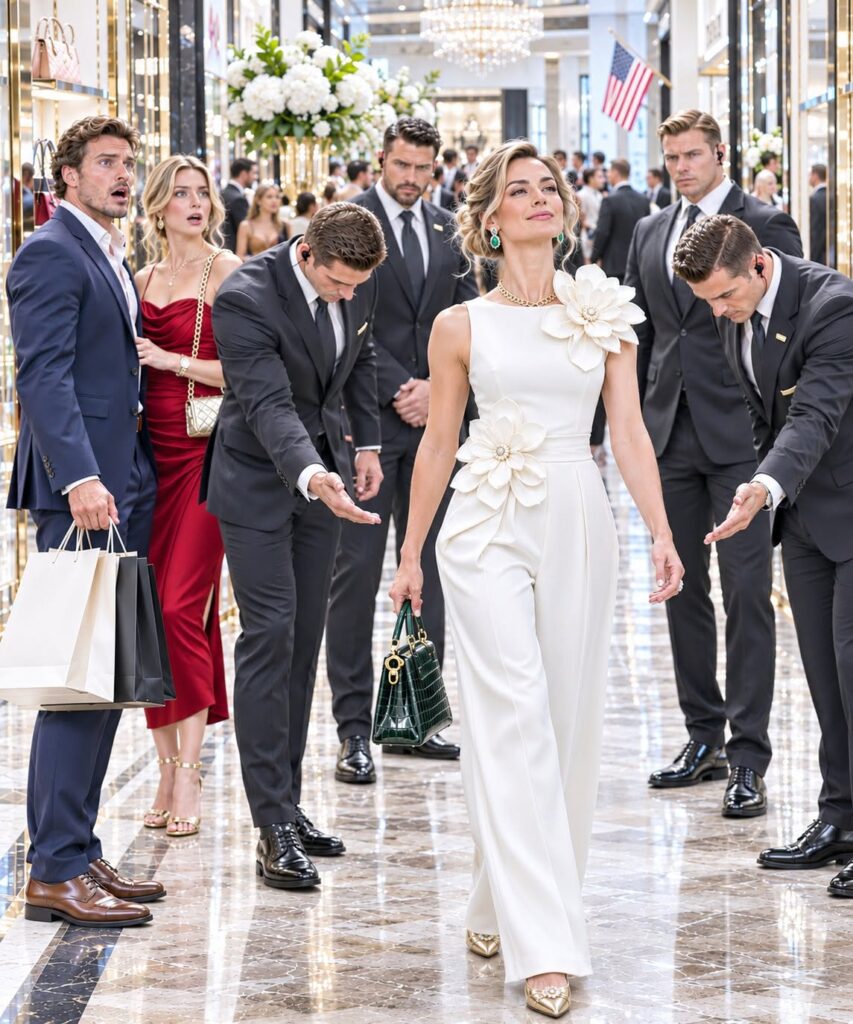
Graham Ellison stood beside his girlfriend, Brielle, gripping my wrist as though he still had the right to control me.
We’d been divorced for exactly three days.
Brielle laughed.
“Laurel, are you seriously following us?”
“I have an appointment,” I answered.
Graham looked around at the expensive boutiques.
“An appointment? Here? This isn’t the discount outlet where you buy supplies for your little purse hobby.”
Several shoppers turned to stare.
I pulled my wrist away.
“Don’t touch me again.”
His expression darkened.
Then four security officers in black suits approached.
Graham smiled triumphantly.
“Finally! This woman is causing a disturbance. Remove her.”
But the guards walked straight past him.
They stopped in front of me and respectfully lowered their heads.
“Good morning, Ms. Whitcomb. We’ve been expecting you.”
Graham’s smile vanished.
“What?”
Their supervisor, Marcus Bell, gestured toward a private exhibition entrance.
“Your guests are waiting inside, ma’am.”
Brielle stared at me.
“Why would they be expecting her?”
Before I could answer, a woman in an elegant ivory suit hurried toward us.
“Laurel! Are you all right?”
It was Evelyn Ashford, a senior executive whose company managed prestigious retail partnerships across several states.
Graham recognized her immediately.
He’d spent years trying to secure a business meeting with someone of her influence.
Yet she was greeting me like an important business partner.
“Evelyn Ashford?” he stammered.
She turned politely.
“Yes?”
“I’m Graham Ellison. That’s my ex-wife.”
Evelyn glanced toward me, then back at him.
“I’m aware.”
Behind her, workers unveiled a massive display.
Elegant bronze letters appeared across the backdrop.
MORROW LEATHERWORKS.
Beneath the name was an enormous photograph of a handcrafted leather handbag with an antique-brass clasp.
Graham stared at it.
He recognized that clasp.
A year earlier, he’d thrown one of my prototypes onto our dining table and called it worthless.
Now the same design was featured at one of the most prestigious retail exhibitions in Charlotte.
He swallowed.
“Who owns that company?”
Evelyn looked surprised.
“Laurel founded Morrow Leatherworks. She’s the reason we’re all here.”
Brielle dropped one of her shopping bags.
Graham stared at me.
For twelve years, he’d dismissed my work as a childish hobby.
Now he was discovering that the business he’d mocked was about to announce a major luxury retail partnership.
But to understand why that moment mattered, you need to know what our marriage had been like.
I was twenty-five when I married Graham.
Back then, he was a junior salesman driving an old pickup truck.
He used to bring me dinner while I worked late in my mother’s leather workshop.
He called me talented.
He said he admired my creativity.
But as his career advanced, something changed.
He became obsessed with appearances.
Expensive cars.
Prestigious connections.
Designer clothes.
He wanted a wife who made him look successful without ever competing for attention.
My mother, June Whitcomb, had spent decades restoring leather goods.
She could repair saddles, briefcases, and handbags that other people considered ruined.
She taught me everything I knew.
After my father died, I began using his old workbench to create my own accessories.
My first online sale was a simple leather wallet.
Then came belts.
Then handbags.
Customers returned.
Small boutiques began placing orders.
Eventually, my friend Piper Keene joined me to handle operations and accounts.
Together, we established Morrow Leatherworks.
We rented a studio, worked with independent craftspeople, and reinvested nearly everything we earned.
Graham knew the business existed.
He simply never cared enough to learn what it was becoming.
When I showed him a new prototype, he laughed.
“When are you going to stop playing store?”
When I received an important wholesale order, he barely looked up.
“That’s nice. Did you pick up my dry cleaning?”
One evening, Piper called with incredible news.
A retailer had ordered four hundred units from our spring collection.
It was our biggest order yet.
I was thrilled.
When Graham walked in, I told him.
He opened the refrigerator.
“Are you making enough to buy yourself a new car?”
“That’s not how we’re measuring growth,” I explained.
“Then don’t get carried away.”
He closed the refrigerator and told me to prepare dinner for six of his colleagues.
At that dinner, one woman asked about my work.
Before I could answer, Graham chuckled.
“Laurel has a cute little hobby making handbags.”
I tried to explain that I ran a manufacturing business.
He interrupted again.
“Trust me. You don’t want to spend dinner talking about purse straps.”
Everyone went quiet.
I wanted to disappear.
The next day, I visited Mom.
She listened as I explained what happened.
Then she opened a drawer and handed me an old brass fastener.
“Your grandmother used this on the first handbag she ever made,” she said.
It was scratched and tarnished.
But beautiful.
Mom placed it in my palm.
“Your work has value before someone important decides to notice it.”
I carried that clasp home.
Over the following months, it inspired the signature fastening on Morrow’s newest handbag collection.
Meanwhile, Graham became increasingly distant.
He began taking calls outside.
Changed his phone password.
Started wearing expensive new clothes.
Then I discovered photographs of him with Brielle Sloane, a public-relations consultant connected to his company.
When I confronted him, he dismissed my concerns.
But two weeks later, I learned he’d lied about attending a conference in Atlanta.
He’d actually been spending time with Brielle at a hotel in Charlotte.
When confronted with the evidence, he finally admitted it.
The affair had lasted six months.
“She understands my ambitions,” he told me.
I stared at him.
“And I don’t?”
He sighed.
“Laurel, you’re a good person. But you’ve stopped growing. Brielle understands success.”
I couldn’t believe the irony.
I’d spent years building a company while he ignored every achievement.
Then he said something that ended our marriage.
“Selling handbags isn’t the same as running a real business.”
I looked at him.
“Then we’re done.”
He seemed shocked.
“You’re not going to fight for us?”
“I’ve been fighting for us alone.”
During the divorce, Graham was eager to keep the house and investment accounts.
Years earlier, he’d insisted on a prenuptial agreement protecting his family’s expected business interests.
That agreement also protected my independently owned company.
My attorney submitted complete financial disclosures identifying Morrow Leatherworks, its assets, revenue, and ownership.
Graham had access to everything.
His own lawyer encouraged him to review the business statements carefully.
But Graham laughed.
“That’s her purse hobby. I don’t want it.”
He signed the settlement.
Our separate business interests remained separate.
And three days after the divorce was finalized, I arrived at Meridian Galleria for the biggest event of my career.
That’s when Graham tried to have security remove me.
After the guards escorted me inside, I found Piper waiting beside our exhibition.
The display was breathtaking.
Glass cases held our finest handbags.
Photographs of our craftspeople covered the walls.
And at the center stood a burgundy leather bag with the antique-brass fastening inspired by my grandmother’s design.
Then I saw Mom.
She stood in front of an enormous photograph showing her hands cutting leather at her old workbench.
“You put me on the wall?” she whispered.
I hugged her.
“You taught me everything that matters.”
At eleven, Evelyn stepped onto the stage.
She introduced Morrow Leatherworks as a brand combining traditional craftsmanship with modern design.
Then she announced a major retail purchasing agreement and plans for expansion into additional premium stores.
The audience applauded.
I stepped forward to speak.
Through the glass doors, I could see Graham watching.
For once, he wasn’t laughing.
He was listening.
I spoke about the long nights, the early customers, our craftspeople, and the family tradition that inspired our designs.
When I finished, buyers approached with questions about manufacturing, quality, and future collections.
Then a commotion erupted near the entrance.
Brielle was arguing with security.
“Does everyone know her husband paid for that company?” she shouted.
I walked over.
Evelyn addressed her calmly.
“Are you claiming Mr. Ellison financed Morrow Leatherworks?”
Brielle folded her arms.
“Of course he did. Laurel was just a housewife!”
I looked directly at Graham.
He knew the truth.
Evelyn turned toward him.
“Mr. Ellison, did you finance this business?”
Graham stared at the floor.
Then he spoke.
“No. I didn’t.”
Brielle froze.
He continued quietly.
“Laurel built it herself.”
It was the first time he’d publicly acknowledged my work.
Twelve years too late.
Later, Graham approached me privately.
“Why didn’t you tell me your company was becoming this successful?”
I stared at him.
“I did.”
He shook his head.
“Not like this.”
“I showed you my designs. I told you about customers. I celebrated our first wholesale orders. Every time I tried to share something, you called it a hobby.”
He looked away.
Then he whispered:
“I remember that brass clasp. I threw it onto the table.”
“Yes.”
“I thought it was junk.”
“You made that very clear.”
For the first time, he seemed genuinely ashamed.
“I owe you an apology.”
I nodded.
“You do.”
He apologized for humiliating me, dismissing my ambitions, and having an affair.
Once, I’d desperately wanted to hear those words.
Now they couldn’t change what had happened.
“You owe me an apology, Graham. But I don’t owe you another marriage.”
He lowered his eyes.
Then I returned to my exhibition.
That afternoon, another major retailer expressed interest in an exclusive handbag collection.
The proposed order was enormous.
Instead of promising more than we could produce, I explained that we needed to evaluate manufacturing capacity first.
It was the kind of practical business decision Graham had always insisted I was incapable of making.
Months later, Morrow Leatherworks continued expanding.
We hired more workers.
Improved our equipment.
And introduced apprenticeship opportunities for women interested in learning leatherworking.
Mom volunteered to lead the first workshop.
One woman admitted she was afraid she’d waited too long to begin a new career.
She was nearly fifty.
Mom placed a piece of leather in front of her.
“Do you know what happens when you make the wrong stitch?”
The woman shook her head.
“You take it out, learn what went wrong, and try again.”
Then Mom smiled.
“Your hands don’t stop being valuable because someone stopped paying attention to them.”
I had to turn away to hide my tears.
Not long afterward, Graham returned a notebook he’d discovered among our old belongings.
It contained my earliest handbag sketches.
On one page, I’d written:
One day, I want to open a real studio. I want Mom to see her designs displayed in a beautiful store. And when I sign my first major retail contract, I want Graham beside me, proud of what we’ve built.
I stared at those words.
There had been a time when I wanted nothing more than his approval.
Now I understood that his refusal to recognize my work had never made it worthless.
He later sent a sincere apology.
I thanked him and wished him well.
But I continued forward.
Eight months after our luxury exhibition, we celebrated the first graduates of our leatherworking apprenticeship program.
Some had already found paid positions.
Others were preparing to launch small businesses of their own.
I watched them proudly display their work.
Then Mom approached me.
“You look happy,” she said.
“I am.”
“Do you ever miss Graham?”
I thought for a moment.
“I miss the man I thought he was. But I don’t miss the life I had to live to keep him happy.”
She squeezed my hand.
Three days after our divorce, Graham had grabbed me at the mall and demanded that security throw me out.
Instead, four guards had greeted me respectfully.
He’d believed those guards were the reason I suddenly mattered.
But he was wrong.
The luxury exhibition hadn’t created my worth.
The retail contracts hadn’t created it.
Even the success of Morrow Leatherworks hadn’t created it.
My worth had always been there—in every late night, every discarded design, and every dream I refused to abandon.
For twelve years, Graham had looked down on me.
By the time he finally looked up, I’d stopped waiting for him to notice.
{"post":117450,"page":2,"next":[{"id":117446,"title":"I hid the fact that I had earned my master\u2019s in law and was pregnant when my husband and I parted ways. Ten years later, he had become a famous lawyer. That morning, dressed impeccably, he walked into the courtroom without knowing I was the presiding judge!","url":"https:\/\/new24.info\/117446"},{"id":117442,"title":"I Brought My Son to His Last Football Game\u2014Then the Stadium Announcer Unveiled a Surprise We Never Expected","url":"https:\/\/new24.info\/117442"},{"id":117438,"title":"My husband told me not to humiliate his pregnant mistress while she paid for our divorce lunch with a credit card bearing my name.","url":"https:\/\/new24.info\/117438"},{"id":117432,"title":"I received a 25-year prison sentence for a crime I didn\u2019t commit. My husband stood beside his pregnant mistress while my mother-in-law pretended to cry. I calmly revealed one secret. The officers froze, and the prosecutor shouted, \u201cStop the transfer!\u201d","url":"https:\/\/new24.info\/117432"},{"id":117427,"title":"The Waitress My Kids Never Forgot..","url":"https:\/\/new24.info\/117427"},{"id":117423,"title":"Husband Offered Me Thousands To Leave Without Knowing About Our Son","url":"https:\/\/new24.info\/117423"},{"id":117419,"title":"Brave Caregiver Uncovers Hidden Medical Danger Threatening Twin Boys In Newport","url":"https:\/\/new24.info\/117419"},{"id":117415,"title":"Secret Inheritance Reveals Ultimate Betrayal And Destroys A Greedy Family Forever","url":"https:\/\/new24.info\/117415"},{"id":117410,"title":"A Straying Husband Tried to Move Back In After His Other Woman Kicked Him Out \u2013 But the Wife\u2019s \u2018Welcome Back\u2019 Revenge Taught Him a Brutal Lesson","url":"https:\/\/new24.info\/117410"},{"id":117406,"title":"My Pregnant Daughter Di3d, And Her Husband Brought His Mistress To The Funeral. He Thought He Would Inherit Everything\u2014Until The Lawyer Opened Her Final Letter.","url":"https:\/\/new24.info\/117406"},{"id":117401,"title":"Estranged Parents Sued Me Over My Farmhouse Before Learning My Secret","url":"https:\/\/new24.info\/117401"},{"id":117397,"title":"My mother handed presents to every grandchild except my two children, then admitted she hadn\u2019t forgotten them. \u201cMaybe next year you\u2019ll learn to be more grateful,\u201d she said.","url":"https:\/\/new24.info\/117397"},{"id":117393,"title":"During my son\u2019s 10th birthday, I overheard my mom tell my brother, \u201cThis party is a waste \u2014 he\u2019s not even that special!\u201d My son was standing right behind her. He heard everything. I didn\u2019t yell. I just asked her to step outside for a moment. Then I locked the door.","url":"https:\/\/new24.info\/117393"},{"id":117388,"title":"My Husband Abandoned Me to Reunite With His Ex and Gave Me an Ultimatum: Take Half His Fortune or Keep Our Son. I Chose My Son\u2026 But What Happened Next Changed Everything\u2026","url":"https:\/\/new24.info\/117388"},{"id":117384,"title":"At the Entrance of a Five-Star Hotel, My Sister Pushed Me Away. \u201cGet lost, you can\u2019t even afford a glass of water here,\u201d She Laughed. My Mother Added, \u201cA former maid like you just smells like bleach. Go back to scrubbing toilets.\u201d","url":"https:\/\/new24.info\/117384"},{"id":117379,"title":"A 6-Foot-8 Woman Joined a Dating App \u2013 Her First Match Asked Her to Wear Heels, but What Happened at Dinner Left Her Terrified","url":"https:\/\/new24.info\/117379"},{"id":117375,"title":"I was 39 weeks pregnant and bleeding while he was out partying with his mistress. He had hidden a letter for five weeks; then, I found his billionaire boss at my bedside, holding my newborn and calling me \u201cdaughter.\u201d","url":"https:\/\/new24.info\/117375"},{"id":117370,"title":"Exhausted Mother Finds Second Refrigerator And Executes Brilliant Legal Eviction Plan","url":"https:\/\/new24.info\/117370"},{"id":117366,"title":"Banished From My Family Home Until One Memorial Tree Revealed Everything","url":"https:\/\/new24.info\/117366"},{"id":117362,"title":"My Husband\u2019s Mistress Was Expecting Twins, So He Offered Me $50 Million to End Our Marriage. But Moments After I Signed the Divorce Papers and Flew to California, Everything Changed\u2026","url":"https:\/\/new24.info\/117362"}]}