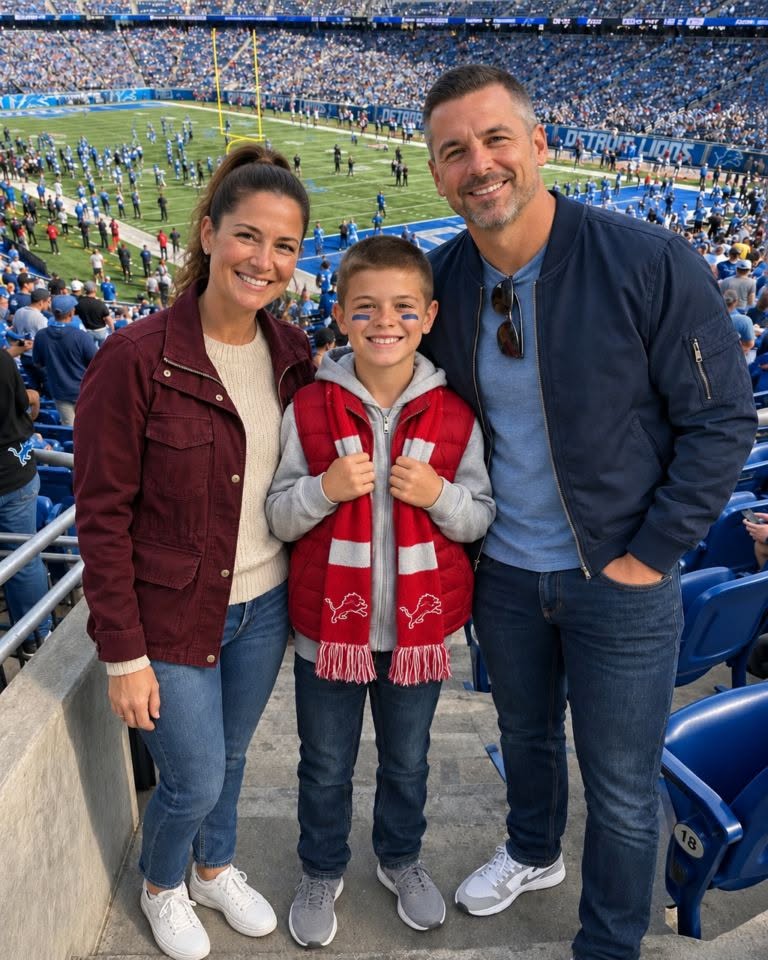
He was wearing his favorite blue football jersey.
We’d bought it a size too large, thinking he would have years to grow into it.
Now it hung loosely from his shoulders.
Ethan had cancer, and his treatments were no longer working.
But that afternoon, he was smiling like any other excited little boy at his first professional football game.
Then the stadium announcer spoke.
“Ethan, we’re so happy you could join us today. But there’s something about your visit that you don’t know.”
My husband, Chris, looked at me in confusion.
The announcer continued.
“Ethan, we’d like you and your parents to turn around.”
Walking down the stadium steps were several familiar faces from our son’s hospital.
At the front was Ray, a maintenance worker Ethan affectionately called Coach Ray.
He was carrying Ethan’s battered plastic tabletop football game.
Behind him came a nurse, another young patient named Cody, and a man named Leo.
The moment Chris recognized Leo, his face changed.
They hadn’t spoken properly in months.
But when Ethan saw his little football game, he burst into laughter.
“Coach Ray! No way!”
I watched in astonishment.
Our son had arranged something behind our backs.
And his real wish, I would soon discover, had almost nothing to do with football.
Three months earlier, we were an ordinary family.
Chris worked as an engineer.
I handled bookkeeping for two small businesses.
And Ethan filled our home with jokes, questions, and constant chatter about football.
Sunday afternoons were our favorite.
Chris shouted at the television whenever our team made a terrible play.
Ethan argued with him about statistics.
And I complained about referees, even though I barely understood the rules.
“Mom, you don’t even know what happened!” Ethan would laugh.
“I know unfairness when I see it!”
That was our life.
Imperfect.
Noisy.
Wonderful.
Then Ethan’s oncologist asked Chris and me to step outside his hospital room.
The treatments weren’t working.
Our son might have far less time than we’d hoped.
Chris immediately began asking about specialists, experimental treatments, and clinical trials.
He wrote down every possibility.
My husband believed every problem had a solution.
But this time, there wasn’t an answer that could make everything right.
When we returned to Ethan’s room, a football game was playing.
Our team scored.
Chris jumped up and shouted.
“Yes!”
Ethan laughed.
Then Chris suddenly became worried.
“Are you okay, Captain? Did laughing hurt?”
Ethan frowned.
“Dad, I just laughed.”
My husband apologized.
But from that day forward, everything changed.
Chris became obsessed with checking whether Ethan was tired, hungry, uncomfortable, or in pain.
And I started photographing everything.
Every meal.
Every smile.
Every joke.
Every ordinary conversation.
I was terrified that one day I might forget the sound of my son’s laughter.
Soon, my phone contained thousands of pictures and videos.
I told myself I was preserving memories.
What I didn’t realize was that I was slowly placing a screen between myself and my child.
Then a representative from a wish-granting organization visited Ethan.
“If you could choose one special experience, what would it be?”
He answered without hesitation.
“A football game!”
Then he added:
“With Mom and Dad.”
The organization arranged the trip, coordinated with his medical team, and made sure he’d have everything he needed.
On game day, Ethan was ecstatic.
He stared at the enormous field.
He laughed when the crowd booed the opposing team.
He ate half a pretzel and stole bites of Chris’s hot dog.
I photographed everything.
Meanwhile, Chris kept asking whether he needed to rest.
“Are you tired?”
“No, Dad.”
“Cold?”
“No.”
“Want my jacket?”
“Dad!”
“What?”
“Watch the game!”
Chris laughed.
“I am watching.”
Ethan looked at him seriously.
“No. You’re watching me watch it.”
My husband went quiet.
Our little boy was right.
Chris was so afraid of losing him that he’d forgotten how to enjoy being beside him.
And I wasn’t doing much better.
I was watching Ethan through my phone.
At halftime, the stadium camera found us.
Our faces appeared on the big screen.
Then Ray arrived with Ethan’s tabletop football game.
Ray worked in the hospital’s maintenance department.
Whenever he visited Ethan’s room to repair something, my son challenged him to a game.
The toy had one crooked goalpost and a plastic player that constantly fell over.
Ray blamed the equipment.
Ethan blamed Ray’s terrible coaching.
But there was one rule.
Everybody plays.
Anyone who entered Ethan’s hospital room had to join in.
Nurses.
Doctors.
Visitors.
Nobody was allowed to stand around watching.
Then I noticed Leo.
Months earlier, his young son had been receiving cancer treatment at the same hospital.
One afternoon, Leo learned that his son’s scans were clear.
He was overcome with joy and began celebrating in the hallway.
But Chris had just learned that another treatment had failed for Ethan.
He couldn’t bear hearing someone else’s good news.
“Could you celebrate somewhere else?” he’d snapped.
Leo apologized immediately.
Chris regretted his words, but never apologized.
What we didn’t know was that Ethan had witnessed the exchange.
The following day, Leo visited his room.
He picked up the plastic football game and challenged Ethan.
And from that day forward, he became one of our son’s favorite visitors.
Now he was standing in the stadium, smiling.
The announcer explained that Ethan had secretly asked the wish-granting team to include his hospital football friends.
Thousands of spectators began cheering.
Ray raised the battered toy triumphantly.
The announcer shouted:
“Ethan’s league has one rule: EVERYBODY PLAYS!”
The stadium erupted in applause.
I instinctively reached for my phone.
But when I raised it, I noticed Ethan watching me.
He wasn’t smiling.
His eyes were fixed on the screen between us.
Slowly, I lowered my phone.
His expression softened.
A short while later, we moved to a quiet family room so Ethan could rest.
Ray and the others gave us some privacy.
I sat beside my son.
“Sweetheart, why did you want your hospital friends here?”
He looked down.
“Because they still act normal around me.”
Chris frowned.
“What do you mean? Don’t we act normal?”
Ethan hesitated.
Then he pointed toward my phone.
“Dad keeps checking if I’m tired every few minutes. And Mom takes pictures of everything.”
I felt my face grow warm.
He continued.
“You used to yell at football, Dad. And Mom used to shout at the referees.”
“Bad referees,” I corrected.
“All referees, Mom.”
I laughed.
Then Ethan looked at us both.
“That’s why I picked football. I wanted you to have fun with me. Not fun because of me. Fun WITH me.”
My eyes filled with tears.
He spoke again, more quietly.
“Everybody acts like everything has to be special now because I’m going to die.”
Neither of us moved.
“I don’t want every little thing to be important.”
He looked toward the plastic football game.
Then he said something I’ll never forget.
“Sometimes I just want stuff to be stuff.”
My heart broke.
For months, I’d been trying to capture every moment because I was afraid of losing him.
Chris had been monitoring every movement because he was terrified something might happen.
But our son wasn’t asking us to stop caring.
He was asking us to stop letting fear control every second we had together.
“I just don’t want to spend the rest of my time being watched,” he whispered.
Chris took his hand.
“I’m sorry, Captain.”
I placed my phone facedown on the couch.
Ethan noticed.
Then he smiled.
Chris nodded toward the field outside.
“You know, Captain, I think you’re right.”
Ethan’s face brightened.
“So you’re admitting I’m right?”
“Absolutely not.”
Ethan burst into laughter.
And for the first time in months, we laughed with him without immediately checking whether he was okay.
A few minutes later, Leo appeared at the doorway.
Chris stood.
For a moment, neither man spoke.
Then Chris asked:
“How’s your son?”
Leo smiled.
“Home. Driving his mother crazy. He keeps leaving his shoes everywhere.”
Chris’s eyes filled with tears.
“That’s wonderful, Leo. I mean it.”
It wasn’t a dramatic apology.
But it was a beginning.
Soon, we returned to our stadium seats.
This time, there was no announcement.
No giant screen.
No special ceremony.
Just football.
Chris immediately began complaining about a terrible play.
Ethan laughed.
“Dad, you don’t know what you’re talking about!”
“I’ve been watching football longer than you’ve been alive!”
“That doesn’t mean you understand it!”
Then a referee threw a yellow flag.
I jumped up.
“Oh, come on!”
Ethan laughed so hard he could barely speak.
“Mom! You don’t even know what happened!”
“I know injustice when I see it!”
Chris burst out laughing.
For a moment, I reached toward my phone.
Then I stopped.
Ethan noticed.
“Mom, aren’t you taking a picture?”
I shook my head.
“No, sweetheart.”
“Why?”
I looked directly at him.
“Because I’m watching you with my own eyes. I’m right here.”
He smiled and turned back toward the field.
Late in the fourth quarter, our team scored.
The stadium erupted.
Chris jumped up cheering.
Ethan grabbed both our hands and pulled himself upright between us.
He was laughing.
Really laughing.
His little football game slipped sideways, and a plastic player fell beneath my seat.
Normally, I would have rushed to pick it up.
Or grabbed my phone to record the moment.
But this time, I simply held my son’s hand.
We cheered.
We laughed.
And for those precious seconds, I wasn’t thinking about hospital appointments or the future.
I was simply his mother, watching football with my family.
Eventually, Ethan noticed the fallen player.
“Mom! My football guy!”
I picked it up and handed it to him.
He placed it back on the plastic field.
Then he whispered:
“Everybody plays.”
I smiled.
Finally, I understood.
Love wasn’t about standing on the sidelines, carefully watching someone else’s life unfold.
It was about participating.
Laughing.
Making mistakes.
Sharing moments that didn’t need to be extraordinary to matter.
I still have thousands of photographs of Ethan.
And I’m grateful for every one.
But my most precious memory from that day isn’t saved on my phone.
It’s the moment I stopped taking pictures.
The moment I chose to hold his hand instead.
My ten-year-old son, whose cancer was no longer responding to treatment, made one special wish before he died.
We thought he wanted a football game.
But what he really wanted was one afternoon when his frightened parents could simply be Mom and Dad again.
He wanted us to laugh with him.
Argue about football.
Shout at referees.
And enjoy the ordinary miracle of being together.
“Everybody plays. Nobody just watches.”
That was Ethan’s rule.
And it became the greatest lesson our little boy ever taught us.
{"post":117442,"page":2,"next":[{"id":117438,"title":"My husband told me not to humiliate his pregnant mistress while she paid for our divorce lunch with a credit card bearing my name.","url":"https:\/\/new24.info\/117438"},{"id":117432,"title":"I received a 25-year prison sentence for a crime I didn\u2019t commit. My husband stood beside his pregnant mistress while my mother-in-law pretended to cry. I calmly revealed one secret. The officers froze, and the prosecutor shouted, \u201cStop the transfer!\u201d","url":"https:\/\/new24.info\/117432"},{"id":117427,"title":"The Waitress My Kids Never Forgot..","url":"https:\/\/new24.info\/117427"},{"id":117423,"title":"Husband Offered Me Thousands To Leave Without Knowing About Our Son","url":"https:\/\/new24.info\/117423"},{"id":117419,"title":"Brave Caregiver Uncovers Hidden Medical Danger Threatening Twin Boys In Newport","url":"https:\/\/new24.info\/117419"},{"id":117415,"title":"Secret Inheritance Reveals Ultimate Betrayal And Destroys A Greedy Family Forever","url":"https:\/\/new24.info\/117415"},{"id":117410,"title":"A Straying Husband Tried to Move Back In After His Other Woman Kicked Him Out \u2013 But the Wife\u2019s \u2018Welcome Back\u2019 Revenge Taught Him a Brutal Lesson","url":"https:\/\/new24.info\/117410"},{"id":117406,"title":"My Pregnant Daughter Di3d, And Her Husband Brought His Mistress To The Funeral. He Thought He Would Inherit Everything\u2014Until The Lawyer Opened Her Final Letter.","url":"https:\/\/new24.info\/117406"},{"id":117401,"title":"Estranged Parents Sued Me Over My Farmhouse Before Learning My Secret","url":"https:\/\/new24.info\/117401"},{"id":117397,"title":"My mother handed presents to every grandchild except my two children, then admitted she hadn\u2019t forgotten them. \u201cMaybe next year you\u2019ll learn to be more grateful,\u201d she said.","url":"https:\/\/new24.info\/117397"},{"id":117393,"title":"During my son\u2019s 10th birthday, I overheard my mom tell my brother, \u201cThis party is a waste \u2014 he\u2019s not even that special!\u201d My son was standing right behind her. He heard everything. I didn\u2019t yell. I just asked her to step outside for a moment. Then I locked the door.","url":"https:\/\/new24.info\/117393"},{"id":117388,"title":"My Husband Abandoned Me to Reunite With His Ex and Gave Me an Ultimatum: Take Half His Fortune or Keep Our Son. I Chose My Son\u2026 But What Happened Next Changed Everything\u2026","url":"https:\/\/new24.info\/117388"},{"id":117384,"title":"At the Entrance of a Five-Star Hotel, My Sister Pushed Me Away. \u201cGet lost, you can\u2019t even afford a glass of water here,\u201d She Laughed. My Mother Added, \u201cA former maid like you just smells like bleach. Go back to scrubbing toilets.\u201d","url":"https:\/\/new24.info\/117384"},{"id":117379,"title":"A 6-Foot-8 Woman Joined a Dating App \u2013 Her First Match Asked Her to Wear Heels, but What Happened at Dinner Left Her Terrified","url":"https:\/\/new24.info\/117379"},{"id":117375,"title":"I was 39 weeks pregnant and bleeding while he was out partying with his mistress. He had hidden a letter for five weeks; then, I found his billionaire boss at my bedside, holding my newborn and calling me \u201cdaughter.\u201d","url":"https:\/\/new24.info\/117375"},{"id":117370,"title":"Exhausted Mother Finds Second Refrigerator And Executes Brilliant Legal Eviction Plan","url":"https:\/\/new24.info\/117370"},{"id":117366,"title":"Banished From My Family Home Until One Memorial Tree Revealed Everything","url":"https:\/\/new24.info\/117366"},{"id":117362,"title":"My Husband\u2019s Mistress Was Expecting Twins, So He Offered Me $50 Million to End Our Marriage. But Moments After I Signed the Divorce Papers and Flew to California, Everything Changed\u2026","url":"https:\/\/new24.info\/117362"},{"id":117357,"title":"I Returned Home Unexpectedly On New Year\u2019s Eve And Found My Wife Still Recovering From Surgery, With Very Little Food Available And Our Newborn Son Needing Warmth. But When I Reviewed The Security Footage, I Discovered A Family Betrayal That Eventually Led To A Police Report.","url":"https:\/\/new24.info\/117357"},{"id":117352,"title":"A Girlfriend Was Leaving Her Partner Because He Wouldn\u2019t Propose \u2013 But Then She Heard Him Whisper to Her Dad, \u2018I Bought the Ring Years Ago, but You Have to Tell Her the Truth First\u2019","url":"https:\/\/new24.info\/117352"}]}