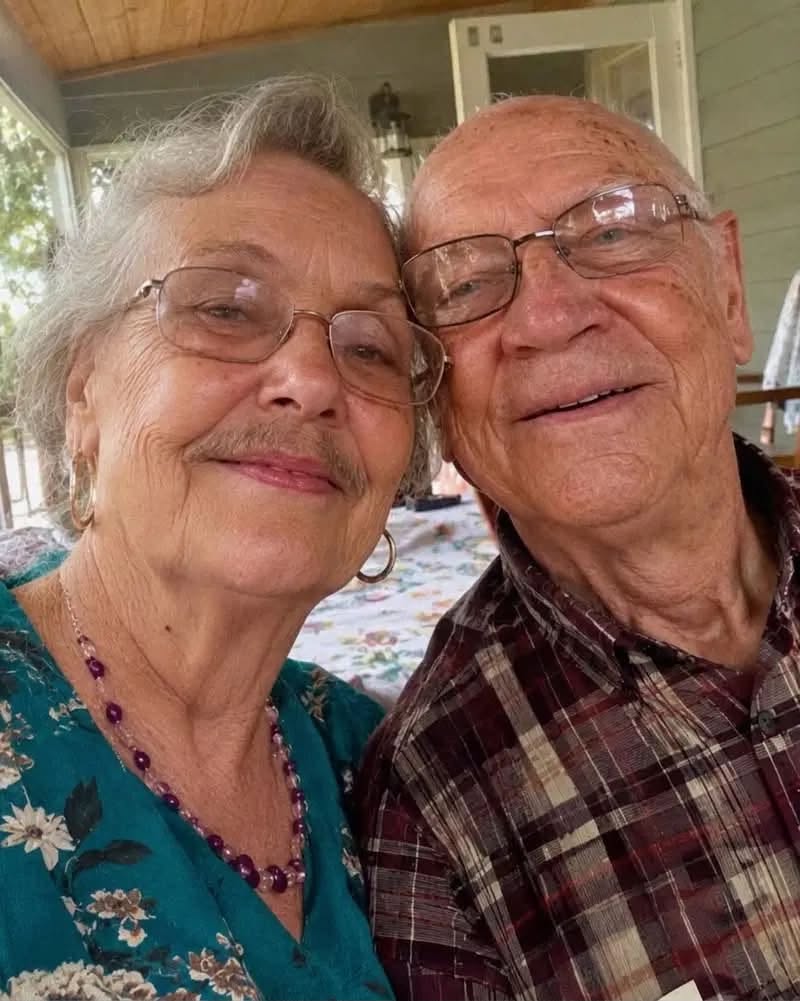
But Arthur had one unusual habit.
He constantly requested photographs of my face.
No makeup. No filters. Nothing covering my upper lip.
At first, I was flattered.
Then I became suspicious.
And when I visited his home for dinner, his housekeeper took one look at me and dropped two crystal glasses.
“Ma’am,” she whispered later, grabbing my hand, “you need to leave before he comes back.”
What I discovered in Arthur’s study involved a photograph taken sixty-one years earlier—and a memory I’d spent my entire life trying to forget.
My name is Holly.
I’ve had a noticeable mustache since my twenties.
For decades, I tried hiding it.
I used makeup, avoided certain lighting, and grew uncomfortable whenever someone’s eyes lingered above my mouth.
My husband, Walter, never cared.
He kissed me every morning, whether I’d shaved or not.
Once, when I nearly skipped a wedding because I felt embarrassed, he handed me my coat.
“Holly, the bride invited you because she loves you. Nobody’s hiring you to model lipstick.”
Walter died nine years ago.
After losing him, I doubted I’d ever find another man who accepted me so completely.
Then my granddaughter created an online dating profile for me.
“Grandma, you deserve companionship.”
Three days later, Arthur contacted me.
Our first conversation was about crossword puzzles.
“Pencil or pen?” he asked.
“Pen. I’m old enough to live dangerously.”
He laughed.
Soon, we were talking every evening.
Arthur remembered little details about my life.
My roses.
My granddaughter’s new job.
My favorite lemon cookies.
Eventually, I nervously mentioned my facial hair.
His response brought me to tears.
“Please don’t ever shave it, Holly. I think you’re beautiful exactly as you are.”
I read those words three times.
For the first time in years, I felt comfortable letting someone see me without trying to hide.
Our first date was wonderful.
Arthur brought lemon cookies and listened patiently while I talked about my garden.
During our second date, he took a photograph of me beside a rosebush.
Then he began requesting more pictures.
“Send me another one, darling. Without makeup.”
I laughed.
“At this rate, you’ll have enough photographs to open a museum!”
He smiled.
“I just love your natural beauty.”
But something bothered me.
He wasn’t asking for photographs of my garden, my home, or my family.
Only my face.
And he seemed particularly interested in my upper lip.
Then he began asking strange questions about my childhood.
Had I always lived in the same city?
Where had my parents worked?
Had I ever lived in Chicago?
I found his curiosity unusual but dismissed it.
Until the evening he invited me to dinner.
Arthur lived in a beautiful old house filled with books and family photographs.
He greeted me with pink roses.
Then introduced his housekeeper, Helen.
“This is Holly,” he said.
Helen turned toward me.
And immediately dropped both crystal glasses she was carrying.
They shattered across the floor.
She stood frozen, staring at my face.
“Holly?” she whispered.
“Yes?”
Arthur quickly stepped between us.
“Helen, please clean that up.”
His voice was unusually harsh.
I felt uncomfortable.
But he guided me into the dining room before I could ask questions.
During dinner, Arthur returned to asking about my childhood.
Then he said something that made my blood run cold.
“Did your mother live in Chicago in 1965?”
I stared at him.
“How do you know that?”
He reached for his glass.
“Lucky guess.”
“Arthur, I never told you I lived in Chicago.”
His expression changed.
Before he could respond, his phone rang.
He excused himself and disappeared down the hallway.
Seconds later, Helen appeared.
She looked terrified.
“Ma’am, please come with me.”
“What’s wrong?”
She grabbed my hand.
“Arthur has been looking for you for years.”
I froze.
“Why?”
Before she could answer, Arthur returned.
“Helen! What are you doing?”
“I’m telling her,” Helen replied.
“Not like this!”
She looked at him angrily.
“You’ve had three dates and an entire dinner. When exactly were you planning to tell her?”
I stepped between them.
“Tell me what?”
Helen led me into Arthur’s study.
On the desk sat a cardboard box filled with old photographs and documents.
She opened it.
Then handed me a picture.
I stared.
My hands began trembling.
It was a photograph of me at seventeen years old.
I was sitting beneath a bright salon light, my hair pinned away from my face.
My hands were folded nervously in my lap.
I recognized the scene immediately.
It was a department-store beauty consultation in Chicago.
My mother had taken me there because she wanted someone to help make me look more feminine.
The employees had discussed my facial hair as though I wasn’t even present.
“That much hair will be difficult to conceal,” one woman had said.
“She’ll need regular treatment.”
I remembered staring at my hands, fighting back tears.
I remembered the humiliation.
And I remembered a young male assistant standing beside the camera.
He’d refused to look directly at me.
I turned toward Arthur.
“You were there.”
He lowered his head.
“Yes.”
I felt dizzy.
“Why do you have this photograph?”
Arthur explained that he’d worked for the company responsible for those consultations.
Years later, a former colleague discovered old photographs and customer records that should have been destroyed.
One contained my name.
Arthur recognized it.
And he kept it.
“Why?” I whispered.
He struggled to answer.
Then he admitted he’d never forgotten that appointment.
He remembered how cruelly the adults had treated me.
He remembered my asking whether I looked terrible.
And he remembered staying silent when I desperately needed someone to defend me.
“I’m sorry, Holly.”
I stared at the photograph.
For sixty-one years, I’d carried the shame of that afternoon.
And now the man I’d started trusting had secretly possessed evidence of it.
“How did you find me?” I asked.
Arthur explained that he’d occasionally searched for me over the years.
After his wife died, he became more determined.
He discovered my name in a community newsletter mentioning my granddaughter and my roses.
Then he saw my dating profile.
The name matched.
The details matched.
And he believed he’d finally found the girl from that salon.
“So meeting me wasn’t a coincidence?”
“No.”
I felt something inside me break.
“Arthur, why didn’t you tell me?”
He looked ashamed.
“I wanted to apologize. But then I enjoyed talking to you. I was afraid you’d stop speaking to me if you knew.”
I thought about every compliment.
Every photograph.
Every question about my childhood.
Then I asked:
“Did you request those pictures to confirm I was the girl in the old photograph?”
He hesitated.
“At first, yes.”
I looked away.
For weeks, I’d believed Arthur simply admired me.
Now I understood he’d been comparing my face with that of a frightened teenage girl.
“You should have told me.”
“I know.”
“You made me believe you loved my appearance without any hidden reason.”
“I do think you’re beautiful, Holly.”
I shook my head.
“Then you should have trusted me enough to tell the truth.”
Arthur began crying.
“I only wanted to make things right.”
I stood.
“You had a chance. You could have been honest on our first date.”
Helen quietly offered to arrange a car.
I accepted.
Arthur apologized again as I left.
But I couldn’t answer.
Four days later, a letter arrived.
Inside was the old photograph.
The original consultation card.
And a handwritten apology.
Arthur acknowledged his silence at the salon, his secrecy during our dates, and the inappropriate requests for photographs.
He didn’t ask me to forgive him.
I sat at my kitchen table studying the picture.
For decades, I’d remembered that seventeen-year-old girl as ugly.
But looking at her now, I saw something different.
She wasn’t ugly.
She was frightened.
She’d been surrounded by adults who made her feel defective because her appearance didn’t meet their expectations.
And nobody had comforted her.
My granddaughter entered the kitchen.
“Grandma, what’s wrong?”
I showed her the picture.
“That’s me at seventeen.”
She studied it carefully.
Then she smiled.
“You had beautiful eyes.”
I began crying.
“That’s what Walter always said.”
A week later, I called Arthur.
We spoke quietly.
I told him how much that salon appointment had affected my life.
How long I’d tried to change something that had never needed fixing.
He apologized again.
This time, I believed he meant it.
But I wasn’t ready to resume our relationship.
“Arthur, I believe you’re sorry. I just don’t know whether I can trust you again.”
He understood.
We agreed to keep our distance.
That evening, I placed my teenage photograph beside a recent picture my granddaughter had taken.
In the new photograph, I was laughing.
My mustache was clearly visible.
Sixty-one years separated the two images.
And for the first time, I didn’t want to hide either one.
At seventy-eight, I thought I’d finally found a man who accepted my appearance without judgment.
Instead, I discovered he’d secretly been searching for me because of a humiliating experience from my childhood.
His intentions may have begun with regret.
But his dishonesty reminded me that genuine affection requires more than beautiful compliments.
It requires trust.
I don’t know whether Arthur and I will ever try again.
But I know something more important now.
The seventeen-year-old girl in that photograph never needed fixing. She needed kindness.
And after sixty-one years, I can finally give her that kindness myself.
{"post":117379,"page":2,"next":[{"id":117375,"title":"I was 39 weeks pregnant and bleeding while he was out partying with his mistress. He had hidden a letter for five weeks; then, I found his billionaire boss at my bedside, holding my newborn and calling me \u201cdaughter.\u201d","url":"https:\/\/new24.info\/117375"},{"id":117370,"title":"Exhausted Mother Finds Second Refrigerator And Executes Brilliant Legal Eviction Plan","url":"https:\/\/new24.info\/117370"},{"id":117366,"title":"Banished From My Family Home Until One Memorial Tree Revealed Everything","url":"https:\/\/new24.info\/117366"},{"id":117362,"title":"My Husband\u2019s Mistress Was Expecting Twins, So He Offered Me $50 Million to End Our Marriage. But Moments After I Signed the Divorce Papers and Flew to California, Everything Changed\u2026","url":"https:\/\/new24.info\/117362"},{"id":117357,"title":"I Returned Home Unexpectedly On New Year\u2019s Eve And Found My Wife Still Recovering From Surgery, With Very Little Food Available And Our Newborn Son Needing Warmth. But When I Reviewed The Security Footage, I Discovered A Family Betrayal That Eventually Led To A Police Report.","url":"https:\/\/new24.info\/117357"},{"id":117352,"title":"A Girlfriend Was Leaving Her Partner Because He Wouldn\u2019t Propose \u2013 But Then She Heard Him Whisper to Her Dad, \u2018I Bought the Ring Years Ago, but You Have to Tell Her the Truth First\u2019","url":"https:\/\/new24.info\/117352"},{"id":117348,"title":"My Mother-in-Law Took My Debit Card to Fund a Lavish Palm Beach Vacation\u2014So I Secretly Swapped It for My Husband\u2019s Hidden Black Card.","url":"https:\/\/new24.info\/117348"},{"id":117343,"title":"Sticky Pecan Pie Cookies: A Buttery Holiday Treat with Caramel Pecan Filling","url":"https:\/\/new24.info\/117343"},{"id":117339,"title":"The Meaning of a Purple Flag at the Beach: What Every Beachgoer Should Know","url":"https:\/\/new24.info\/117339"},{"id":117335,"title":"\u201cDidn\u2019t we pay off your student loans?\u201d Grandpa asked in front of everyone. My mother smirked, \u201cWe used that money for his sister\u2019s wedding instead.\u201d The room fell silent\u2026 Then Grandpa slammed his glass down, pulled out his phone, and growled, \u201cTell Mr. Henderson I need him at my house. Tonight.\u201d","url":"https:\/\/new24.info\/117335"},{"id":117329,"title":"Crispy, Melty Cheese Toast Made in the Air Fryer","url":"https:\/\/new24.info\/117329"},{"id":117325,"title":"Is This Fuzzy Caterpillar Harmless, or Is It Dangerous?","url":"https:\/\/new24.info\/117325"},{"id":117320,"title":"Son Invited Mom to Meet His Live-in Girlfriend \u2013 What She Found in Their Fridge Sh0cked Her, but the Girlfriend\u2019s Reply Was Worse","url":"https:\/\/new24.info\/117320"},{"id":117315,"title":"\u201cI never loved Claire,\u201d my husband whispered to my pregnant best friend as I stood outside her hospital room holding dessert. Seven years of marriage shattered instantly. He planned to leave me, unaware I was hiding a life-changing secret.","url":"https:\/\/new24.info\/117315"},{"id":117309,"title":"At 1am, my parents texted: \u201cWe know you spent $680,000 to save our house\u2026 but your sister doesn\u2019t want you at Thanksgiving.\u201d I just replied, \u201cNoted.\u201d That was the night they realized\u2026 I was done being taken for granted. What happened next sh0cked them.","url":"https:\/\/new24.info\/117309"},{"id":117305,"title":"I Left My Wife and Our 7-Day-Old Baby Boy in My Mother and Sister\u2019s Care for Only Four Days, Believing They Would Look After Them. \u201cDon\u2019t Worry, They\u2019re in Good Hands,\u201d","url":"https:\/\/new24.info\/117305"},{"id":117301,"title":"How One Cruel Prank Cost My Deceitful Husband Eighteen Million Dollars","url":"https:\/\/new24.info\/117301"},{"id":117297,"title":"Secret Billionaire Wife Exposes Her Cheating Husband At High Society Charity Gala","url":"https:\/\/new24.info\/117297"},{"id":117293,"title":"Suspicious Husband Uncovers Hidden Family Secret After Following His Distracted Wife","url":"https:\/\/new24.info\/117293"},{"id":117283,"title":"A 7-Year-Old Girl Found a Diamond Ring at the Grocery Store and Returned It to Its Owner \u2013 The Next Morning, a Stranger Showed up at Her Door and Said, \u2018I Need to Show You Something Right Now!\u2019","url":"https:\/\/new24.info\/117283"}]}