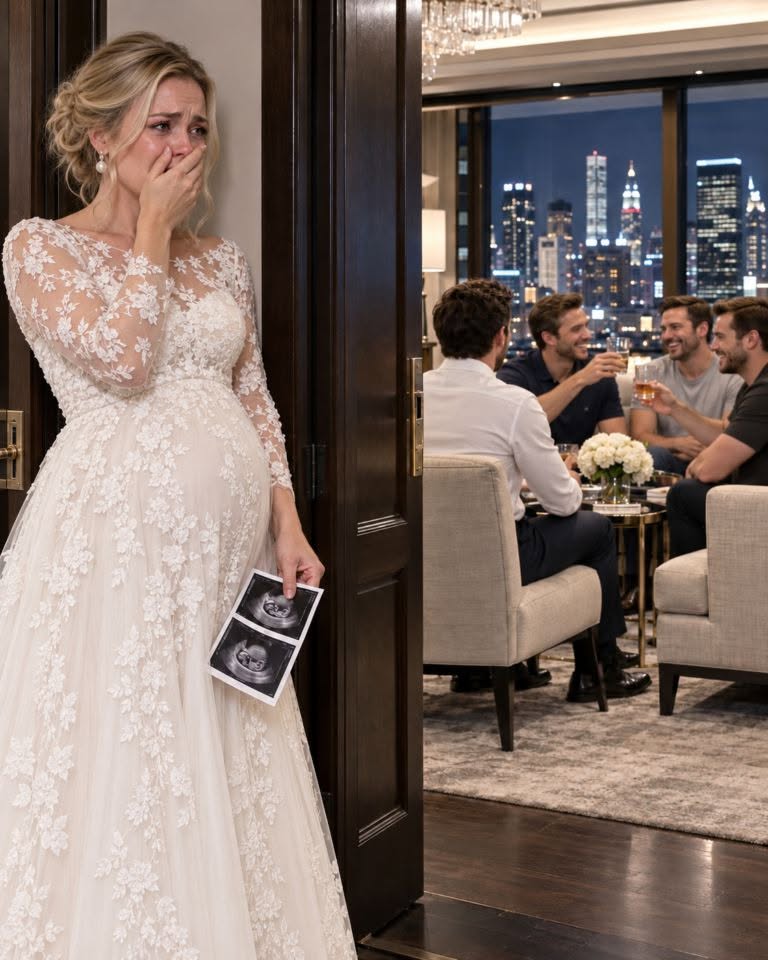
My heart stopped.
Then my husband, Peter, answered.
“Nora thinks they’re ours. The clinic handled the paperwork. She never questioned anything.”
I stood frozen outside the lounge, holding ultrasound photographs of the three babies I’d spent years dreaming about.
Another friend asked what would happen after they were born.
Peter laughed.
“Each family gets the child they were promised. Nora’s doing what she’s useful for.”
The photographs slipped from my fingers.
I couldn’t breathe.
Then someone asked what would happen if I discovered the truth.
Peter’s answer destroyed me.
“She’s six months pregnant with triplets. Where’s she going to go? She wants to be a mother so badly she’ll believe anything I tell her.”
For years, Peter and I had struggled to conceive.
Fertility treatment meant endless appointments, painful injections, and months of uncertainty.
When we finally learned I was carrying three babies, I’d cried with happiness.
We decorated a nursery outside Boston.
Bought tiny blankets.
Discussed names.
And imagined bringing our children home.
Now I was listening to my husband describe me as a convenient way to produce babies for strangers.
Suddenly, a sharp pain tightened across my abdomen.
I grabbed the wall.
Another contraction followed.
Terrified of being discovered, I slipped through a staff doorway and made my way outside.
A hotel employee noticed I was struggling and called an ambulance.
Inside, I begged the paramedic not to contact Peter.
Instead, I called my older sister, Rachel.
At the hospital, doctors monitored my contractions and checked the babies.
Thankfully, all three remained stable, but they wanted to keep me under observation.
When Rachel arrived, I told her everything.
She held my hand.
Then asked a question I hadn’t considered.
“Did you ever see the original paperwork from the fertility clinic?”
“I signed forms.”
“Did you read all of them?”
“I read what they gave me. Peter was always there.”
That evening, we requested my complete fertility records.
Signed consents.
Embryo identification numbers.
Laboratory reports.
And account-access histories.
The following morning, a coordinator called.
Her voice changed as she reviewed my file.
“Mrs. Nora, it appears there may be a third-party reproductive arrangement attached to your account.”
I felt dizzy.
“What does that mean?”
She couldn’t explain without further review.
Then a folder arrived from Peter.
Inside was a contract supposedly bearing my signature.
According to the document, I’d agreed to carry embryos for other families.
But I noticed something immediately.
The agreement was dated two months before Peter and I had even visited the fertility clinic.
I had never signed it.
Rachel contacted Naomi Blake, an attorney specializing in reproductive and family law.
Naomi examined the papers.
“Don’t sign anything else,” she warned. “We need to preserve every document.”
Soon, the clinic released more records.
The embryology pages were alarming.
Three embryo numbers were marked as confidential third-party information.
My transfer was described as a gestational-carrier arrangement.
And the electronic consent was connected to an email address I’d never used.
Further records linked the account to a device assigned to Peter’s office.
Then Naomi discovered something extraordinary.
An earlier laboratory entry stated that the embryos had been created using my eggs and Peter’s sperm.
The entry had later been removed from the active record.
The newer documents contradicted it.
Someone appeared to have rewritten the history of my fertility treatment.
The clinic’s compliance director couldn’t explain who had altered the records.
A coordinator admitted she’d questioned the paperwork on the day of my embryo transfer.
But Dr. Alan Whitaker, the physician Peter had chosen, assured her everything had been properly authorized.
She’d accepted his explanation without asking me.
I felt sick.
Peter hadn’t merely lied to me.
He appeared to have involved medical professionals in an elaborate scheme.
Then Naomi contacted one of the families.
Ellen and George Miller had lost their daughter, Audrey, years earlier.
Peter had told them Audrey’s preserved eggs had been used to create an embryo.
He claimed I’d agreed to carry their grandchild.
He’d even sent them an ultrasound photograph labeled with Audrey’s name.
Ellen began crying during our video call.
“We thought this was our daughter’s final wish.”
I struggled to respond.
“Peter told me these babies were mine.”
Then Naomi discovered that Audrey’s preserved genetic material had never been used.
The agreement supposedly signed on Audrey’s behalf contained an impossible date.
Peter had exploited a grieving family by promising them a baby who wasn’t genetically related to their daughter.
Two other women, Harper and Madison, had received similar promises.
Harper had even paid Peter money for supposed legal and administrative expenses.
Each family believed a different story.
None knew about the others.
And none knew I hadn’t agreed to any of it.
Meanwhile, my condition worsened.
The contractions became stronger.
Doctors warned that my babies might arrive dangerously early.
Then Peter’s attorney appeared at the hospital with proposed custody documents.
He insisted I sign them before delivery.
I was stunned.
Peter was trying to secure control over babies who hadn’t even been born.
Naomi blocked the attorney from entering.
I refused to sign.
“I’m not signing away my children while I’m in labor.”
Hospital security removed him.
Shortly afterward, my obstetrician returned.
“Nora, we’re going to deliver the babies now.”
I was terrified.
But I agreed.
Inside the operating room, bright lights surrounded me.
Doctors spoke urgently.
Then I heard a tiny cry.
Another followed.
And then a third.
“Are they breathing?” I asked.
A nurse reassured me that all three were receiving medical support.
My babies were alive.
They were taken to neonatal intensive care.
I woke later with Rachel beside me.
Then Naomi arrived carrying news.
Investigators had uncovered evidence that my electronic signature had been copied from a legitimate medical document and inserted into the fraudulent agreement.
Clinic logs also showed that Dr. Whitaker had approved the suspicious paperwork despite laboratory evidence identifying Peter and me as the genetic parents.
Peter and Dr. Whitaker were arrested.
Investigators also discovered three additional embryos that had been created from my eggs and Peter’s sperm.
They had been listed as discarded, but were actually found in storage connected to a business associated with Peter’s employer.
A court ordered them preserved while their future was determined.
Then the investigator explained what had happened.
Peter had arranged to create embryos using our genetic material while fabricating agreements that could help him claim control of the children.
He’d promised them to different families, collecting money and manipulating grieving or desperate people along the way.
The supposedly separate genetic arrangements were lies.
Every one of the babies was genetically mine and Peter’s.
I closed my eyes.
For months, I’d carried them, loved them, and imagined their future.
Now I finally had proof of what I’d believed from the beginning.
They were my children. And Peter had known it all along.
The next three months were difficult.
My triplets remained in neonatal intensive care.
Some days brought progress.
Other days brought setbacks.
Rachel stayed beside me.
We celebrated every little improvement.
A stronger breath.
An extra feeding.
A few more minutes without assistance.
Meanwhile, DNA testing confirmed the babies’ parentage.
The fraudulent agreements were invalidated.
A court awarded me primary custody and restricted Peter’s contact during the criminal proceedings.
Harper and Madison wrote supportive letters.
Ellen and George visited when the hospital allowed it.
They brought a yellow blanket they’d made for the grandchild they thought they were expecting.
Ellen handed it to me.
“We’d still like your babies to have this.”
I accepted it through tears.
None of us could undo Peter’s deception.
But we didn’t have to become enemies because of it.
When my babies were finally strong enough, I held them close and gave them their names.
Courage. Truth. And Hope.
I had waited until Peter could no longer influence that decision.
Months later, we returned home to the nursery I’d prepared before discovering his lies.
I removed his decorations and replaced them with three paintings Rachel had made.
A sunrise.
A trail through green hills.
And three stars over a peaceful home.
Ellen and George’s yellow blanket rested over one crib.
On their first birthday, we celebrated with the people who had helped us survive.
Rachel decorated the house.
Naomi brought storybooks.
Ellen and George brought a cake.
Harper and Madison joined virtually.
That evening, after everyone left, I carried my babies upstairs.
Courage fell asleep first.
Truth fought sleep with impressive determination.
Hope held tightly to my finger.
I stood between their cribs, listening to them breathe.
Then I remembered the afternoon outside the hotel lounge.
The ultrasound photographs falling from my hands.
Peter laughing about giving my babies away.
The terrible fear that I’d lose them before I ever got to hold them.
For months, he’d used falsified documents and elaborate lies to claim authority over my pregnancy.
But the truth had finally caught up with him.
My husband promised our triplets to three different families without my knowledge.
He thought he could control their future through forged agreements and deception.
Instead, those very documents helped expose what he’d done.
I looked at my three sleeping children.
The family I’d wanted for so long was finally home.
And this time, nobody else was deciding where they belonged.
They were my children. I was their mother. And our future was ours.
{"post":117239,"page":2,"next":[{"id":117235,"title":"My Husband Passed Away on Our Wedding Day \u2013 A Week Later, He Sat Down Next to Me on a Bus and Whispered, \u2018Don\u2019t Scream, You Need to Know the Whole Truth\u2019","url":"https:\/\/new24.info\/117235"},{"id":117230,"title":"My daughter and son-in-law abandoned me at my wife\u2019s grave, 190 miles from home. \u201cYou\u2019re a burden. Walk home,\u201d he texted. Seconds later, my daughter added, \u201cDon\u2019t wait, Dad.\u201d","url":"https:\/\/new24.info\/117230"},{"id":117225,"title":"A 16-Year-Old Boy Slept over at His Best Friend\u2019s House Every Weekend \u2013 Until His Friend\u2019s Mom Called and Asked, \u2018When Is My Son Coming Home? He\u2019s Been Staying at Your Place for Weeks!\u2019","url":"https:\/\/new24.info\/117225"},{"id":117220,"title":"\u201cLeave The Keys. Get Out!\u201d My Husband Shouted As His Mistress Tossed My Clothes Off The Balcony\u2014Then His Mother Destroyed My Phone. I Retrieved The Cracked Device And Said, \u201cWe Replace The CEO Today.\u201d His Face Turned White\u2026","url":"https:\/\/new24.info\/117220"},{"id":117216,"title":"At 1:46 in the morning, two cops kicked in my door \u2014 with a warrant. \u201cYou\u2019re arrested for estate fraud,\u201d they said","url":"https:\/\/new24.info\/117216"},{"id":117212,"title":"My parents sold my grandma\u2019s antique piano\u2014the one she left only to me\u2014and used the $95,000 to buy my sister a car. When I told Grandma from her hospice bed, she picked up her phone, made 1 call, and said: \u201cIt\u2019s time for them to meet my attorney.\u201d","url":"https:\/\/new24.info\/117212"},{"id":117207,"title":"Don\u2019t Panic\u2014Here\u2019s What to Do If You Find a Lone Star Tick","url":"https:\/\/new24.info\/117207"},{"id":117202,"title":"With broken hearts, we share the heartbreaking news that this world-famous model.. \ud83d\ude2d\ud83d\udc94 Only a few months ago, she welcomed her baby daughter into the world\u2026.See more","url":"https:\/\/new24.info\/117202"},{"id":117199,"title":"With heavy hearts, we announce the passing this wonderful actress who gave us so much \ud83d\udc94\u2026See more","url":"https:\/\/new24.info\/117199"},{"id":117195,"title":"Oven-Baked 5-Ingredient Impossible Cheeseburger Pie: An Easy Retro Dinner","url":"https:\/\/new24.info\/117195"},{"id":117189,"title":"Secret Family Trust Revealed Why My Dying Wife Finally Married Me","url":"https:\/\/new24.info\/117189"},{"id":117185,"title":"Eighteen years after our divorce, my ex-husband watched our son receive a prestigious Harvard award, unaware the brilliant young man was his child. When Noah called me onto the stage, Vincent recognized me and realized the truth I\u2019d hidden for years\u2026","url":"https:\/\/new24.info\/117185"},{"id":117182,"title":"Teen Girl Brought a Cardboard Boy to Graduation \u2013 Classmates Teased Her Until She Stepped up to the Microphone","url":"https:\/\/new24.info\/117182"},{"id":117178,"title":"\u201cEmma, why are you paying rent to your parents to live in MY house?\u201d Grandpa asked at Thanksgiving dinner. My father froze with the carving knife in his hand. \u201cShe\u2019s learning responsibility!\u201d he snapped.","url":"https:\/\/new24.info\/117178"},{"id":117173,"title":"I said to my mother-in-law that I had an early flight and went to bed. At midnight, I heard my door open. She went through my suitcase, zipped something into the inner pocket, then whispered: \u2018It\u2019s in her carry-on. Tip off airport security at six.\u2019","url":"https:\/\/new24.info\/117173"},{"id":117169,"title":"My husband was away in Europe with the woman he had once wanted to marry when I went into premature labor at thirty-two weeks.","url":"https:\/\/new24.info\/117169"},{"id":117164,"title":"I moved our retirement savings, leaving just $96. My son stormed in, demanding answers, while his wife searched our drawers. My husband smiled. \u201cLooking for the missing money?\u201d I asked as police quietly arrived outside.","url":"https:\/\/new24.info\/117164"},{"id":117160,"title":"My father stole my $60,000 SUV, handed the keys to my brother, and laughed when I demanded it back. \u201c\u201dLucas is the man of the family,\u201d\u201d he said. \u201c\u201dYou can manage without it.\u201d\u201d They thought I would swallow the humiliation like I always had.","url":"https:\/\/new24.info\/117160"},{"id":117155,"title":"After three years away, my husband finally returned home, but something felt different. That night, he wrapped his arm around my waist in an unfamiliar way. \u201cWho taught you to hold me like that?\u201d I asked. He sighed, \u201cIf you pretend you don\u2019t know, you can keep being my wife.\u201d I stayed silent, knowing I already had proof of his secret. The next morning, I called my lawyer\u2026","url":"https:\/\/new24.info\/117155"},{"id":117151,"title":"One month after I delivered our son, I dicovered that my husband had secretly purchased a lavish mansion for his personal assistant and her six-year-old daughter.","url":"https:\/\/new24.info\/117151"}]}