Thirty seconds later, my daughter Vanessa sent another message.
Don’t wait, Dad.
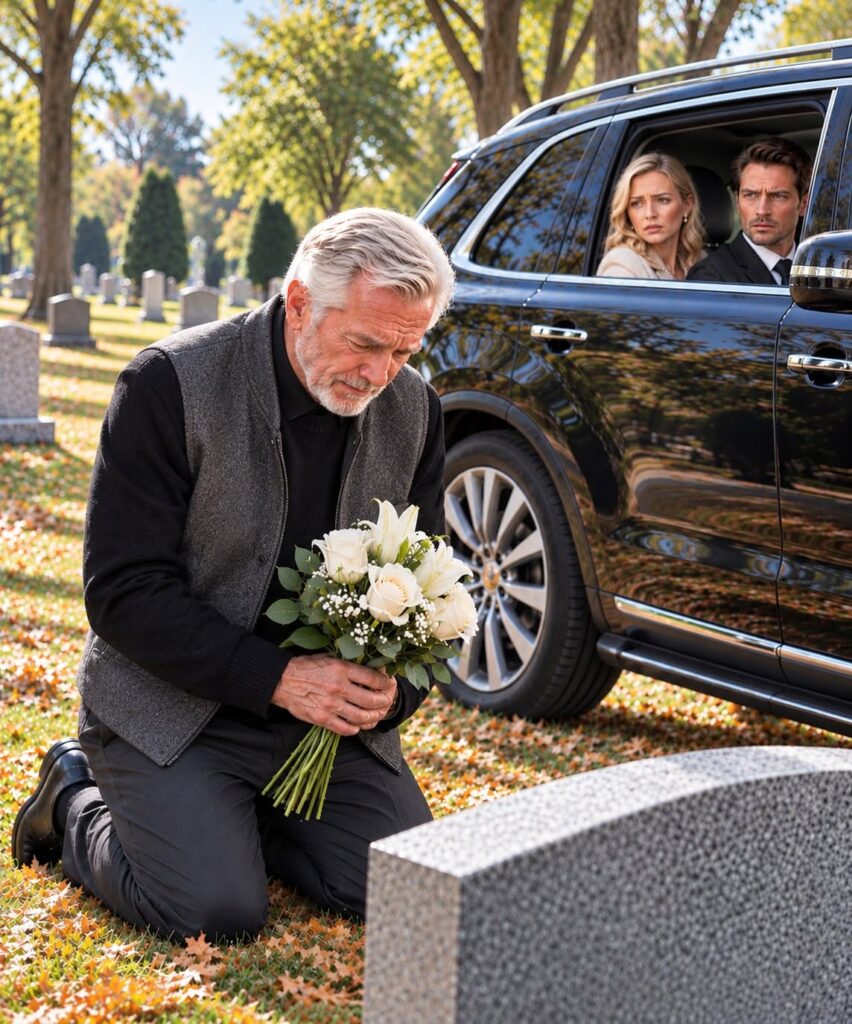
I was seventy-one years old, standing beside my wife’s grave on a freezing November afternoon.
Their black SUV had already disappeared.
They thought I’d panic, beg them to return, and apologize for inconveniencing them.
Instead, I made one phone call.
Four days later, Derek walked into a boardroom expecting a promotion—and found me sitting in the chairman’s chair.
My name is Harold Bennett.
My wife, Eleanor, and I had been married for forty-three years before she passed away.
Together, we’d built a multimillion-dollar logistics business from two borrowed trucks.
She was my business partner, my closest friend, and the love of my life.
That day marked exactly two years since her death.
My car was in the repair shop, so I’d asked Vanessa and Derek to drive me to the cemetery.
They agreed reluctantly, insisting we return before supper.
But when I knelt beside Eleanor’s headstone, the memories overwhelmed me.
I spoke quietly about our garden, our empty kitchen, and how much I missed her.
After twenty minutes, Derek became impatient.
“He’s doing this for attention,” I heard him complain.
Vanessa approached.
“Dad, we’re leaving in five minutes.”
“Just ten more minutes, sweetheart.”
She rolled her eyes.
Three minutes later, they drove away.
Then came their messages.
I stood alone, holding Eleanor’s favorite white roses.
But their cruelty wasn’t entirely surprising.
Three months earlier, Derek had suggested transferring my home into Vanessa’s name.
“Just estate planning,” he’d explained. “At your age, anything could happen.”
When I refused, they began calling me stubborn and forgetful.
They questioned whether I could manage my finances.
And they started treating me like a helpless old man.
What they didn’t know was that I’d recently read a letter Eleanor left behind.
Harold, if Vanessa ever makes you feel like you must purchase her love, remember this: you already gave her everything a father should. Don’t give her your dignity, too.
Standing beside her grave, I finally understood.
I opened my contacts and called Richard Mercer, my company’s longtime attorney.
“Harold Bennett?” he answered. “Is everything all right?”
“Not quite, Richard.”
I looked toward Eleanor’s headstone.
“First, I need a ride. Then I need you to prepare the documents we discussed.”
He hesitated.
“Are you certain?”
“Completely.”
Three hours and twenty minutes later, a chauffeured car picked me up.
By midnight, Vanessa had called eleven times.
I ignored every call.
Derek sent another message.
Hope you’ve learned your lesson. Call when you’re ready to apologize.
They had no idea I was sitting safely in Richard’s office, reviewing financial records.
Six months earlier, I’d noticed unusual withdrawals from a subsidiary account.
The payments led to a consulting company controlled by Derek.
I’d hired him as operations director of Bennett Freight Holdings at Vanessa’s request.
He received an excellent salary.
Yet the records suggested he’d been diverting company money.
Richard placed another document before me.
“Here’s an additional $87,000 transfer.”
“Did I authorize it?”
“No.”
The signature looked like mine.
But it wasn’t.
My daughter had grown up watching me sign documents. Now someone appeared to be imitating my handwriting.
By Tuesday, forensic accountants had traced $416,000 in questionable transfers over eighteen months.
We preserved the evidence, suspended Derek’s financial access, and notified independent board members.
Then Richard reminded me of something Derek had conveniently forgotten.
My family trust controlled 78% of Bennett Freight Holdings.
Derek liked telling people he’d eventually inherit the business.
He’d even ordered business cards suggesting he would become president.
But I’d promised him nothing.
Meanwhile, Vanessa and Derek posted photographs from an expensive restaurant.
Vanessa’s caption read:
Finally setting boundaries with toxic family.
Derek commented:
Some people need tough love.
They didn’t know their corporate cards had been frozen.
Then Vanessa left a voicemail.
“Dad, Derek thinks we should sell your house and move you somewhere smaller. You’ve obviously become confused.”
Richard looked concerned when I played it.
He’d discovered that Vanessa had been collecting information about my health and asking questions about guardianship.
Then his assistant found something even more disturbing.
An email Derek had sent to a residential-care provider three days before abandoning me at the cemetery.
We expect to assume control of my father-in-law’s affairs shortly. Please send pricing for permanent residential placement.
I stared at the screen.
Leaving me at the cemetery hadn’t simply been an act of cruelty. It appeared to be part of a larger effort to make me seem incapable of managing my own life.
Richard arranged an independent medical assessment.
The physician confirmed I was fully capable of handling my affairs.
We also verified that no guardianship proceedings had been filed.
By Thursday, everything was ready.
Vanessa and Derek received notices for an emergency board meeting the following morning.
Derek responded immediately.
Finally. Time to discuss my promotion.
I smiled when Richard showed me.
“Make sure there’s a chair waiting for him.”
At ten on Friday morning, Derek entered the boardroom wearing an expensive navy suit.
Vanessa followed, carrying a designer handbag.
They looked delighted.
Until Derek saw me sitting at the head of the table.
His smile disappeared.
“Harold?”
“Good morning.”
Vanessa stared.
“Dad?”
Derek recovered first.
“So you made it home. You could’ve told us.”
I met his eyes.
“You told me to walk.”
Richard stood beside the projector.
“Please take your seats.”
Derek sighed.
“If this is about the cemetery, you’re seriously overreacting.”
Richard displayed the financial records.
Unauthorized consulting payments.
Altered approval documents.
Invoices for services that apparently had never been provided.
Derek’s face slowly drained of color.
“What is this?”
“Evidence,” Richard replied.
Vanessa turned toward me.
“Dad, you don’t understand business anymore.”
I looked directly at her.
“I understand that your husband received $416,000 in questionable payments from the company your mother and I spent thirty-eight years building.”
Derek jumped up.
“That’s ridiculous!”
Richard placed another document on the table.
“Your access was suspended Tuesday. The board has approved your termination for cause, subject to final legal review.”
He paused.
“The company will also pursue recovery of the funds.”
Derek slammed his hand against the table.
“You can’t fire me! I’m family!”
I looked at him quietly.
“Family. That’s what I thought.”
Then Richard displayed the email about placing me in permanent residential care.
Vanessa began crying.
“Daddy, we were worried about you!”
I took out my phone.
“Were you worried when you drove away?”
She said nothing.
“Were you worried when you told me not to wait?”
I slid the phone across the table.
Their messages were still there.
Derek pointed at me.
“You’re destroying your daughter’s life over one argument?”
“No,” I replied.
“I’m protecting what Eleanor and I spent our lives building.”
Richard presented the physician’s findings, confirming that I remained capable of making my own decisions.
Their attempts to gain control over my finances had no legal foundation.
Then I addressed Derek.
“Your company apartment was part of your employment. Its lease will end according to the agreement.”
Vanessa gasped.
“But that’s our home!”
I held her gaze.
“Then perhaps you’ll understand what it feels like to be left without somewhere to go.”
Richard explained that the company would forward relevant evidence to the authorities.
Any criminal charges would be their decision.
For the first time since entering the room, Derek had nothing to say.
Six months later, insurance and settlement proceeds had recovered much of the missing money.
Derek remained unemployed and faced an ongoing fraud investigation.
Vanessa moved into a modest apartment.
We spoke occasionally.
She apologized.
I listened.
But I stopped paying for her lifestyle.
Forgiving my daughter didn’t mean giving her control over my life again.
Eventually, I bought a smaller home beside Eleanor’s favorite lake.
I also established a scholarship in her name for students who had lost a parent.
Every Sunday, I visited her grave.
One spring morning, I placed fresh white roses beside her headstone.
“You were right, sweetheart,” I whispered.
I remembered that bitter November afternoon.
The empty parking lot.
The cold wind.
The two messages that had broken my heart.
Derek and Vanessa thought abandoning me would make me desperate enough to surrender my independence.
Instead, it reminded me that I still had the right to protect myself.
They left a seventy-one-year-old man stranded 190 miles from home because they believed he was powerless.
Four days later, they discovered that the man they called a burden still controlled the company they wanted to inherit.
But the greatest victory wasn’t removing Derek or recovering the money.
It was remembering Eleanor’s final advice.
I had already given my daughter everything a father should. I didn’t have to surrender my dignity to earn her love.
I touched Eleanor’s headstone one last time and walked toward my car.
This time, I had my own keys.
And no one could leave me behind.
{"post":117230,"page":2,"next":[{"id":117225,"title":"A 16-Year-Old Boy Slept over at His Best Friend\u2019s House Every Weekend \u2013 Until His Friend\u2019s Mom Called and Asked, \u2018When Is My Son Coming Home? He\u2019s Been Staying at Your Place for Weeks!\u2019","url":"https:\/\/new24.info\/117225"},{"id":117220,"title":"\u201cLeave The Keys. Get Out!\u201d My Husband Shouted As His Mistress Tossed My Clothes Off The Balcony\u2014Then His Mother Destroyed My Phone. I Retrieved The Cracked Device And Said, \u201cWe Replace The CEO Today.\u201d His Face Turned White\u2026","url":"https:\/\/new24.info\/117220"},{"id":117216,"title":"At 1:46 in the morning, two cops kicked in my door \u2014 with a warrant. \u201cYou\u2019re arrested for estate fraud,\u201d they said","url":"https:\/\/new24.info\/117216"},{"id":117212,"title":"My parents sold my grandma\u2019s antique piano\u2014the one she left only to me\u2014and used the $95,000 to buy my sister a car. When I told Grandma from her hospice bed, she picked up her phone, made 1 call, and said: \u201cIt\u2019s time for them to meet my attorney.\u201d","url":"https:\/\/new24.info\/117212"},{"id":117207,"title":"Don\u2019t Panic\u2014Here\u2019s What to Do If You Find a Lone Star Tick","url":"https:\/\/new24.info\/117207"},{"id":117202,"title":"With broken hearts, we share the heartbreaking news that this world-famous model.. \ud83d\ude2d\ud83d\udc94 Only a few months ago, she welcomed her baby daughter into the world\u2026.See more","url":"https:\/\/new24.info\/117202"},{"id":117199,"title":"With heavy hearts, we announce the passing this wonderful actress who gave us so much \ud83d\udc94\u2026See more","url":"https:\/\/new24.info\/117199"},{"id":117195,"title":"Oven-Baked 5-Ingredient Impossible Cheeseburger Pie: An Easy Retro Dinner","url":"https:\/\/new24.info\/117195"},{"id":117189,"title":"Secret Family Trust Revealed Why My Dying Wife Finally Married Me","url":"https:\/\/new24.info\/117189"},{"id":117185,"title":"Eighteen years after our divorce, my ex-husband watched our son receive a prestigious Harvard award, unaware the brilliant young man was his child. When Noah called me onto the stage, Vincent recognized me and realized the truth I\u2019d hidden for years\u2026","url":"https:\/\/new24.info\/117185"},{"id":117182,"title":"Teen Girl Brought a Cardboard Boy to Graduation \u2013 Classmates Teased Her Until She Stepped up to the Microphone","url":"https:\/\/new24.info\/117182"},{"id":117178,"title":"\u201cEmma, why are you paying rent to your parents to live in MY house?\u201d Grandpa asked at Thanksgiving dinner. My father froze with the carving knife in his hand. \u201cShe\u2019s learning responsibility!\u201d he snapped.","url":"https:\/\/new24.info\/117178"},{"id":117173,"title":"I said to my mother-in-law that I had an early flight and went to bed. At midnight, I heard my door open. She went through my suitcase, zipped something into the inner pocket, then whispered: \u2018It\u2019s in her carry-on. Tip off airport security at six.\u2019","url":"https:\/\/new24.info\/117173"},{"id":117169,"title":"My husband was away in Europe with the woman he had once wanted to marry when I went into premature labor at thirty-two weeks.","url":"https:\/\/new24.info\/117169"},{"id":117164,"title":"I moved our retirement savings, leaving just $96. My son stormed in, demanding answers, while his wife searched our drawers. My husband smiled. \u201cLooking for the missing money?\u201d I asked as police quietly arrived outside.","url":"https:\/\/new24.info\/117164"},{"id":117160,"title":"My father stole my $60,000 SUV, handed the keys to my brother, and laughed when I demanded it back. \u201c\u201dLucas is the man of the family,\u201d\u201d he said. \u201c\u201dYou can manage without it.\u201d\u201d They thought I would swallow the humiliation like I always had.","url":"https:\/\/new24.info\/117160"},{"id":117155,"title":"After three years away, my husband finally returned home, but something felt different. That night, he wrapped his arm around my waist in an unfamiliar way. \u201cWho taught you to hold me like that?\u201d I asked. He sighed, \u201cIf you pretend you don\u2019t know, you can keep being my wife.\u201d I stayed silent, knowing I already had proof of his secret. The next morning, I called my lawyer\u2026","url":"https:\/\/new24.info\/117155"},{"id":117151,"title":"One month after I delivered our son, I dicovered that my husband had secretly purchased a lavish mansion for his personal assistant and her six-year-old daughter.","url":"https:\/\/new24.info\/117151"},{"id":117147,"title":"A Woman\u2019s Husband Said He\u2019d Forgotten His Passport at Home, So She Sent Her Mom to Get It While They Were at the Airport \u2013 Minutes Later, Her Mom Called and Whispered, \u2018Honey, He Set You Up! Come Home Now!\u2019","url":"https:\/\/new24.info\/117147"},{"id":117143,"title":"\u201cYour house is too big for one person!\u201d my mother yelled when I found my brother, his wife, and their three kids living in MY home. \u201cYou can sleep in the guest room,\u201d my brother laughed.","url":"https:\/\/new24.info\/117143"}]}