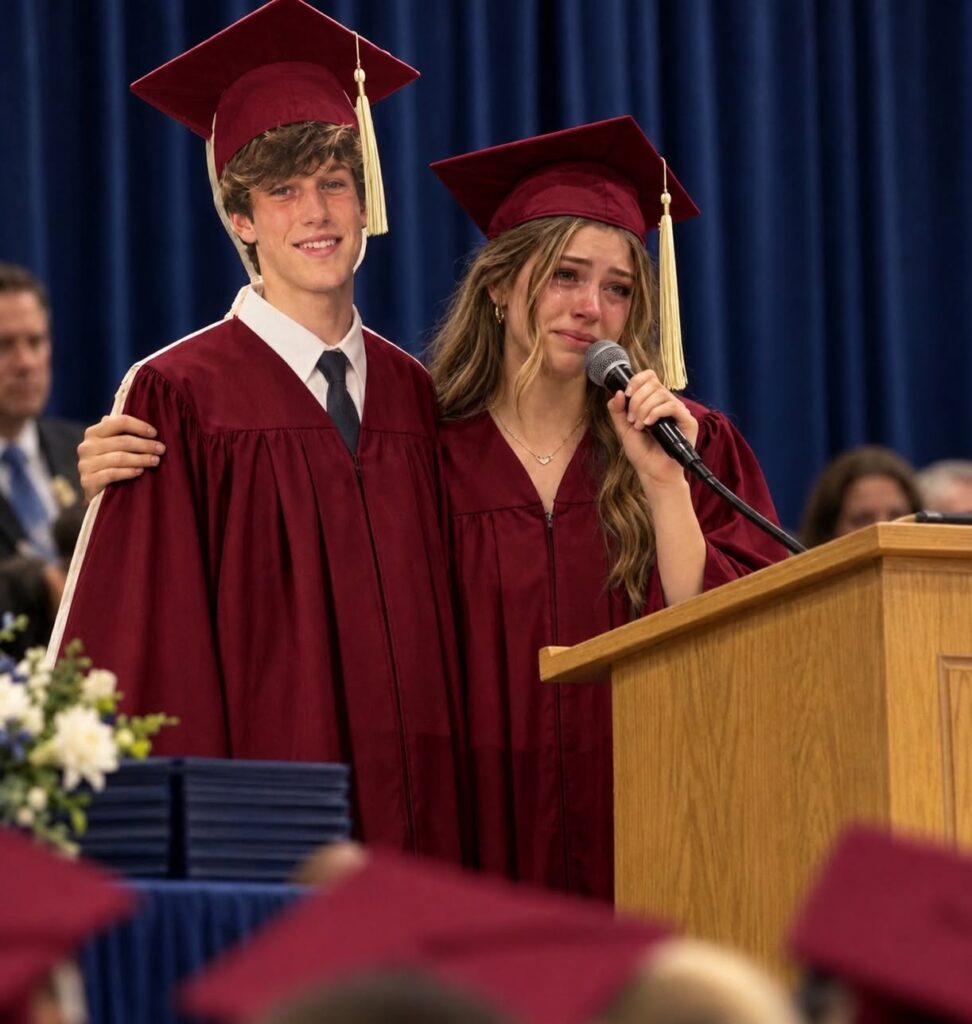
“His cap was crooked, Mom.”
“Emma, I’m serious.”
“So am I.”
Then she turned toward me, her eyes filling with tears.
“Mom, promise you won’t tell anyone why I’m doing this. I need to explain it myself.”
I wanted to argue.
I knew how cruel teenagers could be toward anything unusual.
But I also knew why she had made that cardboard figure.
So I nodded.
“I promise, sweetheart.”
My name is Melinda, and two years earlier, our family suffered a loss that changed us forever.
My son, Felix, died at sixteen after a lifelong battle with a serious heart condition.
Felix was Emma’s twin brother.
They’d been inseparable since birth.
They competed over everything—grades, running races, even who would graduate first.
Felix used to joke that because he’d been born seven minutes earlier, he deserved to cross the graduation stage before Emma.
She always insisted they’d have to go in alphabetical order.
Neither would admit that what they really wanted was to walk together.
Then Felix’s health deteriorated during sophomore year.
He missed weeks of school, sometimes months.
Teachers sent assignments home, and Emma helped him keep up.
Despite everything, he refused to stop studying.
“I can’t let Emma beat me at everything,” he’d joke.
She’d grin.
“Too late.”
One afternoon, after a difficult hospital appointment, Felix asked whether he’d be allowed to cross the graduation stage in a wheelchair.
“Of course,” Emma told him.
“And if they won’t let me?”
“Then I’ll push you across myself.”
He laughed.
“Just don’t crash me into the principal.”
Six months later, Felix was gone.
For weeks, Emma barely spoke.
She continued attending school and completing assignments, but something inside her seemed to have disappeared.
She stopped discussing college.
Avoided conversations about graduation.
And spent hours sitting in her brother’s bedroom, surrounded by his notebooks and belongings.
I didn’t rush her grief.
I was struggling with my own.
Then, one January afternoon, she came home carrying a folder.
“Mom, do you think the school would mention Felix at graduation?”
“I think they might. Have you asked?”
She nodded.
She’d emailed Principal William, requesting a brief acknowledgment of students who had passed away before graduating.
He refused.
The ceremony, he explained, was reserved for students receiving diplomas.
Emma asked whether Felix’s photograph could be displayed near the entrance.
Another refusal.
Then she requested permission to carry a small photograph of him when collecting her diploma.
Again, the answer was no.
William insisted that graduation procedures had to be the same for everyone.
I offered to speak with him myself.
Emma shook her head.
“I can handle it, Mom.”
I thought she’d eventually accept his decision.
Instead, she began working on the cardboard figure.
And now we were standing at her graduation ceremony, surrounded by hundreds of students and parents.
The moment Emma entered the gymnasium carrying the life-sized cutout, people began staring.
“Is that her cardboard boyfriend?” someone laughed.
“That’s so creepy!”
A girl pulled out her phone and began recording.
Emma kept walking.
She didn’t respond.
Then Principal William noticed her.
“Emma, absolutely not. This is a graduation ceremony, not a joke.”
“It’s not a joke, sir.”
“Then remove it. You’re disrupting the ceremony.”
Emma tightened her grip on the cardboard shoulders.
“Please. I just want him to walk across the stage with me.”
William’s expression hardened.
“Put that thing away, or you won’t be walking across the stage at all.”
Students laughed again.
I stood, ready to explain.
But Emma looked toward me and silently shook her head.
I’d made a promise.
Reluctantly, I sat down.
Emma propped the figure against the wall and returned to her seat.
The ceremony continued.
Students collected their diplomas while families applauded.
But I barely heard the speeches.
I kept watching the familiar face printed on the cardboard beside the entrance.
It was one of my favorite photographs of Felix.
He looked pale, and his hair had thinned from treatment.
But he was smiling.
A real, mischievous smile.
The kind he wore whenever Emma said something ridiculous.
Eventually, Principal William called her name.
“Emma.”
My daughter stood.
Then, instead of walking straight toward the stage, she retrieved the cardboard figure.
The principal immediately stiffened.
“Emma! I told you to leave that thing!”
She stopped beside the microphone.
“Please, sir. Just thirty seconds.”
He stepped forward.
But before he could stop her, Emma spoke.
“Before everyone laughs at him again, there’s something I need to tell you about the boy in this picture.”
The gymnasium grew quiet.
Emma reached inside the cardboard gown and removed a folded letter.
She handed it to the principal.
William began reading.
Then his expression changed.
He glanced at the photograph.
“Where did you get this?”
“It belonged to him,” Emma answered.
He looked down again.
“Emma, that’s a private letter.”
“It was written to him. I think that makes it his.”
Then she turned toward the audience.
“His name was Felix.”
She paused.
“And he wasn’t my boyfriend. He was my twin brother.”
A murmur spread through the room.
“He was supposed to graduate with us today,” she continued. “But he died two years ago.”
The girl who’d been recording slowly lowered her phone.
Emma touched the cardboard figure’s shoulder.
“Some of you remember him. Some probably don’t. But he went to school here. He sat in these classrooms. He did the same homework.”
Her voice trembled.
“He wanted to graduate more than anything.”
Then she turned back toward Principal William.
“And you remembered him once.”
She retrieved the letter and carefully unfolded it.
“This was written to Felix when he was in the hospital during sophomore year.”
She began reading.
The principal had praised Felix for continuing his education despite his illness.
He’d described him as a valued member of the school community.
And he’d promised that whatever happened, Felix would always have a place among his classmates.
Emma looked up.
“It was signed by Principal William.”
Nobody laughed.
William lowered his eyes.
“I remember writing that.”
“Then why was it so hard to let me remember him today?”
He said nothing.
“I asked you to mention his name. You said no. I asked to display his photograph. You said no. I asked if I could carry a small picture when I collected my diploma.”
She swallowed.
“You said no again.”
William rubbed his forehead.
“I was trying to keep the ceremony fair.”
Emma looked at him.
“Fair to whom?”
The silence was painful.
“I’m not asking you to pretend Felix finished school,” she continued. “I know he can’t receive a diploma.”
Her voice broke.
“I just wanted someone to remember he was supposed to be here.”
Parents began wiping their eyes.
Emma turned toward the cardboard photograph.
“My brother hated when people felt sorry for him.”
She smiled faintly.
“He was funny. He loved school. He was terrible at basketball but kept playing anyway.”
A few students laughed softly.
“He didn’t want people to remember only that he was sick.”
Then she shared something I’d almost forgotten.
Before Felix died, he’d told Emma that if he missed graduation, he didn’t want her displaying his photograph just to make everyone sad.
He wanted people to remember that he’d been part of the class.
Emma looked toward the cardboard figure.
“I know this looks ridiculous. Felix probably would’ve made fun of it himself.”
Gentle laughter spread through the audience.
“But when the school wouldn’t let me include even a small picture, I didn’t know what else to do.”
She rested her hand on her brother’s shoulder.
“So I made him big enough that nobody could overlook him.”
I covered my mouth as tears spilled down my cheeks.
For two years, I’d watched my daughter struggle to live in a world without her twin.
Now I finally understood.
She wasn’t trying to disrupt graduation.
She was trying to keep a promise to her brother.
Emma faced the principal one last time.
“I brought your letter because I needed to know whether your promise to Felix still meant anything.”
William stood silently for several seconds.
Then he stepped toward the microphone.
“Emma, I owe you an apology.”
His voice echoed through the gym.
“I remember your brother. I remember how hard he worked and how proud his teachers were of him.”
He paused.
“When you contacted me, I treated your requests like scheduling problems. I didn’t consider what that letter meant to Felix—or to you.”
He looked directly at her.
“I was wrong to dismiss you. And I was especially wrong to embarrass you today.”
Then he stepped aside.
“If you’d still like to walk across the stage with your brother, you may.”
Emma stood motionless.
Then she nodded.
“Thank you.”
She straightened Felix’s cap and carefully lifted the figure.
As she approached the stage, a boy in the second row stood.
Then another student rose.
Then another.
Within moments, much of the graduating class was on its feet.
Applause filled the gymnasium.
The same students who’d laughed were now cheering.
William handed Emma her diploma.
“Congratulations, Emma.”
She accepted it with one hand while holding Felix beside her.
Through my tears, I raised my phone and took a photograph.
My daughter in her blue graduation gown.
Her twin brother smiling beside her.
It wasn’t the picture we’d imagined when they were children.
But it was theirs.
After the ceremony, several classmates approached Emma.
Some apologized.
Others shared memories of Felix.
One remembered his ridiculous drawings on worksheets.
Another recalled him helping with mathematics homework.
A girl admitted she’d never known Felix and had thought the cutout was meant as a joke.
Emma accepted their apologies quietly.
Then Principal William approached us.
“Melinda, I’m deeply sorry.”
I nodded.
“Felix loved this school. Even when he was in the hospital, he asked about his teachers and classmates every day.”
William looked ashamed.
“I should have remembered that.”
He offered to discuss a permanent memorial display with the school.
Emma looked at him.
“Please don’t do it just because everyone saw what happened today.”
“I won’t,” he promised. “I’d like you and your mother to help decide what would be appropriate.”
She nodded.
“Felix would’ve liked that.”
Then she added something that made him lower his eyes.
“I wish you’d listened before today.”
“So do I,” he replied.
That evening, Emma received messages from classmates recalling moments they’d shared with Felix.
For the first time in two years, talking about her brother brought more smiles than tears.
Later, I found her sitting on her bedroom floor beside the cardboard figure.
His graduation cap rested beside hers.
Her diploma lay across her knees.
“Are you okay?” I asked.
She nodded.
Then shook her head.
“I don’t know.”
I sat beside her.
“Did today turn out how you hoped?”
“Mostly.”
She touched her diploma.
“Mom, I thought walking across that stage without Felix would mean leaving him behind.”
I waited.
“But when I got my diploma, I was happy.”
“Of course you were.”
Her eyes filled.
“Then I felt guilty.”
I took her hand.
“Sweetheart, remember what Felix said about your future?”
She nodded.
Before he died, he’d made Emma promise something important.
If he couldn’t experience everything they’d planned, she wasn’t supposed to spend her life feeling guilty because she still could.
“You can miss him and still have a wonderful life,” I whispered.
She leaned against me.
“I wish he’d been there for real.”
“Me too.”
We sat quietly for a while.
Then Emma looked toward Felix’s photograph.
“Mom, do you think he’d be proud of me?”
I smiled through my tears.
“He would’ve bragged about you to everyone.”
Emma laughed.
“He would’ve said he could’ve gotten better grades.”
“Absolutely.”
She rested her head against my shoulder.
A few minutes later, she began talking about college.
Classes she wanted to take.
Places she hoped to visit.
The future she’d stopped imagining after Felix died.
I listened without interrupting.
For two years, I’d worried that my daughter might never feel excited about life again.
But watching her smile beside her brother’s photograph, I understood something I’d been afraid to believe.
Moving forward didn’t mean leaving Felix behind.
It meant carrying his memory into the life she still deserved to live.
My daughter brought a cardboard boy to graduation, and her classmates laughed because they didn’t know who he was.
The principal threatened to keep her from walking across the stage.
But one letter reminded everyone of a boy who had once been promised he’d always belong.
That day, Emma finally walked across the stage with her twin brother.
Not the way they’d planned.
But together, in the only way still possible.
And when she began dreaming about college again, I knew she’d honored the most important promise Felix had ever asked her to make.
She remembered him. And she kept living.
{"post":117182,"page":2,"next":[{"id":117178,"title":"\u201cEmma, why are you paying rent to your parents to live in MY house?\u201d Grandpa asked at Thanksgiving dinner. My father froze with the carving knife in his hand. \u201cShe\u2019s learning responsibility!\u201d he snapped.","url":"https:\/\/new24.info\/117178"},{"id":117173,"title":"I said to my mother-in-law that I had an early flight and went to bed. At midnight, I heard my door open. She went through my suitcase, zipped something into the inner pocket, then whispered: \u2018It\u2019s in her carry-on. Tip off airport security at six.\u2019","url":"https:\/\/new24.info\/117173"},{"id":117169,"title":"My husband was away in Europe with the woman he had once wanted to marry when I went into premature labor at thirty-two weeks.","url":"https:\/\/new24.info\/117169"},{"id":117164,"title":"I moved our retirement savings, leaving just $96. My son stormed in, demanding answers, while his wife searched our drawers. My husband smiled. \u201cLooking for the missing money?\u201d I asked as police quietly arrived outside.","url":"https:\/\/new24.info\/117164"},{"id":117160,"title":"My father stole my $60,000 SUV, handed the keys to my brother, and laughed when I demanded it back. \u201c\u201dLucas is the man of the family,\u201d\u201d he said. \u201c\u201dYou can manage without it.\u201d\u201d They thought I would swallow the humiliation like I always had.","url":"https:\/\/new24.info\/117160"},{"id":117155,"title":"After three years away, my husband finally returned home, but something felt different. That night, he wrapped his arm around my waist in an unfamiliar way. \u201cWho taught you to hold me like that?\u201d I asked. He sighed, \u201cIf you pretend you don\u2019t know, you can keep being my wife.\u201d I stayed silent, knowing I already had proof of his secret. The next morning, I called my lawyer\u2026","url":"https:\/\/new24.info\/117155"},{"id":117151,"title":"One month after I delivered our son, I dicovered that my husband had secretly purchased a lavish mansion for his personal assistant and her six-year-old daughter.","url":"https:\/\/new24.info\/117151"},{"id":117147,"title":"A Woman\u2019s Husband Said He\u2019d Forgotten His Passport at Home, So She Sent Her Mom to Get It While They Were at the Airport \u2013 Minutes Later, Her Mom Called and Whispered, \u2018Honey, He Set You Up! Come Home Now!\u2019","url":"https:\/\/new24.info\/117147"},{"id":117143,"title":"\u201cYour house is too big for one person!\u201d my mother yelled when I found my brother, his wife, and their three kids living in MY home. \u201cYou can sleep in the guest room,\u201d my brother laughed.","url":"https:\/\/new24.info\/117143"},{"id":117139,"title":"At 4:03 a.m., my resort manager called, trembling. \u201cSir, your daughter is here with four moving trucks! Her husband says he owns your entire beachfront resort!\u201d","url":"https:\/\/new24.info\/117139"},{"id":117135,"title":"My husband knocked my debit card from my hand at my thirty-six-week appointment, then turned to the receptionist and told her to cancel the ultrasound.","url":"https:\/\/new24.info\/117135"},{"id":117131,"title":"Every month, I gave my mother-in-law $1,500 without ever complaining. But when I couldn\u2019t make the payment because of a family emergency, she became furious. \u201cYou\u2019re nothing but a burden to this family!\u201d she snapped, leaving me deeply h3rt in my own home.","url":"https:\/\/new24.info\/117131"},{"id":117124,"title":"I covered $6,000 for our family getaway, only for Mom to text me: \u201cDon\u2019t come. Your sister\u2019s kids don\u2019t want you there.\u201d","url":"https:\/\/new24.info\/117124"},{"id":117119,"title":"A Rich Woman Took Every Discounted Turkey While an Elderly Grandma Begged for Just One for Her Sick Grandson \u2013 Then a Man\u2019s Voice Came over the Store Intercom, and the Rich Woman Went Pale","url":"https:\/\/new24.info\/117119"},{"id":117115,"title":"Three weeks before her wedding, my daughter looked me in the eyes and said, \u201cYour life is nothing to be proud of, Mom. Don\u2019t come to my wedding!\u201d Then she smiled. \u201cBut you\u2019re still paying for everything, right?\u201d","url":"https:\/\/new24.info\/117115"},{"id":117111,"title":"At my wife\u2019s funeral, my son pulled me aside and coldly made an announcement, \u201cDad, we\u2019re cutting off your allowance. You\u2019ll have to support yourself now!\u201d","url":"https:\/\/new24.info\/117111"},{"id":117106,"title":"Forged Signatures And Dark Secrets Uncovered Beside A Comatose Teenage Son","url":"https:\/\/new24.info\/117106"},{"id":117100,"title":"Ungrateful Son Demanded Wedding Money Without Knowing I Owned His Venue","url":"https:\/\/new24.info\/117100"},{"id":117096,"title":"After my husband Zachary Lexington spent his fifth consecutive night away","url":"https:\/\/new24.info\/117096"},{"id":117091,"title":"I came home from a business trip and found my SUV gone. My stepdaughter sat at the kitchen island and casually said, \u201cDad needed it more than you did.\u201d","url":"https:\/\/new24.info\/117091"}]}