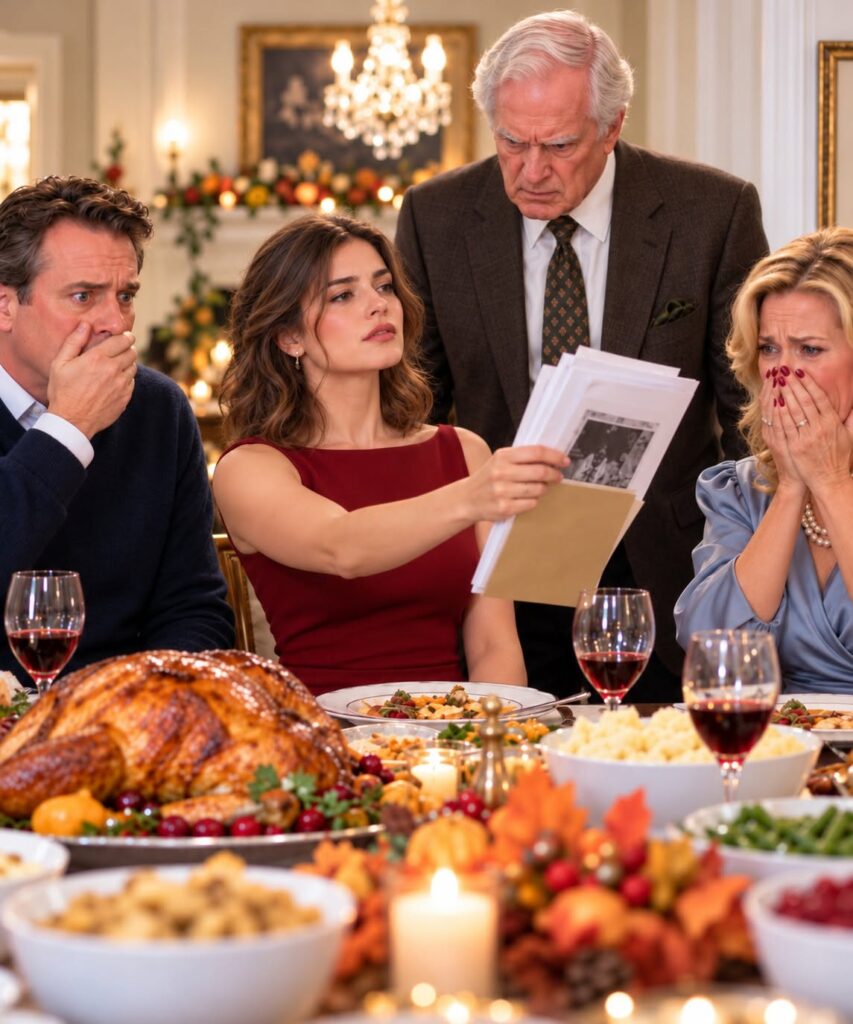
Mom dropped her wineglass.
Dad stood motionless, the carving knife still in his hand.
Then he laughed nervously.
“Dad, she’s twenty-nine. We’re teaching her responsibility.”
Grandpa Walter put down his fork.
“Richard, I wasn’t asking you.”
He turned toward me.
“Emma, sweetheart, how much are you paying?”
I swallowed.
“$1,950 a month.”
His expression changed.
“For how long?”
“Three years.”
Grandpa slowly leaned back in his chair.
“You’ve paid your parents $70,200 to live in a house I own?”
My father slammed the carving knife onto the serving platter.
“She lives under our roof! She should contribute!”
Grandpa stood.
“Your roof?”
Those two words marked the beginning of everything.
My name is Emma. Three years earlier, my grandmother Ruth had passed away after a long illness.
During her final months, I’d moved into the family home to help care for her.
When she died, Grandpa was devastated.
Eventually, he decided to spend more time in Florida.
Before leaving, he told me I could continue living in the house.
It was a beautiful place filled with childhood memories.
Grandma’s roses grew beside the porch, and her favorite photographs still lined the hallway.
Six months later, my parents announced they were moving in.
“We need to look after the property,” Mom explained.
I didn’t object.
They were my parents.
I trusted them.
But a few weeks after arriving, Mom handed me a lease agreement.
“Grandpa wants you to become financially independent,” she said.
I was confused.
“Grandpa told me I could stay here.”
“That doesn’t mean you should live for free,” Dad replied.
When I questioned the amount, he threatened to evict me.
So I began paying $1,950 every month.
Thirty-six payments.
A total of $70,200.
I worked in financial compliance at a regional bank, earning a respectable salary.
But almost $2,000 in monthly rent made saving difficult.
Meanwhile, my parents seemed increasingly comfortable.
They renovated the kitchen.
Purchased an expensive SUV.
Enjoyed vacations across Europe.
Whenever I complained about struggling financially, Mom dismissed me.
“Maybe stop buying so much coffee, sweetheart.”
For three years, I accepted the arrangement because I believed Grandpa needed the money.
Until six weeks before that Thanksgiving dinner.
I’d received another notice suggesting my rent might increase.
Something about it bothered me.
So I began looking into the property’s ownership.
The public records showed Grandpa was still the sole owner.
There was no transfer to my father.
No indication that my parents held any ownership interest.
I also discovered Grandpa had been paying the property taxes and insurance himself.
That’s when I started asking questions.
I reviewed my bank transfers.
Saved copies of the rental agreement.
And collected correspondence relating to the payments.
Then I found an email Mom had accidentally forwarded with another payment demand.
It changed everything.
Now, sitting at Thanksgiving dinner, I reached into my handbag.
“I know, Grandpa,” I said quietly.
Everyone turned toward me.
“I found out six weeks ago.”
Dad’s expression hardened.
“Found out what?”
I placed a thick envelope beside Grandpa’s plate.
“That you’ve been collecting rent you were never authorized to charge.”
Dad reached for the envelope.
Grandpa stopped him.
“Sit down, Richard.”
“I won’t let my daughter spread lies about me!”
“Then you should welcome the evidence.”
I opened the envelope.
First came thirty-six bank records showing payments of $1,950 into Dad’s personal account.
Then I produced the lease.
Under Property Owner appeared my father’s signature.
Grandpa studied it.
“I never transferred this house to you.”
Dad shrugged.
“I managed the property. It’s basically the same thing.”
“No,” Grandpa replied firmly. “It isn’t.”
Mom suddenly began crying.
“Walter, we sacrificed everything raising Emma! How can she embarrass us like this?”
I looked at her.
“Mom, you told me Grandpa needed the rent because his retirement savings were running low.”
Grandpa turned toward her.
“You told her WHAT?”
She went silent.
Then I removed the final document.
The email exchange between my parents.
Mom had accidentally included it in a forwarded message.
One email explained that I was paying without questioning the arrangement.
It warned Dad not to mention the payments to Grandpa, because he would probably allow me to live there for free.
Dad’s reply confirmed their plan.
They believed that as long as I thought my rent was helping Grandpa, I would continue paying.
Grandpa read the messages twice.
His hands began trembling.
For years, my parents had told me they were teaching responsibility.
In reality, they had been using my love for my grandfather to collect thousands of dollars for themselves.
Dad leaned across the table.
“You think these little papers change anything? We live here now.”
I looked at him calmly.
“You’re right, Dad. I don’t decide who stays.”
Then I turned toward Grandpa.
“He does.”
Dad laughed.
“Your grandfather isn’t going to throw his own son out.”
But Grandpa wasn’t laughing.
“Richard, you moved into my home, deceived my granddaughter, and collected money I never authorized you to collect.”
He carefully folded the documents.
“We will discuss your future here with my attorney.”
For the first time that evening, Dad looked genuinely uncomfortable.
The following morning, Grandpa and I met his lawyer.
His accountant joined the meeting remotely.
We expected to focus on my rent payments.
Instead, we uncovered something worse.
Dad had also submitted approximately $38,000 in questionable maintenance invoices to Grandpa.
One invoice claimed the entire roof had been replaced.
I knew that wasn’t true.
The previous winter, I’d personally paid to repair a leaking section.
Further review connected several invoices to a contractor associated with Dad.
The records suggested Grandpa had been charged for work that hadn’t been performed.
Grandpa stared at the documents.
Then he whispered:
“He wasn’t just taking money from you.”
He closed the folder.
“He was taking it from me too.”
Within days, Grandpa revoked Dad’s authority to manage the property.
His attorney requested a complete accounting and began the necessary legal proceedings.
I also pursued reimbursement of the rent payments.
Mom called repeatedly.
When I finally answered, she shouted:
“You’ve turned your grandfather against us!”
“No, Mom. I’ve shown him the records.”
“Do you understand what you’ve done to this family?”
“Yes,” I replied.
“I’ve stopped paying you.”
Then I ended the call.
Dad confronted me in the kitchen two days later.
“You think you’ve won?” he demanded. “You’ll destroy this family before you get a cent.”
I walked past him.
“Maybe you shouldn’t have built your lifestyle with money you weren’t entitled to take.”
The legal review continued.
Investigators examined the bank transfers, maintenance bills, and correspondence involving the contractor.
Eventually, the contractor acknowledged that some invoices described services that had never been performed.
Dad’s employer also learned that he’d used professional connections in the questionable billing arrangements.
He lost his management job.
Then came the civil lawsuit.
My parents insisted that the rent had been voluntary household contributions.
But their own emails suggested otherwise.
During a hearing, Mom’s attorney asked why I’d continued paying for three years if I believed the arrangement was unfair.
I answered truthfully.
“Because I believed my grandfather needed the money. My parents knew that, and they used it to deceive me.”
Behind me, Grandpa wiped away tears.
Several months later, the court issued judgments requiring my parents to repay the $70,200 they’d wrongfully collected from me and the additional $38,000 improperly obtained from Grandpa, along with applicable costs.
The fraudulent maintenance invoices remained the subject of a separate investigation.
My parents also lost their right to occupy the house.
They contested the process, but eventually the court ordered possession restored to Grandpa.
I stood on the porch as movers carried their belongings outside.
Mom approached me.
“I hope you’re happy, Emma. Your own mother has nowhere to go.”
I glanced at their expensive SUV.
“You could sell that.”
Her face tightened.
“You’ve become so cold.”
I shook my head.
“No, Mom. I’ve finally learned the difference between being kind and allowing someone to take advantage of me.”
She walked away without answering.
Eleven months after that Thanksgiving dinner, my life had changed completely.
Grandpa officially transferred ownership of the house to me.
The civil judgments were being enforced, and my parents had begun making repayments.
They moved into a modest apartment.
Dad found lower-paid work, while Mom took a part-time job.
I didn’t celebrate their difficulties.
I simply stopped feeling responsible for rescuing them from the consequences of their choices.
That spring, I planted new roses beside Grandma’s porch.
One evening, Grandpa visited carrying her old cookbook.
“I found something you might like,” he said.
Inside the front cover, Grandma had written six words in her familiar handwriting:
Always know what your love is worth.
I stared at the message.
Then I began crying.
Grandpa wrapped his arms around me.
“You were never supposed to pay for belonging here, sweetheart.”
I held him tightly.
For three years, my parents had convinced me that love and responsibility meant giving them nearly $2,000 every month.
They’d treated my financial independence as something they could exploit.
And they’d counted on my silence.
But they’d forgotten that I’d inherited Grandma’s determination as well as her love for that house.
The following Thanksgiving, Grandpa and I celebrated in my kitchen.
The same kitchen where our family had fallen apart a year earlier.
This time, there were no arguments.
No threats.
No financial demands disguised as lessons about responsibility.
Just a warm meal and the quiet comfort of being home.
As Grandpa raised his glass, my phone vibrated.
A message from Mom.
You took everything from us.
I read it once.
Then deleted it.
Because I knew the truth.
I hadn’t taken everything from my parents. I’d simply refused to let them keep taking from me.
I looked around the house Grandma had loved, the home Grandpa had protected, and the place I’d finally been allowed to call my own.
For the first time in three years, living there didn’t come with a monthly demand.
And for the first time in much longer, I understood that I never should have had to pay for my family’s love.
{"post":117178,"page":2,"next":[{"id":117173,"title":"I said to my mother-in-law that I had an early flight and went to bed. At midnight, I heard my door open. She went through my suitcase, zipped something into the inner pocket, then whispered: \u2018It\u2019s in her carry-on. Tip off airport security at six.\u2019","url":"https:\/\/new24.info\/117173"},{"id":117169,"title":"My husband was away in Europe with the woman he had once wanted to marry when I went into premature labor at thirty-two weeks.","url":"https:\/\/new24.info\/117169"},{"id":117164,"title":"I moved our retirement savings, leaving just $96. My son stormed in, demanding answers, while his wife searched our drawers. My husband smiled. \u201cLooking for the missing money?\u201d I asked as police quietly arrived outside.","url":"https:\/\/new24.info\/117164"},{"id":117160,"title":"My father stole my $60,000 SUV, handed the keys to my brother, and laughed when I demanded it back. \u201c\u201dLucas is the man of the family,\u201d\u201d he said. \u201c\u201dYou can manage without it.\u201d\u201d They thought I would swallow the humiliation like I always had.","url":"https:\/\/new24.info\/117160"},{"id":117155,"title":"After three years away, my husband finally returned home, but something felt different. That night, he wrapped his arm around my waist in an unfamiliar way. \u201cWho taught you to hold me like that?\u201d I asked. He sighed, \u201cIf you pretend you don\u2019t know, you can keep being my wife.\u201d I stayed silent, knowing I already had proof of his secret. The next morning, I called my lawyer\u2026","url":"https:\/\/new24.info\/117155"},{"id":117151,"title":"One month after I delivered our son, I dicovered that my husband had secretly purchased a lavish mansion for his personal assistant and her six-year-old daughter.","url":"https:\/\/new24.info\/117151"},{"id":117147,"title":"A Woman\u2019s Husband Said He\u2019d Forgotten His Passport at Home, So She Sent Her Mom to Get It While They Were at the Airport \u2013 Minutes Later, Her Mom Called and Whispered, \u2018Honey, He Set You Up! Come Home Now!\u2019","url":"https:\/\/new24.info\/117147"},{"id":117143,"title":"\u201cYour house is too big for one person!\u201d my mother yelled when I found my brother, his wife, and their three kids living in MY home. \u201cYou can sleep in the guest room,\u201d my brother laughed.","url":"https:\/\/new24.info\/117143"},{"id":117139,"title":"At 4:03 a.m., my resort manager called, trembling. \u201cSir, your daughter is here with four moving trucks! Her husband says he owns your entire beachfront resort!\u201d","url":"https:\/\/new24.info\/117139"},{"id":117135,"title":"My husband knocked my debit card from my hand at my thirty-six-week appointment, then turned to the receptionist and told her to cancel the ultrasound.","url":"https:\/\/new24.info\/117135"},{"id":117131,"title":"Every month, I gave my mother-in-law $1,500 without ever complaining. But when I couldn\u2019t make the payment because of a family emergency, she became furious. \u201cYou\u2019re nothing but a burden to this family!\u201d she snapped, leaving me deeply h3rt in my own home.","url":"https:\/\/new24.info\/117131"},{"id":117124,"title":"I covered $6,000 for our family getaway, only for Mom to text me: \u201cDon\u2019t come. Your sister\u2019s kids don\u2019t want you there.\u201d","url":"https:\/\/new24.info\/117124"},{"id":117119,"title":"A Rich Woman Took Every Discounted Turkey While an Elderly Grandma Begged for Just One for Her Sick Grandson \u2013 Then a Man\u2019s Voice Came over the Store Intercom, and the Rich Woman Went Pale","url":"https:\/\/new24.info\/117119"},{"id":117115,"title":"Three weeks before her wedding, my daughter looked me in the eyes and said, \u201cYour life is nothing to be proud of, Mom. Don\u2019t come to my wedding!\u201d Then she smiled. \u201cBut you\u2019re still paying for everything, right?\u201d","url":"https:\/\/new24.info\/117115"},{"id":117111,"title":"At my wife\u2019s funeral, my son pulled me aside and coldly made an announcement, \u201cDad, we\u2019re cutting off your allowance. You\u2019ll have to support yourself now!\u201d","url":"https:\/\/new24.info\/117111"},{"id":117106,"title":"Forged Signatures And Dark Secrets Uncovered Beside A Comatose Teenage Son","url":"https:\/\/new24.info\/117106"},{"id":117100,"title":"Ungrateful Son Demanded Wedding Money Without Knowing I Owned His Venue","url":"https:\/\/new24.info\/117100"},{"id":117096,"title":"After my husband Zachary Lexington spent his fifth consecutive night away","url":"https:\/\/new24.info\/117096"},{"id":117091,"title":"I came home from a business trip and found my SUV gone. My stepdaughter sat at the kitchen island and casually said, \u201cDad needed it more than you did.\u201d","url":"https:\/\/new24.info\/117091"},{"id":117087,"title":"I Thought This Was An Ordinary Yard Sale Find, Until I Realized\u2026 See more..","url":"https:\/\/new24.info\/117087"}]}