I had just returned from an oil platform in the Gulf of Mexico, where a severe storm had delayed my trip home for nine days.
My seventeen-year-old son, Mason, had suffered a devastating brain injury during a practice session at his athletic academy.
He’d been unconscious ever since.
And while I was stranded offshore, Todd had apparently made decisions about our son’s future without me.
Standing beside him was his girlfriend, Brittany, along with a man named Walter Pruitt.
“Don’t fight this,” Todd told me. “The doctors say there’s nothing more they can do.”
I stared at him.
“How could you agree to something like this without talking to me?”
He looked away.
A physician named Dr. Holloway explained that Mason hadn’t demonstrated consistent conscious responses and that the team had been discussing whether continued invasive support was appropriate.
But something about the situation felt terribly rushed.
I demanded to see my son.
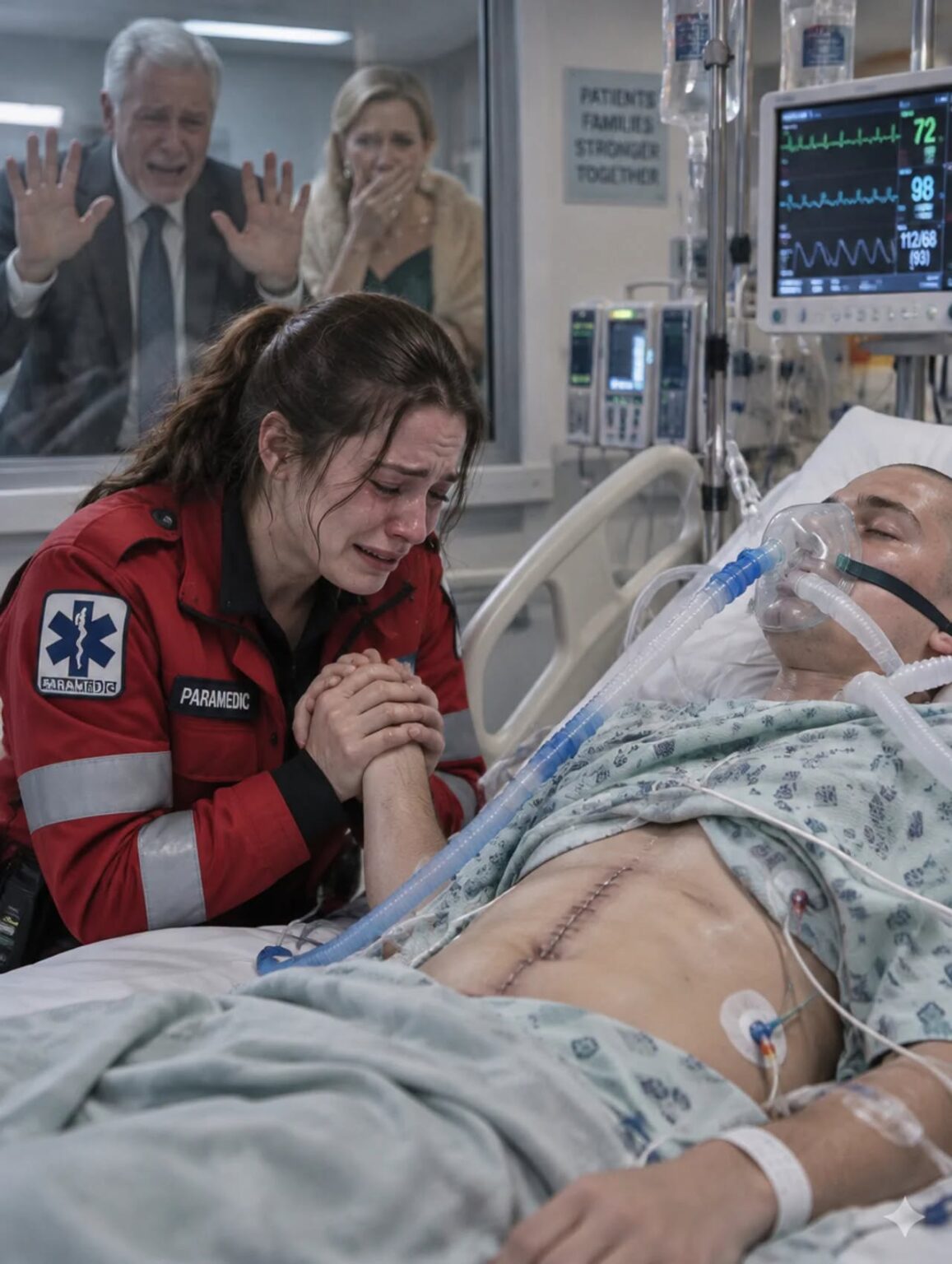
When I entered his room, I barely recognized the boy lying beneath the white sheets.
Mason had always been athletic and energetic.
Now he lay motionless, surrounded by monitors, with a ventilator helping him breathe.
I sat beside him and took his hand.
Then I remembered something from eleven years earlier.
When Mason was six, we’d visited a crowded county fair. He’d become frightened and overwhelmed, unable to explain what was bothering him.
So I’d taught him a little system.
One squeeze meant yes. Two squeezes meant no.
It became our private way of communicating whenever he struggled to find words.
I leaned toward his ear.
“Mason, it’s Mom.”
Nothing.
I swallowed.
“Sweetheart, if you can hear me, remember our old game?”
His fingers remained still.
Then I asked:
“Do you want them to stop helping you breathe on Friday?”
For several seconds, there was no response.
Then I felt it.
A faint pressure around my hand.
One squeeze.
A pause.
Then a second squeeze.
My heart began pounding.
“Mason?”
I called for the nurse immediately.
“He squeezed my hand twice. Please, you need to examine him!”
Todd appeared in the doorway.
“Those movements are probably reflexes.”
Walter agreed.
“The medical schedule has already been established.”
I turned toward him.
“Who are you to decide anything about my son’s treatment?”
He avoided answering.
Then a nurse brought over some paperwork.
As I examined the documents, I noticed a signature on a family request form.
My signature.
Dated three days earlier.
I stared at it.
Someone had signed my name while I was stranded on an oil platform hundreds of miles away.
“I didn’t sign this,” I said.
Todd’s face changed.
I looked toward the nurse.
“I want my objection documented immediately. No decisions should rely on a form I never authorized.”
The charge nurse, Janet, explained that the document was not sufficient on its own to determine Mason’s treatment.
She also revealed something important.
Mason had shown small responses earlier in the week, but those observations hadn’t received the thorough follow-up they warranted.
I insisted on another neurological assessment.
Dr. Holloway and a second physician returned to examine him.
Using our hand-squeeze system, they asked simple identifying questions.
Mason responded.
Not perfectly.
Not every time.
But enough to raise serious questions about his level of awareness.
The doctors paused the proposed withdrawal of support and arranged a specialized evaluation.
I felt hope for the first time since hearing about his accident.
Then Brittany began complaining.
“Do you have any idea how much all this is costing?”
I turned toward her.
“My son is fighting for his life.”
Walter interrupted, mentioning an insurance settlement.
That was when I discovered he wasn’t an independent hospital adviser.
He represented the insurer connected to Mason’s athletic academy.
I demanded that he be excluded from decisions about Mason’s care.
Then I examined the disputed request form again.
Brittany’s name appeared as a witness.
My suspicion grew.
That evening, I contacted one of Mason’s teammates, Jordan.
I asked him to tell me exactly what happened during practice.
A few minutes later, he sent a photograph.
It showed Brittany driving a company truck near the track shortly before Mason’s accident.
The vehicle was approaching an area ordinarily restricted to maintenance traffic.
I immediately contacted an attorney named Diane Foster.
Together, we requested preservation of the academy’s security recordings, access logs, incident reports, and related records.
On Thursday, an independent neurologist examined Mason.
The findings suggested he was transitioning into a minimally conscious state and could demonstrate intentional responses.
His prognosis remained uncertain.
But he was not simply beyond the possibility of awareness, as I’d been led to believe.
The plan to remove ventilator support was canceled pending further evaluation.
With that immediate danger addressed, I confronted Todd in the hospital cafeteria.
I placed Jordan’s photograph and the disputed medical form on the table.
“Tell me what really happened.”
Todd stared at the photograph.
Then his shoulders dropped.
Brittany had driven through a restricted maintenance gate during practice.
Her truck startled Mason, who lost control and crashed into a barrier.
Instead of reporting her involvement honestly, Todd and Brittany had concealed it.
“Why?” I whispered.
Todd began crying.
“Because she could lose her job. And Walter offered a settlement.”
“How much?”
“Forty-five thousand dollars.”
I couldn’t believe it.
They’d hoped to secure a quick insurance payout to cover mounting hospital expenses before Friday.
And in doing so, they’d allowed financial pressure and a fraudulent family request to become entangled with discussions about ending my son’s treatment.
“You were willing to lie about how Mason was hurt?”
Todd said nothing.
“Then you forged my signature?”
He lowered his head.
I stood.
“Our son isn’t a bill you can make disappear.”
Diane and I submitted the evidence to law enforcement and the appropriate authorities.
We rejected the proposed settlement and requested a complete review of the accident, the financial arrangements, and the unauthorized signature.
The months that followed were difficult.
Mason developed a respiratory infection and later required a tracheostomy.
His recovery was slow and exhausting.
Some days, he could barely respond.
Other days, he’d surprise us with a small movement or a clear answer using a communication board.
Eventually, he began participating in intensive rehabilitation.
The investigation confirmed that Brittany had entered a restricted area, leading to her suspension and a broader review of the academy’s responsibility.
Todd and I began divorce proceedings.
He continued contributing toward Mason’s medical expenses and visiting him, but our relationship had been damaged beyond repair.
I couldn’t forgive the decisions he’d made when our son was most vulnerable.
I sold my truck, accepted a land-based safety position, and reorganized my life around Mason’s care.
I no longer cared whether he returned to competitive running.
His father had spent years pushing him toward athletic achievements.
I wanted something different.
I wanted Mason to have the freedom to decide what kind of life he wished to live.
One quiet Sunday afternoon, I visited him during rehabilitation.
He was sitting in a chair beside the window when I pulled something from my pocket.
An old keychain from the county fair.
The same one we’d bought when he was six.
“Remember this?” I asked.
His eyes moved toward it.
I smiled.
“This is where we invented our secret code.”
He gave the faintest smile.
I placed the keychain in his hand.
“Do you want to leave it here at the clinic?”
His fingers closed around mine.
One squeeze.
Then another.
No.
I laughed through my tears.
“All right, sweetheart. We’ll take it home.”
He smiled again.
It was small.
But to me, it meant everything.
Months earlier, I’d walked into a hospital where people were discussing my son’s future as though he had no voice and I had no right to question them.
A forged signature had nearly helped silence my objections.
But one tiny movement of Mason’s fingers changed the course of everything.
I don’t know exactly what his recovery will look like.
I don’t know whether he’ll run again, return to the track, or choose an entirely different future.
But I know one thing.
My son is more than his injuries, more than an insurance settlement, and more than the expectations other people placed on him.
He deserves to be heard.
And as long as I’m beside him, I’ll keep listening.
Even when all he can manage is two small squeezes of my hand.
{"post":117106,"page":2,"next":[{"id":117100,"title":"Ungrateful Son Demanded Wedding Money Without Knowing I Owned His Venue","url":"https:\/\/new24.info\/117100"},{"id":117096,"title":"After my husband Zachary Lexington spent his fifth consecutive night away","url":"https:\/\/new24.info\/117096"},{"id":117091,"title":"I came home from a business trip and found my SUV gone. My stepdaughter sat at the kitchen island and casually said, \u201cDad needed it more than you did.\u201d","url":"https:\/\/new24.info\/117091"},{"id":117087,"title":"I Thought This Was An Ordinary Yard Sale Find, Until I Realized\u2026 See more..","url":"https:\/\/new24.info\/117087"},{"id":117083,"title":"With heavy hearts, we announce the passing of this legendary man who became such a big part of our childhood. Check the first commen.t","url":"https:\/\/new24.info\/117083"},{"id":117079,"title":"It is with heavy hearts that we announce the passing of this legendary musician\u2026See more","url":"https:\/\/new24.info\/117079"},{"id":117075,"title":"CNN Founder Ted Turner Dies at 87 \u2014 The Man Who Changed Television News Forever..","url":"https:\/\/new24.info\/117075"},{"id":117071,"title":"Grandpa Never Raised His Voice When the Teller Brushed Him Off. He Just Asked for the Manager.","url":"https:\/\/new24.info\/117071"},{"id":117066,"title":"Hidden Hospital Footage Revealed My Paralyzed Husband Was Faking His Severe Injuries","url":"https:\/\/new24.info\/117066"},{"id":117062,"title":"The Flight of Honor: How a Father\u2019s Quiet Sacrifice for His Late Wife, an Unjust Flight Agent, and an Unexpected Military Encounter in the First-Class Cabin Brought Healing, Grace, and a Lifelong Family Guardian to a Young Girl\u2019s Grieving World Beneath the Carolina Sky","url":"https:\/\/new24.info\/117062"},{"id":117058,"title":"The Open Garage Exposed a Secret I Never Saw Coming","url":"https:\/\/new24.info\/117058"},{"id":117054,"title":"At 64, I Married a 31-Year-Old Man. Six Months Later, I Noticed That Every Evening He Secretly Added Something to My Drink and Insisted I Finish Every Last Drop.","url":"https:\/\/new24.info\/117054"},{"id":117042,"title":"Very rare photos of Princess Diana","url":"https:\/\/new24.info\/117042"},{"id":117036,"title":"A Life Shaped by Sound, Solitude, and Global Influence","url":"https:\/\/new24.info\/117036"},{"id":117032,"title":"At My 8-Year-Old Daughter\u2019s $2,500 Birthday Party, My Sister-in-Law Snapped, \u201cYOU CAN\u2019T EAT ANYTHING! ASK YOUR MOM FOR FOOD!\u201d While Every Other Child Enjoyed Cake, My Daughter Stood There With an Empty Plate. I Demanded an Explanation, but the Manager Revealed My Husband\u2019s Signature on a Shocking Document\u2026","url":"https:\/\/new24.info\/117032"},{"id":117028,"title":"My son laughed while I rented a one-bedroom apartment behind a laundromat. Eight months later, he walked into my beautiful new villa, looked at his wife, and announced, \u201cIt\u2019s perfect. Kendra will love living here.\u201d","url":"https:\/\/new24.info\/117028"},{"id":117024,"title":"My Ex Husband Trashed My House Until My Father Stepped In","url":"https:\/\/new24.info\/117024"},{"id":117020,"title":"They Sold It to Me for $1 and Forgot Who Paid for Everything After. I Kept the Receipts","url":"https:\/\/new24.info\/117020"},{"id":117015,"title":"My father tossed my grandmother\u2019s savings passbook into her grave and sneered that it was worthless. The following morning, I walked into the bank with that same book, and the teller went pale before reaching for the phone and calling the police.","url":"https:\/\/new24.info\/117015"},{"id":117010,"title":"Widow Sells Her Home To Help Son But Discovers Secret Paperwork","url":"https:\/\/new24.info\/117010"}]}