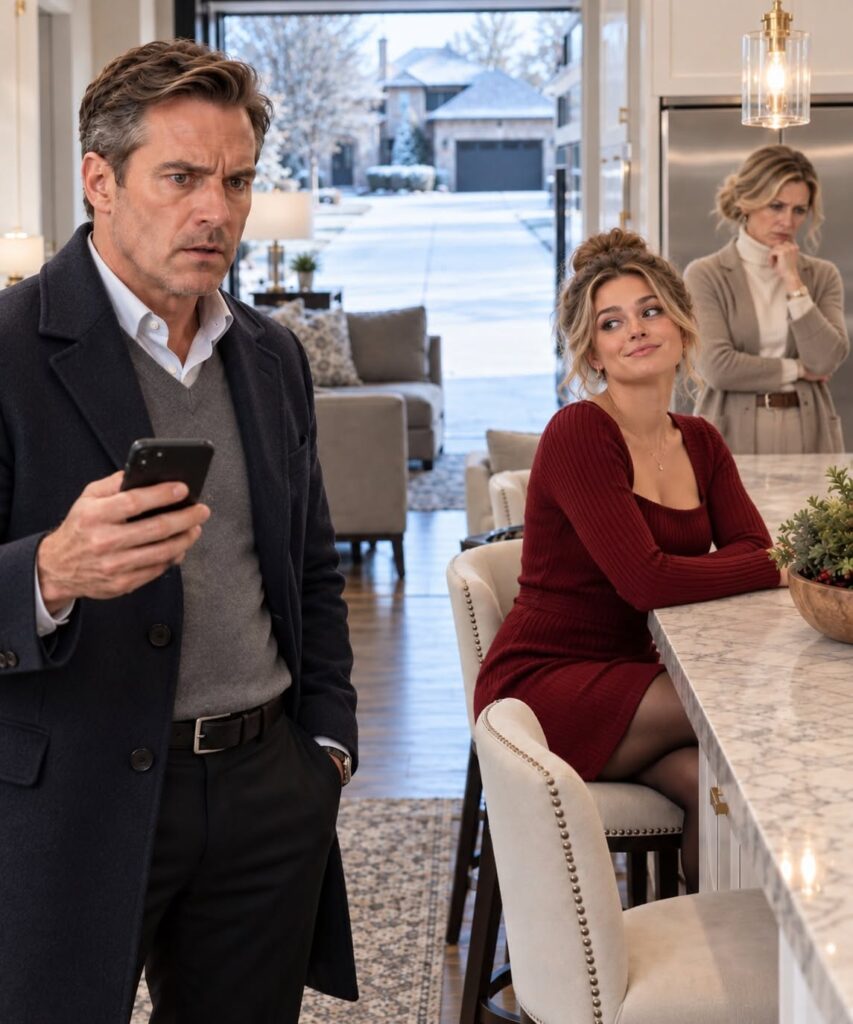
Inside, my twenty-two-year-old stepdaughter, Madison, sat at the kitchen island, scrolling through her phone.
“Where’s my SUV?” I asked.
She barely looked up.
“Dad needed it more than you did.”
I stared at her.
“Excuse me?”
“Derek doesn’t have a reliable car. You have your company sedan.”
My wife, Laura, walked into the kitchen carrying groceries.
When she refused to meet my eyes, I knew she’d been involved.
“Laura, did you know about this?”
She sighed.
“Madison wanted to help her father. I thought you’d understand.”
I couldn’t believe what I was hearing.
I’d purchased that $48,000 vehicle with my own money eighteen months earlier.
The title, registration, and insurance were all in my name.
Yet my stepdaughter had simply handed it to her biological father.
“Where is it now?” I asked.
“At Dad’s apartment,” Madison replied.
“And the keys?”
“He has both sets.”
Then she smiled.
“You can’t take it back anyway. Dad already has paperwork saying it’s his.”
Something inside me went cold.
I walked into my home office and opened the drawer where I kept important documents.
The vehicle’s title folder was missing.
What Madison didn’t know was that I worked in corporate risk management and had recently been promoted to regional fraud investigator.
I dealt with forged signatures, fraudulent transfers, and financial misconduct professionally.
And I had installed a security camera in my office.
Instead of arguing, I quietly began gathering evidence.
The footage showed Madison entering my office late at night while I was away.
She opened my desk, removed the title, and sat down with a pen.
Then she practiced my signature.
Once.
Twice.
Nine times.
Finally, she signed the transfer document herself.
My stepdaughter hadn’t merely given away my SUV. She’d forged my name to make the theft look legal.
I watched the recording twice.
For eight years, I’d helped raise Madison.
I’d paid tuition bills, apartment deposits, and emergency expenses whenever her father refused.
Once, during an argument, she’d screamed that I wasn’t her real dad.
Apparently, I was family whenever she needed money.
But not when my property was involved.
The following morning, I contacted my insurance company, preserved the security footage, and reported the matter to the authorities.
Then Derek called.
“Ethan,” he said smugly, “heard you’re upset about the truck.”
“It’s an SUV.”
“Whatever. Madison gave it to me.”
“She didn’t own it.”
He laughed.
“I have a signed transfer.”
“Do you?”
“Your signature, buddy.”
I let him continue talking.
Then he revealed something even more astonishing.
He was planning to sell the Yukon for $35,000.
Unless, of course, I wanted to buy it back from him.
“How much?” I asked.
“Forty thousand. Family discount.”
I could hardly believe the arrogance.
He wanted me to pay $40,000 to recover my own vehicle.
I kept my voice calm.
“Come to my house tomorrow at six. Bring Madison, Laura, and every document you have.”
He sounded delighted.
“Finally ready to negotiate?”
“Absolutely.”
The next evening, Derek arrived wearing sunglasses and my leather driving gloves.
Madison looked pleased.
Laura seemed relieved that I was apparently willing to settle the matter privately.
Then the doorbell rang again.
Two more visitors entered.
Detective Marcus Hill.
And Rebecca Lawson, an investigator from my insurance company’s special investigations unit.
Derek’s smile vanished.
Madison went pale.
“What is this?” Laura whispered.
I looked at them.
“This is what happens when someone takes property that doesn’t belong to them.”
Derek immediately protested.
“I own that vehicle!”
Rebecca examined the documents.
“The ownership transfer has been reported as fraudulent.”
Then Detective Hill displayed the security footage on our television.
Madison appeared on the screen.
Opening my office drawer.
Removing the title.
Practicing my signature.
Signing the document.
Nobody said a word.
Finally, Madison began crying.
“Ethan, I didn’t know it would go this far.”
I looked at her.
“You forged my signature.”
“Dad said you’d never press charges against family!”
Derek turned sharply.
“Don’t drag me into this!”
Madison stared at him.
“You told me how to sign it!”
Then I played the recording of Derek acknowledging the supposed transfer and demanding money to return my vehicle.
His expression changed completely.
For the first time since I’d known him, he had nothing clever to say.
Laura began crying.
“Ethan, please. We can fix this.”
I shook my head.
“You had every opportunity to stop it.”
“I didn’t know Madison forged your signature!”
“But you knew she gave away my vehicle. And you told me to accept it.”
She looked down.
Then I placed another envelope on the coffee table.
Inside were separation documents prepared with my attorney.
Laura stared at them.
“You’re divorcing me over a car?”
“No,” I replied.
“I’m divorcing you because when your daughter stole from me, you expected me to sacrifice my rights to keep the peace.”
The investigation continued over the following months.
Derek ultimately pleaded guilty to charges arising from possessing and attempting to sell stolen property.
Madison accepted a plea agreement involving probation, restitution, and community service.
Her actions also cost her a promising administrative job.
Laura and I divorced.
I recovered my Yukon within days, but I decided to sell it.
Every time I looked at it, I remembered that afternoon in my kitchen.
I wanted to move forward.
Six months later, I purchased a smaller house overlooking a lake.
It was quiet.
There were no arguments about money, no demands disguised as family obligations, and no one treating my generosity as an entitlement.
One Saturday morning, I sat on my dock with a cup of coffee.
My phone vibrated.
A message from Madison.
I finally understand what I did. I’m sorry.
I stared at the screen for a long time.
Then I set the phone aside.
Maybe someday I’d be ready to respond.
I didn’t wish her harm.
But an apology couldn’t instantly restore the trust she’d destroyed.
I looked across the lake as the morning sunlight spread over the water.
For years, Madison and Derek had mistaken my patience for weakness.
They assumed that because I rarely raised my voice, I would accept whatever they decided.
They’d been wrong.
My stepdaughter thought she could steal a $48,000 SUV because I was too kind to fight back.
What she never understood was that being calm doesn’t mean being powerless.
Sometimes, the strongest response isn’t an argument.
It’s knowing the truth, protecting yourself, and finally refusing to be taken advantage of.
{"post":117091,"page":2,"next":[{"id":117087,"title":"I Thought This Was An Ordinary Yard Sale Find, Until I Realized\u2026 See more..","url":"https:\/\/new24.info\/117087"},{"id":117083,"title":"With heavy hearts, we announce the passing of this legendary man who became such a big part of our childhood. Check the first commen.t","url":"https:\/\/new24.info\/117083"},{"id":117079,"title":"It is with heavy hearts that we announce the passing of this legendary musician\u2026See more","url":"https:\/\/new24.info\/117079"},{"id":117075,"title":"CNN Founder Ted Turner Dies at 87 \u2014 The Man Who Changed Television News Forever..","url":"https:\/\/new24.info\/117075"},{"id":117071,"title":"Grandpa Never Raised His Voice When the Teller Brushed Him Off. He Just Asked for the Manager.","url":"https:\/\/new24.info\/117071"},{"id":117066,"title":"Hidden Hospital Footage Revealed My Paralyzed Husband Was Faking His Severe Injuries","url":"https:\/\/new24.info\/117066"},{"id":117062,"title":"The Flight of Honor: How a Father\u2019s Quiet Sacrifice for His Late Wife, an Unjust Flight Agent, and an Unexpected Military Encounter in the First-Class Cabin Brought Healing, Grace, and a Lifelong Family Guardian to a Young Girl\u2019s Grieving World Beneath the Carolina Sky","url":"https:\/\/new24.info\/117062"},{"id":117058,"title":"The Open Garage Exposed a Secret I Never Saw Coming","url":"https:\/\/new24.info\/117058"},{"id":117054,"title":"At 64, I Married a 31-Year-Old Man. Six Months Later, I Noticed That Every Evening He Secretly Added Something to My Drink and Insisted I Finish Every Last Drop.","url":"https:\/\/new24.info\/117054"},{"id":117042,"title":"Very rare photos of Princess Diana","url":"https:\/\/new24.info\/117042"},{"id":117036,"title":"A Life Shaped by Sound, Solitude, and Global Influence","url":"https:\/\/new24.info\/117036"},{"id":117032,"title":"At My 8-Year-Old Daughter\u2019s $2,500 Birthday Party, My Sister-in-Law Snapped, \u201cYOU CAN\u2019T EAT ANYTHING! ASK YOUR MOM FOR FOOD!\u201d While Every Other Child Enjoyed Cake, My Daughter Stood There With an Empty Plate. I Demanded an Explanation, but the Manager Revealed My Husband\u2019s Signature on a Shocking Document\u2026","url":"https:\/\/new24.info\/117032"},{"id":117028,"title":"My son laughed while I rented a one-bedroom apartment behind a laundromat. Eight months later, he walked into my beautiful new villa, looked at his wife, and announced, \u201cIt\u2019s perfect. Kendra will love living here.\u201d","url":"https:\/\/new24.info\/117028"},{"id":117024,"title":"My Ex Husband Trashed My House Until My Father Stepped In","url":"https:\/\/new24.info\/117024"},{"id":117020,"title":"They Sold It to Me for $1 and Forgot Who Paid for Everything After. I Kept the Receipts","url":"https:\/\/new24.info\/117020"},{"id":117015,"title":"My father tossed my grandmother\u2019s savings passbook into her grave and sneered that it was worthless. The following morning, I walked into the bank with that same book, and the teller went pale before reaching for the phone and calling the police.","url":"https:\/\/new24.info\/117015"},{"id":117010,"title":"Widow Sells Her Home To Help Son But Discovers Secret Paperwork","url":"https:\/\/new24.info\/117010"},{"id":117006,"title":"A Father Started Charging His 18-Year-Old Son $250 a Month for His Room \u2013 Five Years Later, the Young Man Received a Box That Turned His Life Upside Down","url":"https:\/\/new24.info\/117006"},{"id":117001,"title":"A Woman\u2019s Husband Didn\u2019t Know She\u2019d Regained Her Sight After Two Years of Blindness \u2013 When She Saw What He\u2019d Been Keeping in Their Bedroom, She Was Speechless","url":"https:\/\/new24.info\/117001"},{"id":116997,"title":"My eight-year-old son chose his wealthy father in court and told the judge, \u201cMy mom can\u2019t give me the future I deserve.\u201d","url":"https:\/\/new24.info\/116997"}]}