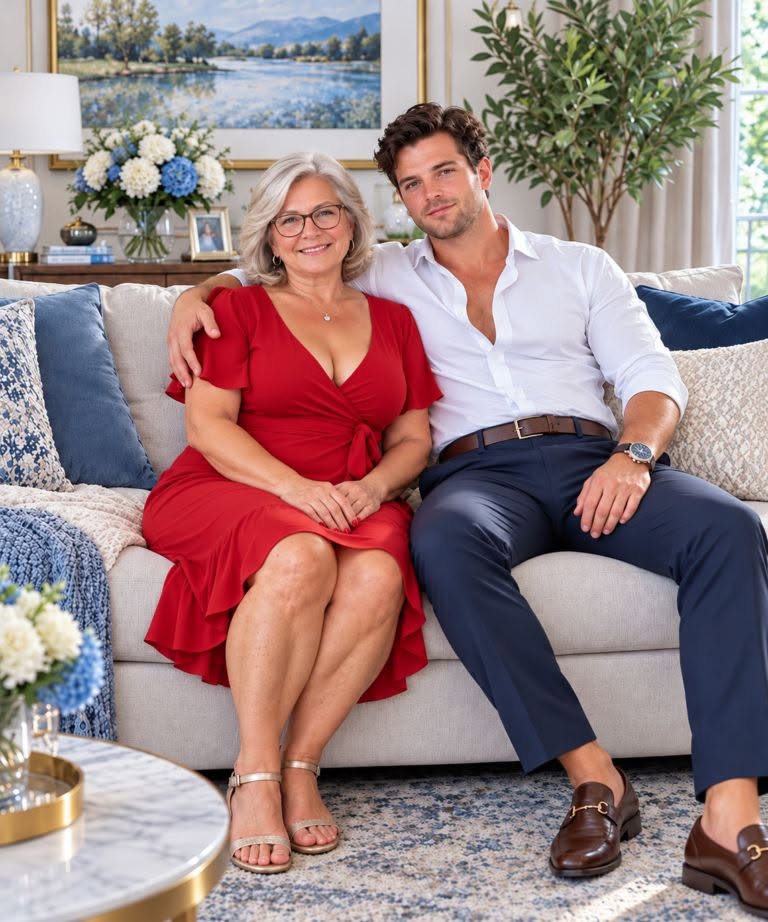
I always gave the same answer.
“Because he loves me.”
For the first few months, I genuinely believed it.
Daniel was attentive, generous, and seemingly devoted. He remembered my favorite flowers, my childhood stories, and even the books I’d loved as a little girl.
Then he began preparing me a warm bedtime drink.
Milk, honey, cinnamon, and vanilla.
“My mother used to make this,” I told him.
“I remembered,” he said.
But soon, something changed.
I began waking up exhausted. I struggled to concentrate, forgot ordinary conversations, and sometimes felt confused for hours.
Daniel insisted I was simply getting older.
Then one evening, I walked into the kitchen unexpectedly.
He was standing over my cup, adding drops from a small dark bottle.
“What are you putting in there?”
He quickly turned.
“Just flavoring, sweetheart.”
“Can I see it?”
His expression tightened.
“Margaret, don’t worry about everything.”
That night, I barely slept.
A few days later, I overheard him whispering into his phone.
“She’s getting suspicious. We’re running out of time.”
Then came the words that terrified me.
“I know what happened to the others. I won’t let that happen again.”
The others?
Who was he talking about?
I decided to find out.
I arranged for a sample of the drink to be independently analyzed.
Two days later, a physician named Dr. Samuel Reeves asked me to visit his office.
He studied the laboratory results with a serious expression.
“Mrs. Bennett, this beverage contains a compound associated with an experimental medical research program.”
I stared at him.
“Experimental?”
He nodded.
“Something like this should never be administered without proper medical supervision and informed consent.”
Then he asked whether I’d recently attended a private clinic.
I had.
Three months earlier, Daniel had insisted I undergo an expensive medical screening with a physician named Dr. Adrian Cole.
I’d signed several documents.
Daniel had assured me they were routine.
Dr. Reeves turned his computer toward me.
There was my name.
My address.
My medical information.
And beneath it:
RESEARCH PARTICIPANT.
“I never agreed to be part of an experiment,” I whispered.
The records suggested I’d been enrolled in a study investigating biological processes associated with aging.
Daniel’s company was one of its financial backers.
Then Dr. Reeves handed me a sealed envelope someone had delivered for me.
Inside was an old photograph.
A hospital bed.
A silver-haired woman who looked astonishingly like me.
And beside her stood a young man who looked exactly like Daniel.
But the photograph was dated twenty-seven years earlier.
On the back, someone had written:
Margaret is not the first. Ask Daniel what happened to the other three.
My hands shook.
Before I could ask another question, someone knocked.
“Margaret?”
It was Daniel.
He had followed me to the doctor’s office.
I held up the photograph.
“Who is this woman?”
His face crumpled.
“Her name was Evelyn Mercer.”
“And the man beside her?”
“My father.”
Daniel explained that Evelyn had been deeply important to his father, a physician who’d spent years researching her complicated neurological illness.
When she died, his father continued investigating experimental treatments involving aging-related biological processes.
Three other women later participated in the research.
All experienced serious medical complications.
Two eventually died.
The third survived with lasting health problems.
I felt sick.
“And you knew about this?”
Daniel hesitated.
“Yes.”
“Before we got married?”
He lowered his head.
“Yes.”
Then I asked the question I’d been afraid to say aloud.
“Did you marry me because I look like Evelyn?”
Tears filled his eyes.
“Not only because of that.”
I felt as though the room had tilted.
Daniel admitted he’d first noticed my photograph in records connected to the research program.
He’d learned details about my life before approaching me at a charity fundraiser.
My career.
My family.
My preferences.
Even some of the thoughtful surprises I’d believed proved how carefully he listened.
Our meeting hadn’t been accidental.
“At first, I wanted to meet you because of the research,” he admitted. “But I truly fell in love with you.”
I stared at him.
“You enrolled me in an experiment without telling me.”
He tried to explain that Dr. Cole had assured him the treatment was promising.
Then Daniel admitted he’d discovered discrepancies in my medical records.
The original tests hadn’t established the condition used to justify my participation.
Yet he’d continued preparing my nightly drink.
“You watched me become exhausted and confused,” I whispered.
He nodded.
“And you still gave it to me?”
“I was afraid stopping without medical supervision might hurt you.”
Dr. Reeves interrupted.
“That doesn’t justify withholding information or continuing treatment without informed consent.”
I turned toward Daniel.
“You don’t get to decide what happens to my body simply because you think you know what’s best.”
For once, he had no answer.
I asked for independent medical care and a full review of the research records.
Then I called Helen.
She arrived shortly afterward and took me home with her.
Over the following weeks, investigators began examining the clinic and its earlier research.
Documents confirmed serious concerns about my enrollment and the way my symptoms had been handled.
The program was suspended, and Dr. Cole was removed pending further review.
Eventually, I discovered who had sent the photograph.
Her name was Laura Mitchell.
She was the third woman from the earlier research.
She’d survived, but her health had never fully recovered.
After learning that the program might have resumed, she’d tried to warn me.
When we finally met, I asked why she’d gone to so much trouble.
She smiled sadly.
“Because nobody listened when I first asked questions.”
I reached across the table and squeezed her hand.
“Thank you.”
Months later, I returned to Daniel’s mansion with Helen to collect my belongings.
He was waiting in the entrance hall.
“I really did fall in love with you, Margaret,” he said.
I looked at him.
“Perhaps you did. But you were so determined to finish your father’s research that you forgot I was a person who had the right to choose.”
He began crying.
“Please don’t leave.”
I shook my head.
“Our marriage is over.”
Eventually, we divorced.
Daniel cooperated with the investigation and sent me one final letter, acknowledging that he’d mistaken control for protection.
I didn’t respond.
A year after discovering the bottle, I moved into a small home near Helen.
I returned to volunteering with children, helping them learn to read.
My energy gradually improved under independent medical care.
One evening, I stood in my kitchen preparing a familiar drink.
Warm milk.
Honey.
Cinnamon.
Vanilla.
The same recipe Daniel had made for me.
For a moment, I hesitated.
Then I carried the cup to the window and took a sip.
It tasted exactly like the drink my mother used to prepare.
Comforting.
Familiar.
Safe.
I drank half.
Then I set it down.
And smiled.
Because for the first time in months, nobody was insisting I finish it.
I could drink the rest.
Or pour it away.
The decision was mine.
I once believed the greatest proof of love was having someone who wanted to take care of me.
Now I understand that genuine love also means respecting my right to make my own decisions.
Daniel gave me a beautiful home, expensive gifts, and promises of a wonderful future.
But he’d taken away something far more precious.
My ability to choose what happened to my own life.
And getting that freedom back meant more than anything his millions could ever buy.
{"post":117054,"page":2,"next":[{"id":117042,"title":"Very rare photos of Princess Diana","url":"https:\/\/new24.info\/117042"},{"id":117036,"title":"A Life Shaped by Sound, Solitude, and Global Influence","url":"https:\/\/new24.info\/117036"},{"id":117032,"title":"At My 8-Year-Old Daughter\u2019s $2,500 Birthday Party, My Sister-in-Law Snapped, \u201cYOU CAN\u2019T EAT ANYTHING! ASK YOUR MOM FOR FOOD!\u201d While Every Other Child Enjoyed Cake, My Daughter Stood There With an Empty Plate. I Demanded an Explanation, but the Manager Revealed My Husband\u2019s Signature on a Shocking Document\u2026","url":"https:\/\/new24.info\/117032"},{"id":117028,"title":"My son laughed while I rented a one-bedroom apartment behind a laundromat. Eight months later, he walked into my beautiful new villa, looked at his wife, and announced, \u201cIt\u2019s perfect. Kendra will love living here.\u201d","url":"https:\/\/new24.info\/117028"},{"id":117024,"title":"My Ex Husband Trashed My House Until My Father Stepped In","url":"https:\/\/new24.info\/117024"},{"id":117020,"title":"They Sold It to Me for $1 and Forgot Who Paid for Everything After. I Kept the Receipts","url":"https:\/\/new24.info\/117020"},{"id":117015,"title":"My father tossed my grandmother\u2019s savings passbook into her grave and sneered that it was worthless. The following morning, I walked into the bank with that same book, and the teller went pale before reaching for the phone and calling the police.","url":"https:\/\/new24.info\/117015"},{"id":117010,"title":"Widow Sells Her Home To Help Son But Discovers Secret Paperwork","url":"https:\/\/new24.info\/117010"},{"id":117006,"title":"A Father Started Charging His 18-Year-Old Son $250 a Month for His Room \u2013 Five Years Later, the Young Man Received a Box That Turned His Life Upside Down","url":"https:\/\/new24.info\/117006"},{"id":117001,"title":"A Woman\u2019s Husband Didn\u2019t Know She\u2019d Regained Her Sight After Two Years of Blindness \u2013 When She Saw What He\u2019d Been Keeping in Their Bedroom, She Was Speechless","url":"https:\/\/new24.info\/117001"},{"id":116997,"title":"My eight-year-old son chose his wealthy father in court and told the judge, \u201cMy mom can\u2019t give me the future I deserve.\u201d","url":"https:\/\/new24.info\/116997"},{"id":116993,"title":"My thirteen-year-old son sold his prized electric guitar to buy a specialized wheelchair for a girl in his class\u2026 but early the next morning, two armed police officers showed up at our front door. And what they revealed left me completely paralyzed.","url":"https:\/\/new24.info\/116993"},{"id":116988,"title":"Claire Bought a Two-Dollar Ticket Right Before Mark Demanded Her House Keys","url":"https:\/\/new24.info\/116988"},{"id":116983,"title":"Undercover Boss Discovers Shocking Secret Destroying His Mothers Sacred Diner Legacy","url":"https:\/\/new24.info\/116983"},{"id":116979,"title":"My Husband Chose His Mistress And Lost My Seventy Three Million Fortune","url":"https:\/\/new24.info\/116979"},{"id":116975,"title":"Entitled Son Mocked My Purchases So I Canceled His Secret Financial Lifeline","url":"https:\/\/new24.info\/116975"},{"id":116970,"title":"At seven months pregnant, I received a call from a police officer. \u201cYour husband was in a car accident. He\u2019s in the hospital.\u201d","url":"https:\/\/new24.info\/116970"},{"id":116966,"title":"I came home late from my hospital shift during a blizzard. Dad had locked the door: \u201cCurfew is 10. Rules are rules.\u201d","url":"https:\/\/new24.info\/116966"},{"id":116962,"title":"My Husband Said Senior Night Was \u201cFor Real Dads\u201d So My 79-Year-Old Father Walked My Daughter Out on His Cane","url":"https:\/\/new24.info\/116962"},{"id":116958,"title":"My Husband and I Returned to Our Honeymoon Hotel 40 Years Later \u2013 The Receptionist Looked at Him and Said, \u2018Welcome Back\u2019","url":"https:\/\/new24.info\/116958"}]}