Now they wanted it back.
“Your brother Jeff needs somewhere to live with his children,” she explained.
I understood why she was worried.
Jeff, forty-three, had recently separated from his wife. His three children were sleeping on air mattresses in my parents’ basement.
But the farmhouse wasn’t simply an old family property anymore.
It was my home.
My husband Dale and I had spent twenty years repairing it, investing $60,340 of our hard-earned savings.
We’d replaced dangerous wiring, repaired the roof, installed a new furnace, fixed plumbing, and restored rooms that had been neglected for decades.
I’d kept every receipt.
And now my parents wanted us to hand it over for a dollar.
“We gave it to you when you needed help,” Mom said. “Now Jeff needs help.”
I glanced at Dale.
He looked as stunned as I felt.
But instead of arguing, I took a breath.
“I’ll give you my answer this weekend.”
That night, Dale and I talked for hours.
“I love your family,” he told me. “And I want to help Jeff. But this is our home too.”
“I know.”
Then I thought about the three empty bedrooms upstairs.
Our fifteen-year-old daughter, Hannah, occupied one. The other two were filled with old furniture and boxes.
Suddenly, I had an idea.
The next morning, I called Jeff.
“Bring the children Saturday. We’re clearing the upstairs bedrooms.”
He went silent.
“Tammy, I can’t ask you to do that.”
“You didn’t ask. I’m offering.”
“Does Dale know?”
“We’re doing it together.”
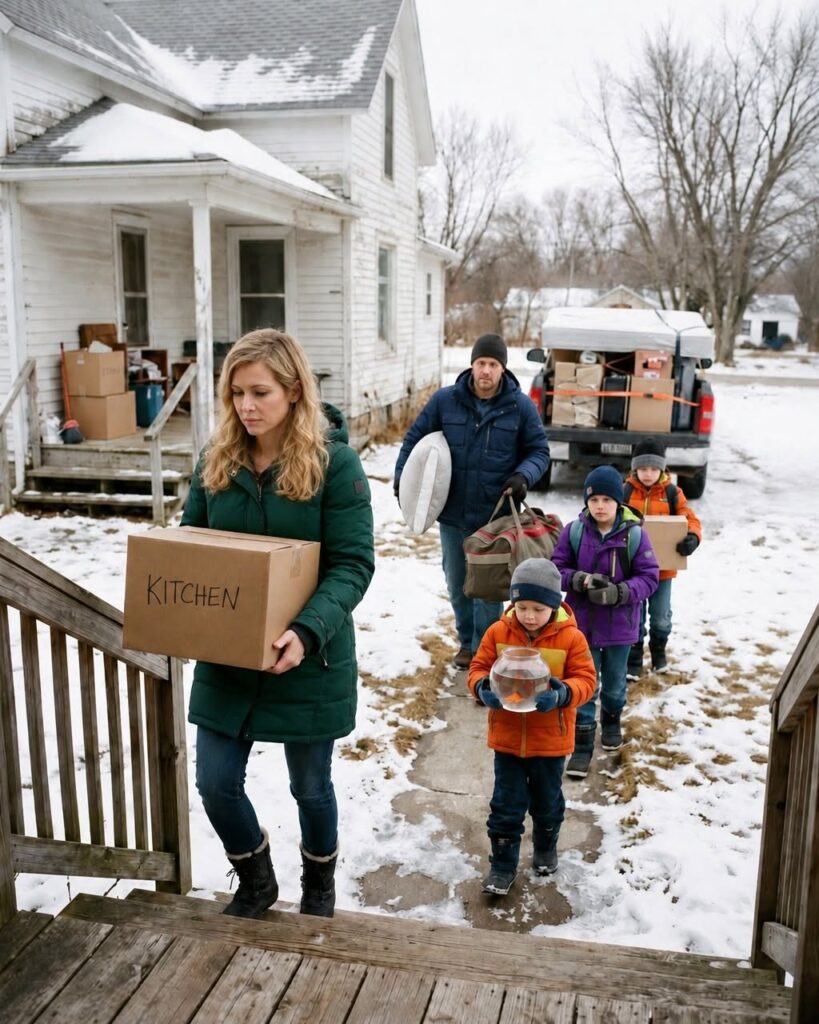
By Saturday afternoon, Jeff and his children arrived.
Brody was twelve, Kenzie nine, and Cole six.
Cole climbed out of the pickup holding a fishbowl.
“This is Pickles,” he announced seriously.
I smiled.
“Well, Pickles, welcome to the farm.”
That evening, seven of us crowded around the kitchen table.
There was laughter, spilled milk, and endless requests for more food.
For the first time in weeks, Jeff’s children looked relaxed.
Later, while unpacking, Jeff discovered something inside an upstairs closet.
Pencil marks on the wooden doorframe.
They recorded our heights as children.
Tammy — age 3.
Jeff — age 2.
And dozens more.
I’d protected those markings through every renovation.
Jeff stood there smiling.
“You never painted over them?”
“Of course not.”
He brought sleepy little Cole into the room, measured him against the wood, and added another mark.
Cole — age 6 — 2026.
His voice trembled as he asked me:
“Why are you doing all this for us?”
“Because you’re my brother,” I answered.
The next afternoon, our parents came for Sunday dinner.
Everything was going beautifully until Mom said something unexpected.
“Well, Jeff, once Tammy signs the papers, you can start fixing up the house however you want.”
Jeff stopped eating.
“What papers?”
Mom smiled.
“The papers to transfer the farmhouse back to us. Then we’ll give it to you.”
His expression changed.
“You asked Tammy to give you her house?”
“We were only trying to help!”
Jeff slowly stood.
“Mom, I never asked for this house.”
She looked confused.
“But you need somewhere to live.”
“And Tammy is helping me. Without losing the home she and Dale spent twenty years rebuilding.”
He turned toward me.
“Did you know about this?”
I nodded.
“They asked me last week. I never agreed.”
Jeff faced our parents again.
“You can’t solve my problems by taking away something my sister worked for.”
Mom’s eyes filled with tears.
For a moment, nobody spoke.
Then little Cole interrupted.
“Grandma! Daddy measured me in the closet! I’m taller than he was!”
Mom looked up.
“The old measuring marks?”
Jeff nodded.
“Tammy saved every one.”
Mom began crying again.
But this time, she seemed to understand what that house meant to us.
Over the following months, our arrangement worked better than expected.
Jeff contributed $400 monthly toward groceries and utilities and saved the rest of his earnings.
The children settled into school routines.
Hannah and Kenzie became inseparable.
Dale taught Brody to help with chores around the farm.
And Cole became convinced the barn cats belonged to him.
By August, Jeff had saved $9,400.
Then a small house went up for sale just down our gravel road.
Asking price: $138,000.
He examined his finances, applied for a mortgage, and qualified using his own income.
That October, Jeff and the children moved into their own home.
When we finished unloading the pickup, he hugged me tightly.
“Thank you, Tam. You gave us somewhere to land.”
“You did the hard work,” I replied.
The following morning, Dad visited me alone.
He stood in the kitchen holding his old wallet.
“Tammy, there’s something I want to give you.”
He carefully removed a folded dollar bill.
The paper was worn, its creases nearly white.
“Remember this?”
I stared.
It was the dollar I’d handed him when we bought the farmhouse twenty years earlier.
He’d kept it in his wallet all that time.
“I used to tell everyone I sold this house to my daughter for a dollar,” he said.
His voice became unsteady.
“But I never thought about what you paid afterward. The repairs, the work, all those years.”
He looked around the kitchen.
“Then I came here and asked you to give it back as though it was still worth a dollar.”
Tears gathered in his eyes.
“I’m sorry, Tammy.”
I reached for his hand.
“I forgive you, Dad.”
He smiled.
“But I still wasn’t giving you the farmhouse,” I added.
Dad laughed through his tears.
“I know.”
Then he pushed the dollar toward me.
“Keep it. You’ve earned this place.”
I placed it inside my notebook with the repair receipts.
It seemed exactly where it belonged.
A few days later, I went upstairs to clean the bedrooms Jeff’s children had occupied.
The house felt strangely quiet.
In the closet, the old pencil marks were still there.
My childhood.
Jeff’s childhood.
And at the very bottom:
Cole — age 6 — 2026.
I smiled.
There was still plenty of space on that doorframe.
And I intended to protect every mark.
My parents had believed that helping my brother meant taking something away from me.
But Jeff never needed someone to hand him a house.
He needed a safe place to stay, a little time to save money, and the confidence to begin again.
We didn’t give him our farmhouse. We gave him the opportunity to build a home of his own.
And watching him accomplish that meant far more than any property transfer ever could.
{"post":117020,"page":2,"next":[{"id":117015,"title":"My father tossed my grandmother\u2019s savings passbook into her grave and sneered that it was worthless. The following morning, I walked into the bank with that same book, and the teller went pale before reaching for the phone and calling the police.","url":"https:\/\/new24.info\/117015"},{"id":117010,"title":"Widow Sells Her Home To Help Son But Discovers Secret Paperwork","url":"https:\/\/new24.info\/117010"},{"id":117006,"title":"A Father Started Charging His 18-Year-Old Son $250 a Month for His Room \u2013 Five Years Later, the Young Man Received a Box That Turned His Life Upside Down","url":"https:\/\/new24.info\/117006"},{"id":117001,"title":"A Woman\u2019s Husband Didn\u2019t Know She\u2019d Regained Her Sight After Two Years of Blindness \u2013 When She Saw What He\u2019d Been Keeping in Their Bedroom, She Was Speechless","url":"https:\/\/new24.info\/117001"},{"id":116997,"title":"My eight-year-old son chose his wealthy father in court and told the judge, \u201cMy mom can\u2019t give me the future I deserve.\u201d","url":"https:\/\/new24.info\/116997"},{"id":116993,"title":"My thirteen-year-old son sold his prized electric guitar to buy a specialized wheelchair for a girl in his class\u2026 but early the next morning, two armed police officers showed up at our front door. And what they revealed left me completely paralyzed.","url":"https:\/\/new24.info\/116993"},{"id":116988,"title":"Claire Bought a Two-Dollar Ticket Right Before Mark Demanded Her House Keys","url":"https:\/\/new24.info\/116988"},{"id":116983,"title":"Undercover Boss Discovers Shocking Secret Destroying His Mothers Sacred Diner Legacy","url":"https:\/\/new24.info\/116983"},{"id":116979,"title":"My Husband Chose His Mistress And Lost My Seventy Three Million Fortune","url":"https:\/\/new24.info\/116979"},{"id":116975,"title":"Entitled Son Mocked My Purchases So I Canceled His Secret Financial Lifeline","url":"https:\/\/new24.info\/116975"},{"id":116970,"title":"At seven months pregnant, I received a call from a police officer. \u201cYour husband was in a car accident. He\u2019s in the hospital.\u201d","url":"https:\/\/new24.info\/116970"},{"id":116966,"title":"I came home late from my hospital shift during a blizzard. Dad had locked the door: \u201cCurfew is 10. Rules are rules.\u201d","url":"https:\/\/new24.info\/116966"},{"id":116962,"title":"My Husband Said Senior Night Was \u201cFor Real Dads\u201d So My 79-Year-Old Father Walked My Daughter Out on His Cane","url":"https:\/\/new24.info\/116962"},{"id":116958,"title":"My Husband and I Returned to Our Honeymoon Hotel 40 Years Later \u2013 The Receptionist Looked at Him and Said, \u2018Welcome Back\u2019","url":"https:\/\/new24.info\/116958"},{"id":116953,"title":"Why Is My Ground Beef Gray Inside?","url":"https:\/\/new24.info\/116953"},{"id":116948,"title":"If You Were a Child or Teenager Between The 1950s And 1970s, You May Remember This Strange Object See it below!","url":"https:\/\/new24.info\/116948"},{"id":116945,"title":"Doctors Explain What May Happen to Your Body If You Eat a Banana Every Day After Age 60","url":"https:\/\/new24.info\/116945"},{"id":116941,"title":"My husband gave away every maternity dress I owned while I was at work. When I asked what I was supposed to wear, he kept spreading mustard on his sandwich.","url":"https:\/\/new24.info\/116941"},{"id":116936,"title":"Woman Rushed to See Her Daughter After a Serious Operation \u2013 But Her Daughter Refused to Uncover Her Face","url":"https:\/\/new24.info\/116936"},{"id":116931,"title":"A Husband Laughed When His Wife Used Her Inheritance to Buy a Run-Down House, Calling It the Worst Decision She\u2019d Ever Made \u2013 Three Days Later, He Went There Alone and Called Her, \u2018Get in the Car. You Need to See This\u2019","url":"https:\/\/new24.info\/116931"}]}