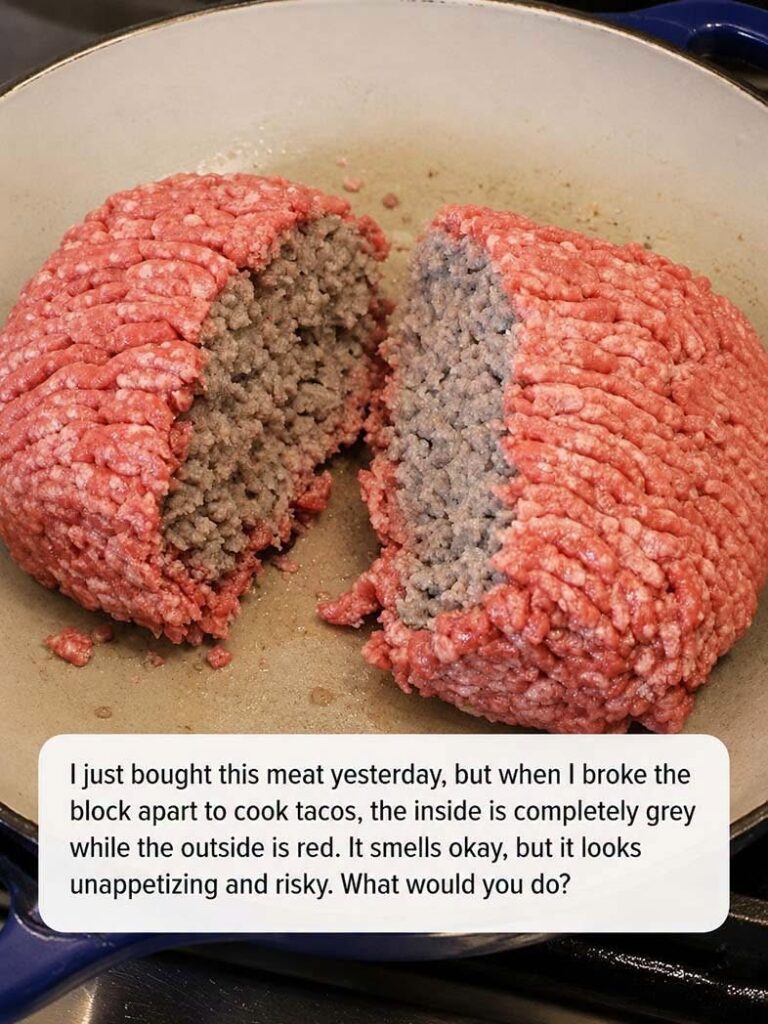
But this color difference is often completely normal.
The explanation involves a natural protein in meat called myoglobin.
When myoglobin is exposed to oxygen, it helps give beef the bright red color shoppers commonly associate with freshness.
However, oxygen doesn’t always reach the center of tightly packed ground beef. As a result, the meat inside may appear darker, brownish, or grayish rather than bright red.
Does that mean the beef is safe to eat?
Not necessarily. Color alone cannot tell you whether meat is safe.
An unpleasant odor, sticky or slimy texture, damaged packaging, or improper storage can be warning signs. However, harmful bacteria may also be present without any noticeable smell or visible change.
For safer handling, keep ground beef refrigerated at 40°F (4°C) or below, and cook or freeze it within one to two days of purchase.
When cooking, use a food thermometer to ensure the center reaches 160°F (71°C).
So, the next time you see grayish-brown meat beneath a bright red surface, don’t automatically assume you’ve been sold spoiled beef.
The difference may simply be caused by how much oxygen reaches the meat.
The important thing is to judge ground beef by proper storage, handling, and cooking—not by color alone.
{"post":116953,"page":2,"next":[{"id":116948,"title":"If You Were a Child or Teenager Between The 1950s And 1970s, You May Remember This Strange Object See it below!","url":"https:\/\/new24.info\/116948"},{"id":116945,"title":"Doctors Explain What May Happen to Your Body If You Eat a Banana Every Day After Age 60","url":"https:\/\/new24.info\/116945"},{"id":116941,"title":"My husband gave away every maternity dress I owned while I was at work. When I asked what I was supposed to wear, he kept spreading mustard on his sandwich.","url":"https:\/\/new24.info\/116941"},{"id":116936,"title":"Woman Rushed to See Her Daughter After a Serious Operation \u2013 But Her Daughter Refused to Uncover Her Face","url":"https:\/\/new24.info\/116936"},{"id":116931,"title":"A Husband Laughed When His Wife Used Her Inheritance to Buy a Run-Down House, Calling It the Worst Decision She\u2019d Ever Made \u2013 Three Days Later, He Went There Alone and Called Her, \u2018Get in the Car. You Need to See This\u2019","url":"https:\/\/new24.info\/116931"},{"id":116927,"title":"My parents stopped inviting me to family events. \u201cYour sister has important people to entertain.\u201d I was the \u201cembarrassing\u201d daughter. So I built my own life. Years later, my sister brought her biggest client home. He saw me. Then he asked: \u201cWait\u2026 you\u2019re her sister?\u201d and then\u2026","url":"https:\/\/new24.info\/116927"},{"id":116922,"title":"My husband threw me out, drained our accounts, and mocked me as a broke nobody. In court, his lawyer laughed\u2014until the judge revealed who I really was\u2026 and federal agents walked through the doors","url":"https:\/\/new24.info\/116922"},{"id":116916,"title":"In the morning, my mother called: \u201cPlans changed Ivy isn\u2019t welcome. Your sister wants adults only at Thanksgiving.\u201d That same day I canceled the lake house, stopped every payment, and took back the car. When they realized what I\u2019d done\u2026 31 missed calls.","url":"https:\/\/new24.info\/116916"},{"id":116911,"title":"For twenty years, my mother made sure the homeless boy living behind our house never went hungry. After her funeral, he took both my hands in his and told me, \u201cBefore she d:ie:d, she BEGGED ME TO KEEP HER SECRET FROM YOU.\u201d","url":"https:\/\/new24.info\/116911"},{"id":116907,"title":"The Purpose of Fabric Strips on Hotel Beds","url":"https:\/\/new24.info\/116907"},{"id":116903,"title":"The Grandma\u2019s Glasses Challenge","url":"https:\/\/new24.info\/116903"},{"id":116898,"title":"On my wedding day, my mother called me in a panic: \u201cDon\u2019t open the door! Get out through the back!\u201d I thought she was overreacting until I checked the security camera and saw my fianc\u00e9 with his pregnant mistress and three men who planned to force me to sign an $18 million debt.","url":"https:\/\/new24.info\/116898"},{"id":116895,"title":"Man Blamed Himself After His Wife Passed Away Giving Birth to Twins \u2013 Then Her Mother Arrived with a Truth She Had Hidden","url":"https:\/\/new24.info\/116895"},{"id":116886,"title":"\u201cWe\u2019re here to claim our share! We need separate bedrooms!\u201d my son demanded, standing at my door with his wife, mother-in-law, and four suitcases.","url":"https:\/\/new24.info\/116886"},{"id":116881,"title":"My daughter and son-in-law abandoned me at my wife\u2019s grave, 190 miles from home. \u201cYou\u2019re a burden. Walk home,\u201d he texted. Seconds later, my daughter added, \u201cDon\u2019t wait, Dad.\u201d","url":"https:\/\/new24.info\/116881"},{"id":116872,"title":"My mother-in-law placed a gold bracelet on my husband\u2019s mistress at our divorce dinner, and his entire family applauded as if I had never belonged at their table.","url":"https:\/\/new24.info\/116872"},{"id":116868,"title":"When My Husband Demanded Our Mansion He Discovered A Devastating Corporate Secret","url":"https:\/\/new24.info\/116868"},{"id":116864,"title":"Why Forty Three Officers Saluted My Grieving Son At A School Assembly","url":"https:\/\/new24.info\/116864"},{"id":116860,"title":"A Secret Letter Revealed My Adopted Daughter Was Actually My Biological Child","url":"https:\/\/new24.info\/116860"},{"id":116856,"title":"Husband Orchestrates Elaborate Deception to Save His Grieving Wife from Heartbreak","url":"https:\/\/new24.info\/116856"}]}