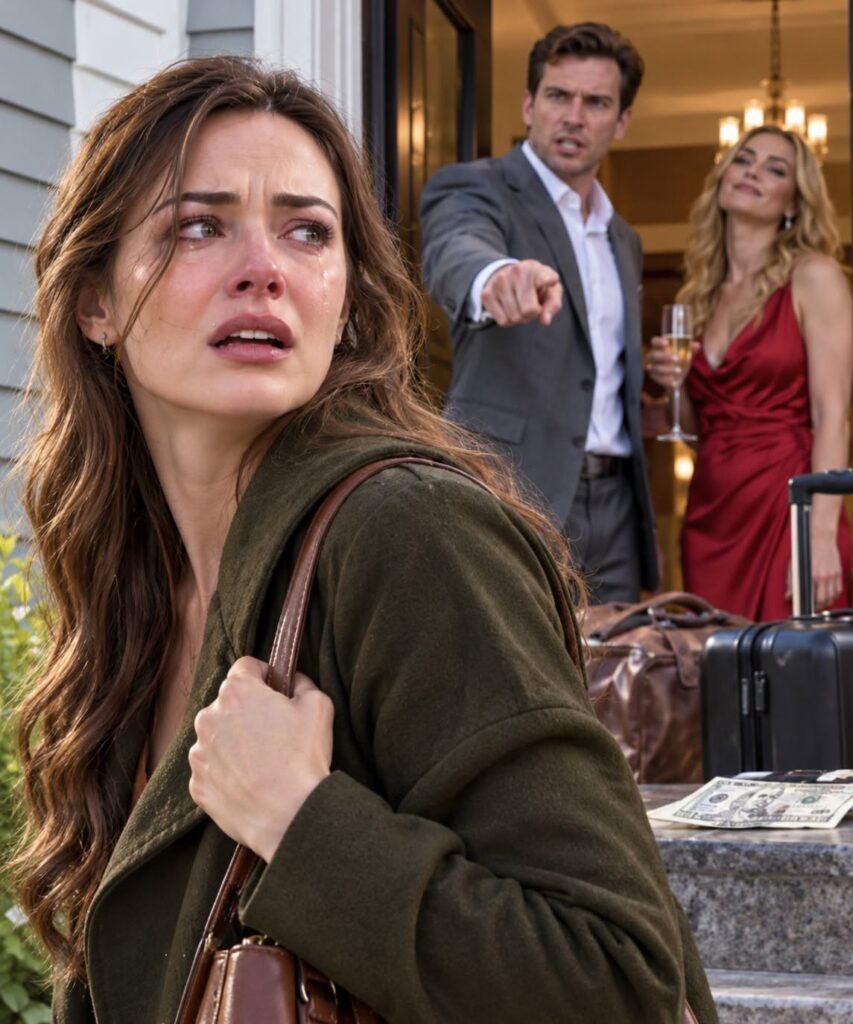
He’d emptied our joint accounts, packed my belongings into two suitcases, and told me to leave the house.
“The house is in my name,” he said. “The cars are mine. You haven’t earned a real paycheck in years. What exactly are you going to fight me with?”
Vanessa laughed.
“Maybe the library is hiring.”
I picked up the twenty dollars and walked outside.
My phone showed a transfer of $184,600 from our savings to a Nevada bank.
I recognized the institution.
It had appeared in a suspicious transaction my investment firm’s auditors were already examining.
What Grant didn’t know was that I secretly owned the investment company controlling 64% of his business.
Before our marriage, I’d helped develop fraud-detection software and sold my stake.
I invested the proceeds through Alder Point Capital, a private firm I owned.
Years later, when Grant’s logistics company faced financial difficulties, Alder Point provided the capital that kept Bennett Freight Solutions operating.
Grant knew the investment firm.
He simply never knew who owned it.
I’d kept my finances separate from our marriage because I wanted a relationship built on trust.
Instead, Grant had mistaken my quietness for helplessness.
That night, I called my attorney, Mara Ellis.
“Grant emptied our accounts,” I told her.
“Are you safe?”
“Yes.”
“Then preserve every banking alert. We’ll address the transfers through the court.”
The next morning, I met her with the records.
But the missing savings weren’t our only concern.
Three months earlier, Alder Point had commissioned an independent audit after investigators noticed payments for trucks that apparently didn’t exist.
The review uncovered questionable invoices, duplicated expenses, and transfers involving businesses connected to Vanessa.
One suspicious payment exceeded a million dollars.
The findings had already been referred to the appropriate authorities.
Grant had no idea how much of his financial conduct was being examined.
Instead, he sent mocking messages.
You’ll leave court poorer than you arrived, sweetheart.
His proposed divorce settlement offered me almost nothing.
He claimed I’d contributed nothing financially to our marriage.
Mara reviewed the documents and looked at me.
“He thinks you have no leverage.”
“He thinks I have no money,” I replied. “Those aren’t the same thing.”
We prepared the certified ownership records.
On the day of our hearing, Grant arrived in an expensive suit.
Vanessa sat beside him.
When he saw my simple navy jacket, he smirked.
“Still dressing for job interviews?”
I walked past without answering.
His attorney told the judge that Grant had supported an unemployed wife who was now demanding assets she hadn’t earned.
Grant leaned forward.
“She has twenty dollars to her name.”
The judge turned toward Mara.
“Counsel?”
Mara presented the company’s ownership documents.
The judge studied them.
Then she looked toward Grant.
“These records establish that Mrs. Bennett owns Alder Point Capital, which holds sixty-four percent of the voting shares in Bennett Freight Solutions.”
Grant stopped smiling.
“That’s impossible.”
His attorney quickly began examining the paperwork.
I watched Grant struggle to understand.
The company he proudly called his empire was largely controlled by the investment firm he’d barely bothered to investigate.
And that firm belonged to me.
But Mara wasn’t finished.
She submitted evidence concerning the $184,600 removed from our joint accounts.
Grant had claimed the money was used for ordinary household expenses.
The banking records raised serious questions about that explanation.
The judge ordered further accounting and preservation of relevant assets.
Grant’s confidence began to crumble.
Then, before the hearing concluded, federal agents entered the courtroom with warrants issued in a separate investigation.
Grant and Vanessa were taken into custody on allegations involving bank and wire fraud.
As the agents approached, Grant turned toward me.
“You set this up!”
I shook my head.
“No, Grant. The investigators followed the financial records.”
For months, he’d believed I was too powerless to challenge him.
He’d never imagined that the woman he dismissed as his unemployed wife understood the transactions behind his business better than he did.
The criminal proceedings continued separately from our divorce.
Eighteen months later, Grant was imprisoned after pleading guilty to federal fraud offenses.
Vanessa also pleaded guilty and faced restitution obligations.
Bennett Freight’s board removed them from their positions and appointed new leadership.
The company began addressing its legitimate debts while protecting employees who had done nothing wrong.
In our divorce, the court addressed the missing marital savings and ordered repayment, subject to the normal collection process.
I didn’t celebrate Grant’s imprisonment.
Seven years of marriage had meant something to me, even if he’d eventually treated those years as worthless.
I remembered the man who’d comforted me when my father died.
The promises we’d made.
The ordinary evenings I’d believed we were happy.
But I also remembered his face when he threw my suitcases onto the porch.
He hadn’t merely wanted a divorce.
He’d wanted me to feel incapable of surviving without him.
Months later, I moved into a sunlit home near the ocean.
I returned to my professional work and gradually rebuilt the routines I’d neglected during my marriage.
There were difficult days.
But for the first time in years, the silence in my home felt peaceful.
I kept the twenty-dollar bill Grant had left on the counter.
Not as a trophy.
As a reminder.
He thought leaving me with twenty dollars meant leaving me with nothing.
But my security had never depended on his generosity.
And my dignity had never depended on his permission.
I hadn’t needed to destroy his life to reclaim mine.
I had only needed to stop letting him decide what I was worth.
{"post":116922,"page":2,"next":[{"id":116916,"title":"In the morning, my mother called: \u201cPlans changed Ivy isn\u2019t welcome. Your sister wants adults only at Thanksgiving.\u201d That same day I canceled the lake house, stopped every payment, and took back the car. When they realized what I\u2019d done\u2026 31 missed calls.","url":"https:\/\/new24.info\/116916"},{"id":116911,"title":"For twenty years, my mother made sure the homeless boy living behind our house never went hungry. After her funeral, he took both my hands in his and told me, \u201cBefore she d:ie:d, she BEGGED ME TO KEEP HER SECRET FROM YOU.\u201d","url":"https:\/\/new24.info\/116911"},{"id":116907,"title":"The Purpose of Fabric Strips on Hotel Beds","url":"https:\/\/new24.info\/116907"},{"id":116903,"title":"The Grandma\u2019s Glasses Challenge","url":"https:\/\/new24.info\/116903"},{"id":116898,"title":"On my wedding day, my mother called me in a panic: \u201cDon\u2019t open the door! Get out through the back!\u201d I thought she was overreacting until I checked the security camera and saw my fianc\u00e9 with his pregnant mistress and three men who planned to force me to sign an $18 million debt.","url":"https:\/\/new24.info\/116898"},{"id":116895,"title":"Man Blamed Himself After His Wife Passed Away Giving Birth to Twins \u2013 Then Her Mother Arrived with a Truth She Had Hidden","url":"https:\/\/new24.info\/116895"},{"id":116886,"title":"\u201cWe\u2019re here to claim our share! We need separate bedrooms!\u201d my son demanded, standing at my door with his wife, mother-in-law, and four suitcases.","url":"https:\/\/new24.info\/116886"},{"id":116881,"title":"My daughter and son-in-law abandoned me at my wife\u2019s grave, 190 miles from home. \u201cYou\u2019re a burden. Walk home,\u201d he texted. Seconds later, my daughter added, \u201cDon\u2019t wait, Dad.\u201d","url":"https:\/\/new24.info\/116881"},{"id":116872,"title":"My mother-in-law placed a gold bracelet on my husband\u2019s mistress at our divorce dinner, and his entire family applauded as if I had never belonged at their table.","url":"https:\/\/new24.info\/116872"},{"id":116868,"title":"When My Husband Demanded Our Mansion He Discovered A Devastating Corporate Secret","url":"https:\/\/new24.info\/116868"},{"id":116864,"title":"Why Forty Three Officers Saluted My Grieving Son At A School Assembly","url":"https:\/\/new24.info\/116864"},{"id":116860,"title":"A Secret Letter Revealed My Adopted Daughter Was Actually My Biological Child","url":"https:\/\/new24.info\/116860"},{"id":116856,"title":"Husband Orchestrates Elaborate Deception to Save His Grieving Wife from Heartbreak","url":"https:\/\/new24.info\/116856"},{"id":116851,"title":"Why Is My Ground Beef Gray Inside?","url":"https:\/\/new24.info\/116851"},{"id":116847,"title":"He was called \u201cstupid\u201d because he couldn\u2019t read until he was 31, and yet he became famous and loved by millions of people.\ud83e\udd2f\ud83e\udd2f\ud83d\udc47","url":"https:\/\/new24.info\/116847"},{"id":116841,"title":"My Husband Asked for My Tears. I Gave Him the Clause That Destroyed His Empire.","url":"https:\/\/new24.info\/116841"},{"id":116837,"title":"12 Hours After I Gave Part of My Liver to Save My Sister\u2019s 10-Year-Old Son, She Kissed My Husband in My Hospital Room and Claimed He Was the Boy\u2019s Real Father. He Handed Me Divorce Papers Like I Had Already Lost\u2014Until a Genetic Report From the Transplant Team Exposed a Secret Neither of Them Saw Coming and Turned Their Perfect Little Victory Into Something Else Entirely.","url":"https:\/\/new24.info\/116837"},{"id":116833,"title":"On the second day of our marriage, at 7 am, my husband sl3pped me across the face and shouted, \u201cYou\u2019re still in bed? get up and make me breakfast! in my house, you don\u2019t make the rules\u2014I do!\u201d I held my cheek, tears filling my eyes as I stared at him. But moments later, a mysterious smile appeared on my face\u2026","url":"https:\/\/new24.info\/116833"},{"id":116829,"title":"\u201cWelcome to MY luxury Christmas resort!\u201d my sister Vanessa announced, raising her champagne glass inside my $1.8 million mountain cabin.","url":"https:\/\/new24.info\/116829"},{"id":116825,"title":"At breakfast, my dad said: \u201cWe\u2019ve booked a trip to Italy. Just the five of us. You understand, right?\u201d I nodded: \u201cYeah, ok.\u201d That night, I got a bank alert. $9,600 charged from Rome, Venice,\u2026 So I shut everything down. And everything collapsed in 48 hours.","url":"https:\/\/new24.info\/116825"}]}