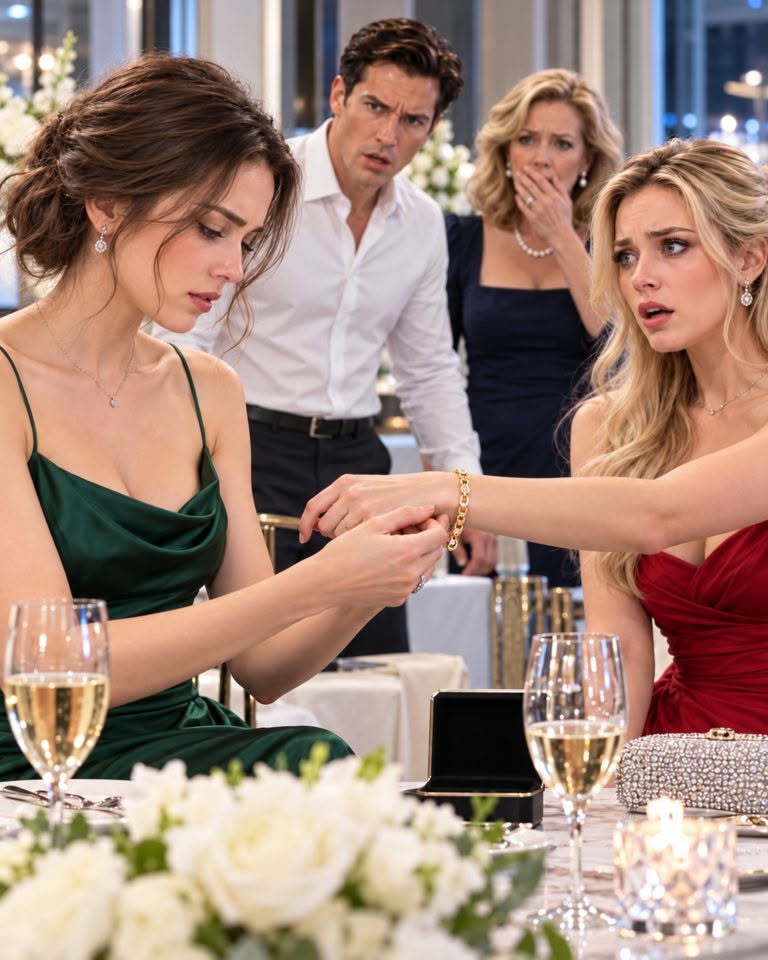
Engraved inside were two words:
FAMILY ONLY.
Everyone applauded.
Grant leaned toward me. “See, Ava? Some people understand what family means.”
I said nothing.
Instead, I asked Tiffany if I could examine the bracelet.
Inside the clasp was a tiny serial number.
CM-1187-04.
I recognized it immediately.
The bracelet belonged to my late mother.
And it had been missing from her estate for seven months.
My mother, Celeste Caldwell, had collected antique jewelry, but the Magnolia Collection was especially precious to her. Commissioned by my great-grandfather in 1958, it contained five pieces.
After Mom died, only four remained.
I’d spent months searching for the missing bracelet.
Now it was sitting on my husband’s mistress’s wrist.
“Charlotte,” I asked quietly, “where did you get this?”
She smiled.
“It’s a Whitaker family heirloom.”
“No,” I replied. “It isn’t.”
Grant frowned.
“Ava, don’t start.”
I looked at the serial number again.
Then I reached for my phone.
For nine years, I’d tried to be a good wife to Grant.
When my mother became seriously ill, I spent countless nights beside her hospital bed.
Grant claimed he was working late.
In reality, he was seeing Tiffany.
After Mom died, he barely acknowledged my grief. Within months, he demanded a divorce.
His family arranged one final dinner, supposedly to give everyone closure.
Instead, they used it to celebrate my replacement.
I’d known they intended to humiliate me.
What I hadn’t expected was that they’d use something stolen from my mother to do it.
Before dessert arrived, my mother’s probate attorney, Martin Hale, entered the restaurant.
He’d been investigating the missing bracelet for weeks.
When I told him what I’d found, he asked to see the serial number.
Then he turned toward Grant.
“Mr. Whitaker, we need to discuss your access to your mother-in-law’s safe-deposit box.”
Grant’s expression changed.
Months earlier, while Mom was critically ill, he’d handed me several financial documents at the hospital.
I signed them because I trusted him.
One provided limited authorization to assist with inventorying her belongings.
It did not authorize him to remove anything.
Martin explained that bank records showed Grant had accessed the box on February 14.
The estate’s investigation had also obtained evidence concerning a small jewelry case removed during that visit.
Charlotte suddenly stopped smiling.
Martin continued.
“We also have a jeweler’s work order showing that Mrs. Whitaker had this bracelet engraved in March.”
Tiffany stared at her wrist.
“You told me it belonged to your family.”
Charlotte looked toward Grant.
He avoided her eyes.
Then Martin identified the bracelet from my mother’s estate inventory.
The last appraisal valued it at $286,000.
Tiffany unfastened it with trembling fingers.
“I didn’t know,” she whispered.
I couldn’t tell how much she’d known.
But she looked frightened now.
Martin arranged for the bracelet to be preserved as evidence in the ongoing investigation.
Grant reached toward me.
“Ava, let’s discuss this privately.”
I moved my hand away.
“You gave your mother’s approval to stealing from mine?”
He shook his head.
“It wasn’t supposed to happen like this.”
That answer told me enough.
Then he admitted Charlotte had encouraged him to take the bracelet because she believed I was receiving too much in the divorce.
I looked at the woman who’d spent nine years criticizing my clothes, my career, and even the years I’d devoted to caring for my dying mother.
“Charlotte, my mother treated you like family.”
She crossed her arms.
“Your family has always had more than enough.”
“So that made it acceptable to take what belonged to her?”
She didn’t answer.
Neither did Grant.
And for the first time that evening, the entire table was quiet.
The bracelet wasn’t the only financial concern.
Martin had also been reviewing discrepancies involving property transfers and loans connected to Grant’s business.
Some documents appeared to use assets from my family as proposed collateral without proper authorization.
Those matters would need separate legal examination.
I didn’t demand that anyone be arrested at dinner.
I simply gave Martin the information we’d discovered and allowed the appropriate investigation to continue.
Grant pleaded with me to reconsider our divorce settlement.
But I’d already spent years accepting explanations that never quite matched the truth.
I wasn’t going to do it anymore.
As I prepared to leave, Martin handed me another envelope.
“This is from your mother,” he said.
“She asked me to give it to you when we found the bracelet.”
I took it outside.
Rain fell softly over Charleston.
Beneath the restaurant awning, I opened the letter.
Mom had written it shortly before she died.
She told me she loved me.
That she’d worried about how much of myself I’d sacrificed trying to keep everyone happy.
And that she’d come to understand Grant wasn’t treating me with the kindness I deserved.
Near the end, she’d written:
Don’t confuse peace with permission.
You don’t have to keep protecting people from the truth.
I sat on the stone steps and cried.
Not because Grant had been exposed.
Not because Charlotte had finally been confronted.
But because my mother had understood more than I’d realized.
And even in her final days, she’d been thinking about how to protect me.
The following months were difficult.
The estate continued its efforts to recover the bracelet.
The financial transactions were reviewed, and Grant’s divorce disclosures were challenged.
Eventually, we reached a revised settlement protecting my family’s assets.
The bracelet was returned after the necessary evidence procedures were completed.
Grant and Charlotte faced separate legal scrutiny over their involvement.
The outcome wasn’t an instant public downfall.
There were attorneys, documents, interviews, and months of uncertainty.
But I no longer felt responsible for shielding them from the consequences of their decisions.
When I finally held the bracelet again, I noticed Charlotte’s engraving.
FAMILY ONLY.
I considered having it removed.
Instead, I asked a trusted jeweler to add another line beneath it.
And family tells the truth.
That Thanksgiving, I wore the bracelet at my mother’s beach house on Sullivan’s Island.
My closest friends gathered around the table.
The gravy was lumpy, someone burned a pie, and the children laughed so loudly that we could barely finish a conversation.
It wasn’t elegant.
It wasn’t perfectly arranged.
But nobody was trying to make anyone feel unwanted.
At one point, my friend’s little daughter climbed onto my lap.
“Does that bracelet make you a princess?” she asked.
I smiled.
“No, sweetheart. It belonged to my mother.”
“Was she nice?”
I looked around the room.
“She was.”
The little girl studied the bracelet.
“Then it’s special.”
I nodded.
“Yes. It is.”
Later, I stood by the window watching the ocean.
For months, I’d associated the bracelet with betrayal, humiliation, and the last painful chapter of my marriage.
But now I could remember Mom’s hands fastening it around her wrist.
Her laughter.
Her kindness.
The way she’d always made room for people at her table.
My former husband’s family had tried to welcome another woman using something stolen from mine.
But they couldn’t take what the bracelet truly represented.
My mother’s love had never depended on status, appearances, or who was considered worthy of belonging.
And I no longer needed the Whitakers to make room for me.
I had finally made a life where I belonged.
{"post":116872,"page":2,"next":[{"id":116868,"title":"When My Husband Demanded Our Mansion He Discovered A Devastating Corporate Secret","url":"https:\/\/new24.info\/116868"},{"id":116864,"title":"Why Forty Three Officers Saluted My Grieving Son At A School Assembly","url":"https:\/\/new24.info\/116864"},{"id":116860,"title":"A Secret Letter Revealed My Adopted Daughter Was Actually My Biological Child","url":"https:\/\/new24.info\/116860"},{"id":116856,"title":"Husband Orchestrates Elaborate Deception to Save His Grieving Wife from Heartbreak","url":"https:\/\/new24.info\/116856"},{"id":116851,"title":"Why Is My Ground Beef Gray Inside?","url":"https:\/\/new24.info\/116851"},{"id":116847,"title":"He was called \u201cstupid\u201d because he couldn\u2019t read until he was 31, and yet he became famous and loved by millions of people.\ud83e\udd2f\ud83e\udd2f\ud83d\udc47","url":"https:\/\/new24.info\/116847"},{"id":116841,"title":"My Husband Asked for My Tears. I Gave Him the Clause That Destroyed His Empire.","url":"https:\/\/new24.info\/116841"},{"id":116837,"title":"12 Hours After I Gave Part of My Liver to Save My Sister\u2019s 10-Year-Old Son, She Kissed My Husband in My Hospital Room and Claimed He Was the Boy\u2019s Real Father. He Handed Me Divorce Papers Like I Had Already Lost\u2014Until a Genetic Report From the Transplant Team Exposed a Secret Neither of Them Saw Coming and Turned Their Perfect Little Victory Into Something Else Entirely.","url":"https:\/\/new24.info\/116837"},{"id":116833,"title":"On the second day of our marriage, at 7 am, my husband sl3pped me across the face and shouted, \u201cYou\u2019re still in bed? get up and make me breakfast! in my house, you don\u2019t make the rules\u2014I do!\u201d I held my cheek, tears filling my eyes as I stared at him. But moments later, a mysterious smile appeared on my face\u2026","url":"https:\/\/new24.info\/116833"},{"id":116829,"title":"\u201cWelcome to MY luxury Christmas resort!\u201d my sister Vanessa announced, raising her champagne glass inside my $1.8 million mountain cabin.","url":"https:\/\/new24.info\/116829"},{"id":116825,"title":"At breakfast, my dad said: \u201cWe\u2019ve booked a trip to Italy. Just the five of us. You understand, right?\u201d I nodded: \u201cYeah, ok.\u201d That night, I got a bank alert. $9,600 charged from Rome, Venice,\u2026 So I shut everything down. And everything collapsed in 48 hours.","url":"https:\/\/new24.info\/116825"},{"id":116817,"title":"Depressing find at the bottom of the Mariana Trench is a warning to the world 11","url":"https:\/\/new24.info\/116817"},{"id":116813,"title":"Inside the tough and challenging life of Pattie Mallette","url":"https:\/\/new24.info\/116813"},{"id":116809,"title":"The Price Of Saving A Family House And The Quiet Morning When I Stopped Playing The Dependable Daughter Who Always Cleaned Up Every Careless Mess","url":"https:\/\/new24.info\/116809"},{"id":116805,"title":"My entire family burst into laughter when I arrived alone at my sister\u2019s lavish wedding. My father deliberately shouted, \u201cShe couldn\u2019t even find a man willing to come with her!\u201d","url":"https:\/\/new24.info\/116805"},{"id":116800,"title":"My mother-in-law confiscated the keys to the SUV I had purchased, and my husband willingly gave them to her while I struggled through a mile-long walk home with our eleven-month-old son","url":"https:\/\/new24.info\/116800"},{"id":116796,"title":"While I was giving birth, my husband secretly sold my $3 million home. When I returned with our newborn daughter, he handed me $200 and said, \u201cFind a cheap room to rent and get out.\u201d","url":"https:\/\/new24.info\/116796"},{"id":116790,"title":"My husband told his mistress that our daughter and I had three weeks to disappear, then said he had never wanted our little girl anyway. He had no idea that an agreement bearing his own signature was about to threaten the future he had planned.","url":"https:\/\/new24.info\/116790"},{"id":116787,"title":"Man Blamed Himself After His Wife Passed Away Giving Birth to Twins \u2013 Then Her Mother Arrived with a Truth She Had Hidden","url":"https:\/\/new24.info\/116787"},{"id":116784,"title":"Selfish Mother Returns For Wedding And Faces A Shocking Fifteen Year Secret","url":"https:\/\/new24.info\/116784"}]}