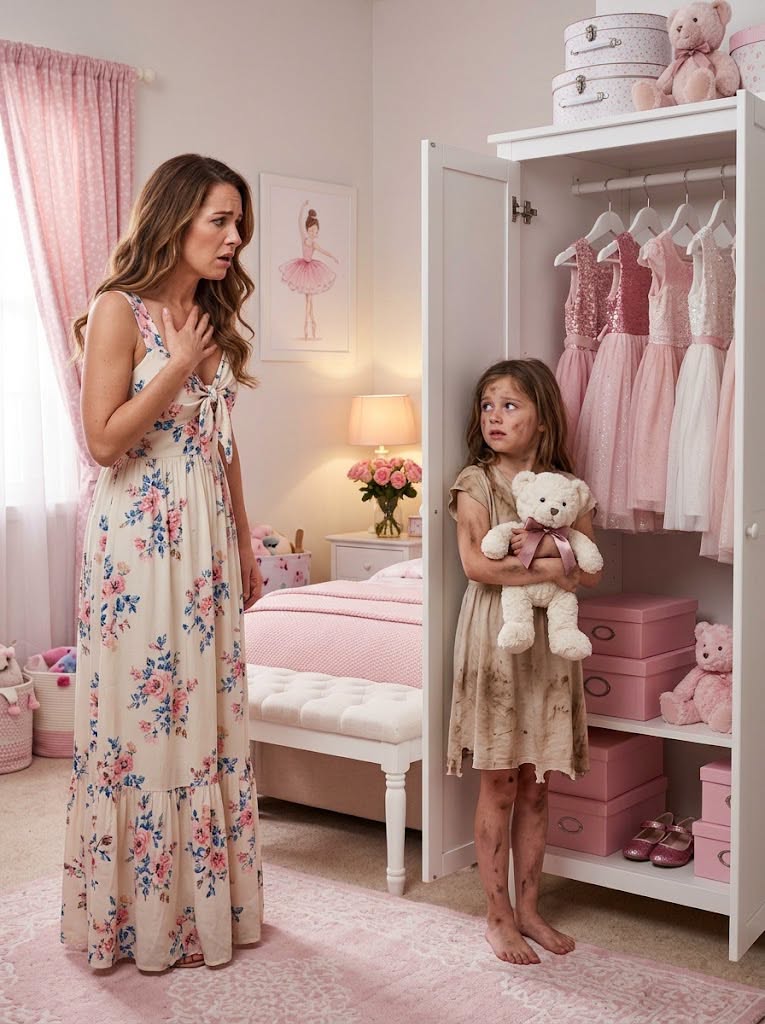
Then the closet door creaked open.
A little girl stepped out.
She had Chloe’s face, her dark eyes, and even the tiny mole beneath her chin.
“Mommy?” she whispered. “I’m hungry.”
I couldn’t breathe.
My daughter had died after months of painful medical treatments. I’d held her hand in the hospital as her life slipped away.
Yet here she was, standing in front of me.
I touched her cheek.
She was real.
I ran into the living room, searching for Chloe’s urn.
It was gone.
In its place were recent photographs showing us together as a happy family.
When I called my husband, Lucas, he rushed home.
“What’s happening?” I demanded. “Who is that little girl?”
He looked at me with frightening concern.
“That’s Chloe, sweetheart.”
I shook my head.
“Chloe died.”
Lucas took my hands.
“No. She recovered. You’ve been struggling with your memories again.”
He warned that if I continued frightening our daughter, we’d need to seek medical help.
For a moment, I wondered whether grief had somehow broken my mind.
But I remembered the funeral.
I remembered the tiny coffin.
And I remembered saying goodbye.
That night, I searched our safe and discovered medical papers claiming Chloe had been discharged from the hospital six months earlier.
Something was terribly wrong.
The next morning, our neighbors greeted the little girl as though she’d always lived with us.
Then I saw Teresa, Chloe’s former nanny.
When she spotted the child, she went pale.
She looked at Lucas.
Then quickly walked away.
I followed my husband later that afternoon and watched him hand Teresa an envelope filled with money.
When I confronted him afterward, he finally broke down.
“Chloe is gone,” he whispered.
My knees weakened.
“Then who is she?”
“Her name is Lily.”
I stared at him.
Lucas explained that Lily was a five-year-old orphan who looked remarkably like Chloe.
After our daughter’s death, my grief had become so overwhelming that he’d feared losing me too.
He’d convinced himself that bringing home a child who resembled Chloe might give me a reason to live.
He’d arranged for Lily to stay with us without completing the proper legal process.
Then he’d taught her Chloe’s habits, favorite foods, and memories.
He had even paid people to support the deception and created false medical records.
“She wanted a family,” he sobbed. “I told her if she behaved like Chloe, you’d love her.”
I covered my mouth.
Somewhere in our home was a little girl who believed she had to become someone else to deserve a mother.
I was devastated.
Not only by my husband’s deception, but by what he’d done to a child who was already vulnerable.
I told Lucas we needed professional help immediately.
We contacted a lawyer and the appropriate child welfare authorities to explain Lily’s situation.
I also began seeing a grief counselor.
The truth was painful, but I couldn’t allow another child to build her life around a lie.
Lucas finally showed me where he’d hidden Chloe’s urn.
At a quiet memorial chapel, I held it against my chest and cried.
For two years, I’d tried to survive by avoiding everything that reminded me of my daughter.
Lucas had tried to survive by pretending she hadn’t died.
Neither of us had truly faced our loss.
But Chloe deserved to be remembered.
And Lily deserved to be herself.
When it was appropriate, with guidance from the professionals helping her, we explained the truth to Lily.
“You don’t have to pretend to be Chloe,” I told her gently.
Her eyes filled.
“Will you still like me?”
I knelt beside her.
“I already care about you, Lily. You never needed to be anyone else.”
She began crying.
I held her carefully, knowing that affection alone couldn’t repair the confusion we’d placed upon her.
Lucas cooperated with the investigation into the falsified documents and unlawful arrangements.
The child welfare team assessed Lily’s needs, her legal status, and whether a safe, permanent placement with us could be approved.
We didn’t get to decide that simply because we’d grown attached to her.
We had to earn the trust we’d damaged.
Months passed.
There were counseling appointments, legal proceedings, and difficult conversations.
Eventually, after the required assessments and approvals, Lily became part of our family through a lawful adoption.
Her life wasn’t magically healed.
Neither was ours.
But she finally had the freedom to be herself.
One afternoon, while preparing her birthday celebration, I asked whether she wanted strawberry cake.
She made a face.
“I hate strawberries!”
I laughed.
“Then what would you like?”
“Chocolate. With lots of frosting.”
For the first time, she answered without glancing at Lucas to check whether she’d chosen correctly.
We bought the chocolate cake.
Later that evening, I stood in our hallway looking at two photographs.
One showed Chloe, smiling in her favorite pink dress.
The other showed Lily, laughing with chocolate frosting on her nose.
Two different girls.
Two precious lives.
We had restored Chloe’s memorial and begun speaking openly about her again.
I still missed her every day.
There were moments when grief arrived so suddenly I could barely stand.
But loving Lily didn’t require me to forget Chloe.
And remembering Chloe didn’t mean I had less love to give.
My husband had tried to bring our daughter back because he couldn’t bear losing her. But healing began only when we stopped pretending she was still here—and gave another little girl the freedom to be herself.
{"post":116856,"page":2,"next":[{"id":116851,"title":"Why Is My Ground Beef Gray Inside?","url":"https:\/\/new24.info\/116851"},{"id":116847,"title":"He was called \u201cstupid\u201d because he couldn\u2019t read until he was 31, and yet he became famous and loved by millions of people.\ud83e\udd2f\ud83e\udd2f\ud83d\udc47","url":"https:\/\/new24.info\/116847"},{"id":116841,"title":"My Husband Asked for My Tears. I Gave Him the Clause That Destroyed His Empire.","url":"https:\/\/new24.info\/116841"},{"id":116837,"title":"12 Hours After I Gave Part of My Liver to Save My Sister\u2019s 10-Year-Old Son, She Kissed My Husband in My Hospital Room and Claimed He Was the Boy\u2019s Real Father. He Handed Me Divorce Papers Like I Had Already Lost\u2014Until a Genetic Report From the Transplant Team Exposed a Secret Neither of Them Saw Coming and Turned Their Perfect Little Victory Into Something Else Entirely.","url":"https:\/\/new24.info\/116837"},{"id":116833,"title":"On the second day of our marriage, at 7 am, my husband sl3pped me across the face and shouted, \u201cYou\u2019re still in bed? get up and make me breakfast! in my house, you don\u2019t make the rules\u2014I do!\u201d I held my cheek, tears filling my eyes as I stared at him. But moments later, a mysterious smile appeared on my face\u2026","url":"https:\/\/new24.info\/116833"},{"id":116829,"title":"\u201cWelcome to MY luxury Christmas resort!\u201d my sister Vanessa announced, raising her champagne glass inside my $1.8 million mountain cabin.","url":"https:\/\/new24.info\/116829"},{"id":116825,"title":"At breakfast, my dad said: \u201cWe\u2019ve booked a trip to Italy. Just the five of us. You understand, right?\u201d I nodded: \u201cYeah, ok.\u201d That night, I got a bank alert. $9,600 charged from Rome, Venice,\u2026 So I shut everything down. And everything collapsed in 48 hours.","url":"https:\/\/new24.info\/116825"},{"id":116817,"title":"Depressing find at the bottom of the Mariana Trench is a warning to the world 11","url":"https:\/\/new24.info\/116817"},{"id":116813,"title":"Inside the tough and challenging life of Pattie Mallette","url":"https:\/\/new24.info\/116813"},{"id":116809,"title":"The Price Of Saving A Family House And The Quiet Morning When I Stopped Playing The Dependable Daughter Who Always Cleaned Up Every Careless Mess","url":"https:\/\/new24.info\/116809"},{"id":116805,"title":"My entire family burst into laughter when I arrived alone at my sister\u2019s lavish wedding. My father deliberately shouted, \u201cShe couldn\u2019t even find a man willing to come with her!\u201d","url":"https:\/\/new24.info\/116805"},{"id":116800,"title":"My mother-in-law confiscated the keys to the SUV I had purchased, and my husband willingly gave them to her while I struggled through a mile-long walk home with our eleven-month-old son","url":"https:\/\/new24.info\/116800"},{"id":116796,"title":"While I was giving birth, my husband secretly sold my $3 million home. When I returned with our newborn daughter, he handed me $200 and said, \u201cFind a cheap room to rent and get out.\u201d","url":"https:\/\/new24.info\/116796"},{"id":116790,"title":"My husband told his mistress that our daughter and I had three weeks to disappear, then said he had never wanted our little girl anyway. He had no idea that an agreement bearing his own signature was about to threaten the future he had planned.","url":"https:\/\/new24.info\/116790"},{"id":116787,"title":"Man Blamed Himself After His Wife Passed Away Giving Birth to Twins \u2013 Then Her Mother Arrived with a Truth She Had Hidden","url":"https:\/\/new24.info\/116787"},{"id":116784,"title":"Selfish Mother Returns For Wedding And Faces A Shocking Fifteen Year Secret","url":"https:\/\/new24.info\/116784"},{"id":116781,"title":"A School Held a Charity Basketball Game for a Woman\u0027s Seriously Ill Son, but a Rude Couple Refused to Leave the Accessible Seats Reserved for Him and His Mother \u2013 Then the Referee Did Something That Made the Entire Gym Hold Its Breath","url":"https:\/\/new24.info\/116781"},{"id":116779,"title":"I Chose A Tiny House Over My Daughter\u2019s Basement And Then Everything Came Out Thursday","url":"https:\/\/new24.info\/116779"},{"id":116777,"title":"My Daughter Told Me to Stay Out of Her Life \u2013 Then She Came Back Asking About the Bills","url":"https:\/\/new24.info\/116777"},{"id":116772,"title":"Ten minutes before our wedding, I heard my fianc\u00e9 tell his sister, \u201cDon\u2019t worry about daycare anymore. Natalie will take care of all three kids starting Monday.\u201d","url":"https:\/\/new24.info\/116772"}]}