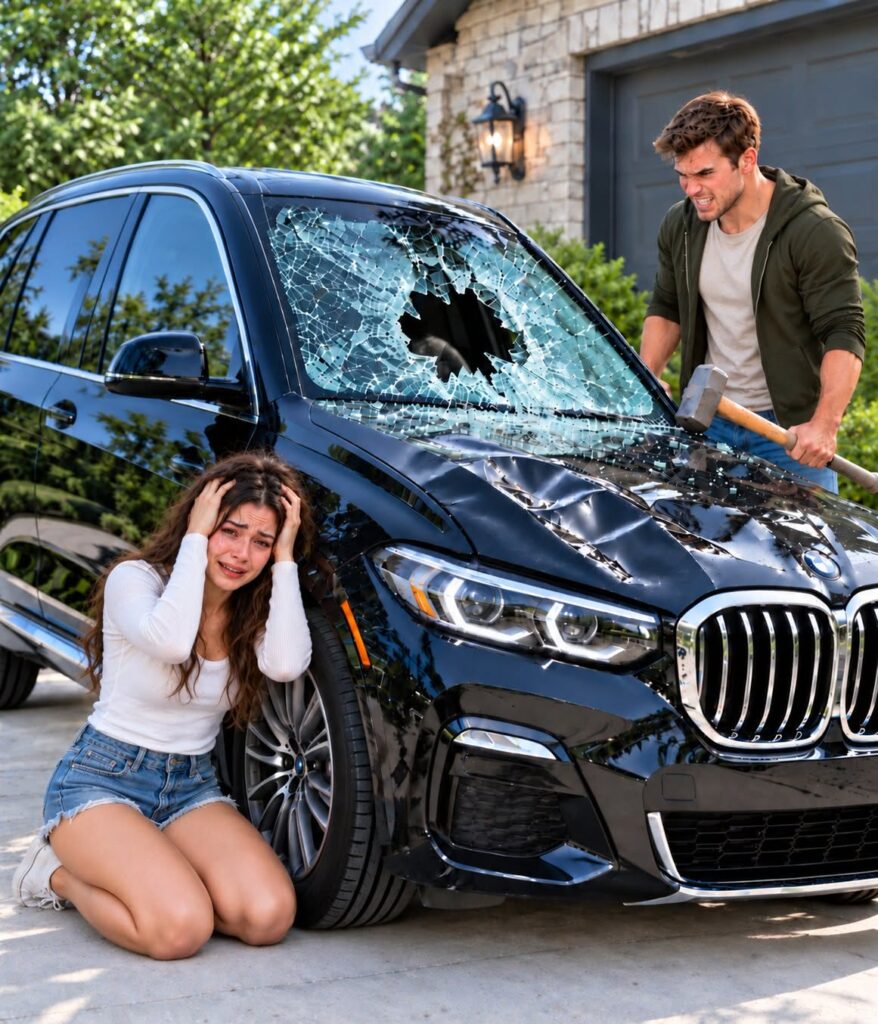
“Ethan, it’s just a car! Tell insurance someone stole it.”
I looked at her.
My brother had just deliberately destroyed something I worked years to afford.
And she wanted me to protect him by committing insurance fraud.
For the first time in my life, I said no.
It started on a Sunday afternoon.
I’d stopped at Mom’s house to deliver some paperwork from Dad’s estate.
My brother Mason came outside with his wife, Vanessa.
“Vanessa needs a safer car,” he announced.
I glanced at my SUV parked by the curb.
“Okay?”
“So give her yours.”
I laughed, thinking he was joking.
He wasn’t.
“You’re single,” he continued. “You don’t need something that big.”
“It’s my car, Mason.”
Mom appeared on the porch.
“Ethan, your brother’s trying to start a family. You could help.”
“I do help. I’ve helped him for years.”
Vanessa folded her arms.
“You can afford another one.”
That was the problem with my family.
They treated anything I owned as something Mason deserved if he wanted it badly enough.
His unpaid debts became my responsibility.
His mistakes were excuses for Mom to ask me for money.
Whenever I refused, I was selfish.
I looked at Mason.
“No. I’m not giving you my car.”
His expression changed.
“Then nobody gets it.”
He walked to his pickup and returned holding a tire iron.
At first, I thought he was bluffing.
Then he struck my driver’s window.
Glass shattered across the seat.
“Mason, stop!”
He hit the windshield next.
Then a headlight.
Neighbors emerged from their homes.
Vanessa stood near the porch, saying nothing.
Mom rushed toward me.
“Don’t make this worse!”
I stared at her.
“I’m not the one destroying a car.”
Mason climbed into his pickup.
Before I could understand what he intended, he drove forward and struck the SUV’s bumper.
Metal buckled.
He backed away.
I moved farther from the vehicles and told everyone to stay clear.
My hands were shaking.
I took out my phone.
Mom caught my wrist.
“Ethan, listen. Just tell insurance it was stolen. Nobody needs to know.”
I gently pulled away.
“No, Mom.”
“Your brother could lose his job!”
“Then he shouldn’t have done this.”
I called 911.
Mason watched me from beside his truck.
“You’re really calling the cops on your own brother?”
“Yes.”
“You’ll regret this.”
I stepped back and waited.
Mom kept asking me to reconsider.
She said family should protect family.
I had heard that sentence my entire life.
But protection had always meant protecting Mason from the consequences of his behavior.
Nobody had considered protecting me from him.
When the officers arrived, Mason immediately claimed the damage was accidental.
He said we’d argued about borrowing the SUV.
Mom supported his account.
I explained what had happened and provided the officers with the recording from my phone.
Then I mentioned something else.
My SUV belonged to my consulting business and had cameras operating in parking mode.
The vehicle’s system had recorded portions of the incident.
I worked in insurance investigations, so documenting vehicle damage was part of my professional life.
That didn’t make me a police officer or give me special authority.
It simply meant I understood the importance of preserving evidence.
The officers reviewed what was available and asked witnesses for statements.
Then one turned toward Mason.
“Did you deliberately strike the vehicle?”
Mason looked at Mom.
She looked away.
The officer continued.
“Because we have witnesses describing the tire iron and the collision. You need to understand that this isn’t just a disagreement about who should drive the car.”
Mason stopped arguing.
Police documented the damage and continued their investigation.
I provided the original recordings and arranged for the vehicle to be inspected.
My insurer was notified truthfully.
I made no claim that the SUV had been stolen.
The investigators examined Mason’s conduct and whether any offenses had occurred.
I was told that restitution could also be pursued through the appropriate legal process.
None of it was as satisfying as the dramatic confrontation I’d sometimes imagined during years of being pushed around.
But it was real.
And it meant I no longer had to pretend Mason’s choices were harmless.
That evening, Mom called.
“How could you do this to your brother?”
I was sitting at home, staring at the repair estimate.
“Mom, he destroyed my car.”
“It’s replaceable.”
“Yes,” I said. “But that doesn’t make it acceptable.”
She began crying.
“He’s always struggled.”
“I know.”
“You’ve always been the successful one.”
“That doesn’t mean I owe him everything I have.”
She was quiet.
Then she said, “Family is supposed to forgive.”
I thought about all the money I’d lent Mason.
The debts I’d covered.
The excuses I’d accepted.
“I’ve forgiven him many times,” I replied. “But I don’t have to keep paying for his behavior.”
Mom asked whether I would withdraw my statement.
“No.”
I told her I would no longer lend Mason money or cover his debts.
And until he could speak to me without threats or demands, I needed distance.
She called me cruel.
I ended the conversation.
The months afterward were uncomfortable.
The damaged SUV required extensive repairs, and the financial consequences took time to resolve.
Mason disputed parts of the incident through the legal process.
I cooperated with investigators and let the evidence speak for itself.
I didn’t call his employer.
I didn’t contact Vanessa’s school.
I didn’t publish the recordings online.
If consequences followed from the investigation, they would come from what Mason had done, not from a campaign to humiliate him.
Mom occasionally sent messages.
Sometimes angry.
Sometimes apologetic.
I didn’t block every attempt at contact.
But I stopped responding to demands that I pretend nothing had happened.
Six months later, I visited a small lakeside property I’d been considering buying.
It was quiet.
Pine trees lined the shore.
The house was modest compared with the places I’d once imagined owning.
But standing on the porch, I felt something I hadn’t felt in years.
Relief.
My phone wasn’t ringing with another request to cover Mason’s expenses.
Nobody was asking me to prove my love by giving away something I owned.
I could simply enjoy an afternoon.
I thought about my brother.
I didn’t wish him poverty or humiliation.
I hoped he would take responsibility for what he’d done.
Maybe someday we could have a relationship that didn’t depend on me giving him money.
But I couldn’t create that relationship alone.
Before leaving, I sat on the porch steps and called Mom.
She answered cautiously.
“Ethan?”
“Hi, Mom.”
For a moment, neither of us spoke.
Then she asked whether I was ready to put everything behind us.
“I’m willing to talk,” I said. “But I’m not willing to pretend Mason didn’t hurt me.”
She sighed.
“I just want my sons to get along.”
“So do I.”
And I meant it.
I had never wanted a family divided by resentment.
I wanted one where saying no didn’t mean becoming the enemy.
Where helping someone was appreciated rather than expected.
Where love didn’t require dishonesty.
Mom didn’t promise to change.
I didn’t pretend the conversation had fixed anything.
But for once, I had spoken without apologizing for having boundaries.
When the call ended, I looked across the lake.
The water was calm.
I couldn’t control whether Mason would apologize.
I couldn’t force Mom to recognize how differently she’d treated her sons.
But I could decide what I would accept in my own life.
My brother had destroyed my SUV because I wouldn’t give it to him.
The car could be repaired or replaced.
Our relationship would require something money couldn’t purchase.
Accountability.
And until that happened, I was allowed to keep my distance without wishing him harm.
I stood, picked up my keys, and headed home.
For the first time, I wasn’t afraid of being called selfish.
I was simply learning that generosity meant more when I was free to say no.
{"post":116764,"page":2,"next":[{"id":116749,"title":"Donald Trump\u0027s Granddaughter Shares Update After Unexpected Medical Procedure \u2014 Photos","url":"https:\/\/new24.info\/116749"},{"id":116746,"title":"Woman Went to Pick up Her Daughter\u2019s Wedding Cake \u2013 The Baker Saw Her Name and Said, \u2018I Was Told Not to Give It to You\u2019","url":"https:\/\/new24.info\/116746"},{"id":116741,"title":"With heavy hearts, we share the sad news that a classic Hollywood actor who gave us so much has passed away","url":"https:\/\/new24.info\/116741"},{"id":116739,"title":"My Husband Stole My Platinum Card to Fund His Family\u2019s Luxury Vacation\u2014Then Threatened Divorce When I Canceled It","url":"https:\/\/new24.info\/116739"},{"id":116737,"title":"A Gynecologist\u0027s Patient Told Her, \u0027I\u0027m Pregnant with Your Husband\u0027s Baby. You Need to Divorce Him!\u0027 \u2013 The Next Morning, the Patient Called Her, Screaming, \u0027What Did You Do?!\u0027","url":"https:\/\/new24.info\/116737"},{"id":116732,"title":"Mother Who Abandoned Six Daughters Returns for Wedding\u2014And Faces the Truth","url":"https:\/\/new24.info\/116732"},{"id":116727,"title":"Why She Wears a Pinky Ring as a Promise to Herself","url":"https:\/\/new24.info\/116727"},{"id":116724,"title":"What That Mysterious \u0027G\u0027 on a Manual Gear Stick Actually Means","url":"https:\/\/new24.info\/116724"},{"id":116721,"title":"She Sewed a Princess Dress for Three Nights \u2014 Then Let Her Daughter Decide What Love Looks Like","url":"https:\/\/new24.info\/116721"},{"id":116715,"title":"Can You Spot the Hidden Man\u0027s Face Hiding in This Peaceful Shoreline?","url":"https:\/\/new24.info\/116715"},{"id":116706,"title":"I came home carrying ivory roses after spending nine days with my mistress, only to discover that my wife and newborn son had vanished from our house.","url":"https:\/\/new24.info\/116706"},{"id":116702,"title":"While I was away on business, I got a call my husband had cr:ashed. At the hospital, a nurse whispered, \u201cYou can\u2019t go in his wife and child are already with him.\u201d","url":"https:\/\/new24.info\/116702"},{"id":116698,"title":"Eight months pregnant, I stood beside my billionaire father\u2019s coffin when my husband walked into the funeral holding his mistress\u2019s hand.","url":"https:\/\/new24.info\/116698"},{"id":116694,"title":"I Came Home With Our Newborn Twins To Find My Mother-In-Law Living In Our Bedroom And A Second Refrigerator For Her And My Husband. \u201cBuy Your Own Food For You And The Girls,\u201d He Said","url":"https:\/\/new24.info\/116694"},{"id":116688,"title":"Six Winters In A Room With Water Stains While A Card I Refused To Touch Sat Inside A Box","url":"https:\/\/new24.info\/116688"},{"id":116685,"title":"The Day I Let My Son Walk Home Alone, He Became Someone\u0027s Hero","url":"https:\/\/new24.info\/116685"},{"id":116681,"title":"Ben Affleck Opens Up About Jennifer Garner and Jennifer Lopez in New Interview","url":"https:\/\/new24.info\/116681"},{"id":116674,"title":"With heavy hearts, we announce the tragic loss of this hit television show judge at 46 as tragic details about his death emerge","url":"https:\/\/new24.info\/116674"},{"id":116671,"title":"A Woman Brought Her Own Food to Her DIL\u0027s Dinner Party So Her Son \u0027Wouldn\u0027t Starve\u0027 \u2013 But the DIL\u0027s Reaction Made Her Drop Her Fork and Whisper, \u0027You Wouldn\u0027t Dare!\u0027","url":"https:\/\/new24.info\/116671"},{"id":116667,"title":"A 7-Year-Old Girl Found a Diamond Ring at the Grocery Store and Returned It to Its Owner \u2013 The Next Morning, a Stranger Showed up at Her Door and Said, \u0027I Need to Show You Something Right Now!\u0027","url":"https:\/\/new24.info\/116667"}]}