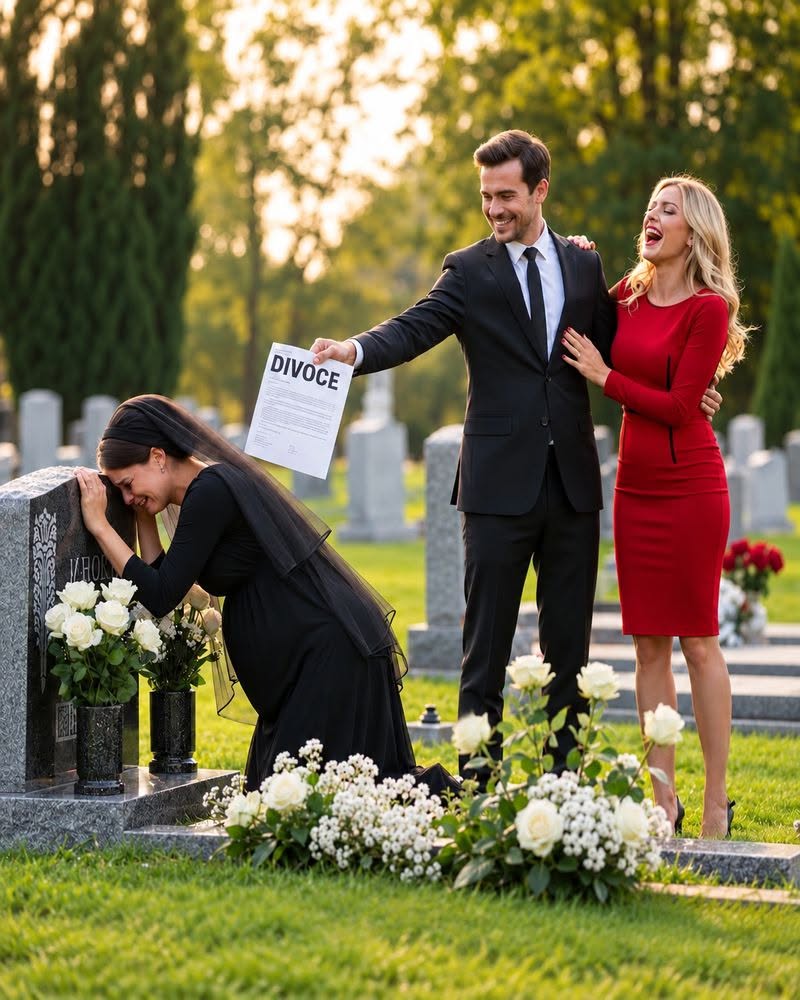
Caleb approached me as though nothing was wrong.
Then he leaned close.
“Your father’s gone, Eleanor. You need to start thinking practically. You can’t manage everything he left behind.”
I stared at him.
He continued.
“I’ve prepared documents. You should sign them before the estate becomes complicated.”
My father had been dead for four days.
And my husband was already asking me to surrender control of his life’s work.
Dad had built Whitmore Holdings over forty years.
He was wealthy, certainly, but what I remembered most was how seriously he took responsibility.
He knew employees by name.
He read contracts carefully.
And whenever I accompanied him to meetings, he explained decisions instead of expecting me to admire them.
“Money gives you choices,” he once told me. “Don’t let anyone convince you it means they should make those choices for you.”
I thought about those words as Caleb stood before me.
For six years, I’d believed he loved me.
We’d met at a charity fundraiser.
He was charming, attentive, and interested in everything I enjoyed.
But after we married, his questions increasingly concerned my family’s finances.
When I became pregnant, he encouraged me to withdraw from business matters.
“Let me handle the difficult decisions,” he would say.
I’d wanted to believe he was protecting me.
Dad wasn’t so sure.
Three weeks before his death, Dad asked me to visit him alone.
He was terribly weak.
But his mind was clear.
“Eleanor, there’s something you need to see.”
He showed me records his legal advisers had gathered.
There were indications of questionable transactions involving businesses connected to Caleb.
There were also photographs and messages suggesting he was involved with Vanessa.
I cried beside my father’s hospital bed.
“I don’t understand.”
Dad squeezed my hand.
“I know.”
He didn’t tell me to ruin Caleb.
He didn’t demand that I end my marriage.
He simply asked me to consult independent legal counsel before signing anything.
“Make your decisions with the truth in front of you,” he said.
I promised.
At the funeral, Caleb seemed to believe my silence meant I was frightened.
He glanced toward Vanessa.
“She’s been helping me through a difficult time,” he said.
I looked at the woman holding his hand.
Then I looked at him.
“Today is my father’s funeral. Please leave me alone.”
His expression hardened.
Before he could respond, Mr. Harlan, Dad’s longtime attorney, approached.
“Eleanor, your father left a letter for you.”
He handed me a black envelope bearing our family crest.
Caleb immediately reached toward it.
“I should probably review that.”
Mr. Harlan kept it in his own hand.
“The letter is addressed to Eleanor.”
For the first time that morning, Caleb had nothing to say.
I read Dad’s letter privately after the service.
It wasn’t a dramatic denunciation of my husband.
It began with memories.
The first time I accompanied him to work.
The questions I asked as a child.
The day I negotiated my first business contract without his help.
Then came the paragraph that made me cry.
I hope you never mistake needing advice for needing someone else’s permission. You are capable of making difficult decisions, even when you’re frightened.
He explained that his estate planning documents had been reviewed carefully.
The family trust established authority and responsibilities that Caleb would not acquire simply through marriage.
Dad had also arranged for independent advisers to help me understand my obligations.
At the bottom, he’d written:
Whatever you decide about your marriage, Eleanor, decide it because it is right for you and your child. Not because someone has convinced you that you cannot manage without him.
I folded the letter and held it against my chest.
I missed him so much that I could barely breathe.
That evening, Caleb came home.
He wanted to know what the letter said.
I told him it was private.
He became angry.
“Eleanor, you’re pregnant, you’re grieving, and you’ve never managed a company this size.”
“I know I have things to learn.”
“Then let me help.”
I looked at him.
“By asking me to sign away authority before my father was buried?”
He said he had only been trying to protect our future.
I asked about Vanessa.
He admitted the affair.
Then he called it a mistake.
I asked about the financial records.
His expression changed.
“Your father was investigating me?”
“There were concerns about company transactions. Independent counsel is reviewing them.”
He stood abruptly.
“You’re going to destroy my career over this?”
“No,” I said. “Your conduct will be examined through the proper process. Our marriage is a separate matter.”
For a moment, he stared at me.
Then he picked up his coat and left.
The following weeks were exhausting.
Whitmore Holdings initiated an independent review of the questionable payments.
Caleb was removed from company advisory responsibilities pending that investigation.
The evidence was evaluated by professionals who weren’t involved in our family dispute.
Some transactions required further legal action.
Others were resolved through accounting reviews and contractual remedies.
I did not try to personally decide criminal guilt.
Meanwhile, I filed for divorce.
My attorney helped me address marital finances and prepare for parenting arrangements.
Caleb initially resisted.
He accused me of turning my father against him.
Then he apologized.
Then he asked whether we could start again.
I listened, but I didn’t agree.
I still remembered the man I’d loved.
The trips we’d taken.
The evenings we’d spent imagining our daughter’s future.
Those memories mattered.
But so did the way he’d tried to pressure me when I was grieving and vulnerable.
An apology couldn’t instantly restore trust.
Two months after Dad’s funeral, I gave birth to a daughter.
I named her Grace.
When the nurse placed her against my chest, I cried.
Dad had wanted so badly to meet her.
He’d helped choose the little white crib in her nursery.
He’d bought a collection of children’s books and written a note inside the first one.
For Grace, who has so much to discover.
I read it aloud that evening.
Then I held her close until she fell asleep.
For the first time since Dad’s death, I felt something other than grief.
Not happiness exactly.
Hope.
The divorce and financial proceedings continued.
Caleb remained Grace’s father, and parenting arrangements were addressed with her welfare in mind.
I didn’t want her growing up believing she had to choose between loving her parents.
Whatever had happened between us belonged to the adults.
At Whitmore Holdings, I began working more closely with experienced executives.
I attended meetings.
Asked questions.
Made mistakes and corrected them.
There were days when I felt completely unprepared.
But I stopped treating uncertainty as evidence that I didn’t belong.
Dad had never expected me to know everything.
He had expected me to keep learning.
One afternoon, I visited his grave with Grace.
The cemetery was quiet.
I placed white roses beside his headstone.
Then I sat near him while Grace slept in her stroller.
“Dad,” I whispered, “you were right about some things.”
My voice trembled.
“I wish I’d listened sooner.”
I thought about the letter.
The careful arrangements he’d made.
The years he’d spent teaching me how to understand the business rather than simply inherit its privileges.
But I also remembered what he’d never done.
He had never told me I was too weak to make my own choices.
Even when he worried about my marriage, he’d left the decision to me.
I looked at my daughter.
Someday, Grace would make choices I couldn’t control.
She might love people I worried about.
She might make mistakes.
She might need help without wanting to ask for it.
I hoped I would remember my father’s example.
To offer guidance.
To tell the truth.
And to respect her ability to decide.
Before leaving, I unfolded the letter one more time.
Near the bottom, Dad had written:
You don’t have to prove you’re strong by facing everything alone. Strength also means knowing whom to trust and when to ask for help.
I smiled through my tears.
For months, I’d believed that protecting myself meant becoming harder.
Less trusting.
Less willing to love.
But that wasn’t what Dad wanted for me.
He wanted me to recognize the difference between someone who stood beside me and someone who wanted control over me.
I placed the letter safely in my bag.
Then I adjusted Grace’s blanket and prepared to leave.
My husband had arrived at my father’s funeral believing his death would make me dependent on him.
What he hadn’t understood was that Dad’s greatest gift wasn’t the fortune he’d left behind.
It was a lifetime of preparing me to make my own decisions—even when he could no longer stand beside me.
{"post":116698,"page":2,"next":[{"id":116694,"title":"I Came Home With Our Newborn Twins To Find My Mother-In-Law Living In Our Bedroom And A Second Refrigerator For Her And My Husband. \u201cBuy Your Own Food For You And The Girls,\u201d He Said","url":"https:\/\/new24.info\/116694"},{"id":116688,"title":"Six Winters In A Room With Water Stains While A Card I Refused To Touch Sat Inside A Box","url":"https:\/\/new24.info\/116688"},{"id":116685,"title":"The Day I Let My Son Walk Home Alone, He Became Someone\u0027s Hero","url":"https:\/\/new24.info\/116685"},{"id":116681,"title":"Ben Affleck Opens Up About Jennifer Garner and Jennifer Lopez in New Interview","url":"https:\/\/new24.info\/116681"},{"id":116674,"title":"With heavy hearts, we announce the tragic loss of this hit television show judge at 46 as tragic details about his death emerge","url":"https:\/\/new24.info\/116674"},{"id":116671,"title":"A Woman Brought Her Own Food to Her DIL\u0027s Dinner Party So Her Son \u0027Wouldn\u0027t Starve\u0027 \u2013 But the DIL\u0027s Reaction Made Her Drop Her Fork and Whisper, \u0027You Wouldn\u0027t Dare!\u0027","url":"https:\/\/new24.info\/116671"},{"id":116667,"title":"A 7-Year-Old Girl Found a Diamond Ring at the Grocery Store and Returned It to Its Owner \u2013 The Next Morning, a Stranger Showed up at Her Door and Said, \u0027I Need to Show You Something Right Now!\u0027","url":"https:\/\/new24.info\/116667"},{"id":116664,"title":"I Kept The Check My Family Laughed At And Walked Into The Bank Next Morning","url":"https:\/\/new24.info\/116664"},{"id":116661,"title":"My Son Had Been Walking Home Alone for Only 20 Minutes When My Neighbor Said, \u201cCome Outside. You Need to See This\u201d","url":"https:\/\/new24.info\/116661"},{"id":116653,"title":"11 years after their split, Ben Affleck doesn\u2019t hold back as he describes his ex-wife","url":"https:\/\/new24.info\/116653"},{"id":116647,"title":"At dinner, my sister sneered, \u201cYou\u2019re still the family garbage,\u201d then praised her husband\u2019s prestigious career in front of 30 guests.","url":"https:\/\/new24.info\/116647"},{"id":116643,"title":"Five-Year-Old Girl Saves Her Mother From Two Years of Hidden Poisoning","url":"https:\/\/new24.info\/116643"},{"id":116639,"title":"A Womans Husband Suggested That She and Her Friend Swap Husbands for a Week She Thought He Was Joking Until She Found Out Her Friend Was Actually Willing to Do It so She Agreed and Decided to Teach Them Both a Lesson","url":"https:\/\/new24.info\/116639"},{"id":116635,"title":"The Multi-Million Dollar Betrayal: My 78-Year-Old Billionaire Husband\u2019s Shocking Wedding Confession Left Me Speechless!","url":"https:\/\/new24.info\/116635"},{"id":116632,"title":"A Teen Brought His Mother to Prom\u2014and Finally Gave Her the Night She Missed","url":"https:\/\/new24.info\/116632"},{"id":116622,"title":"Late Night Phone Call Exposes Secret Twin Living Inside My Home","url":"https:\/\/new24.info\/116622"},{"id":116617,"title":"I Married a Homeless Man Until His Final Letter Revealed the Truth","url":"https:\/\/new24.info\/116617"},{"id":116613,"title":"12 years ago they were dubbed as the most beautiful twins in the world \u2013 but wait till you see how they look today: See in 1st comment","url":"https:\/\/new24.info\/116613"},{"id":116610,"title":"Husband Cheated on His Wife with Their Daughter-in-Law \u2013 What the Wife and Her Son Did Next Was Brutal","url":"https:\/\/new24.info\/116610"},{"id":116607,"title":"Man Returned from a Three-Day Fishing Trip with a Wedding Ring Mark \u2013 He Hadn\u2019t Worn One in 12 Years","url":"https:\/\/new24.info\/116607"}]}