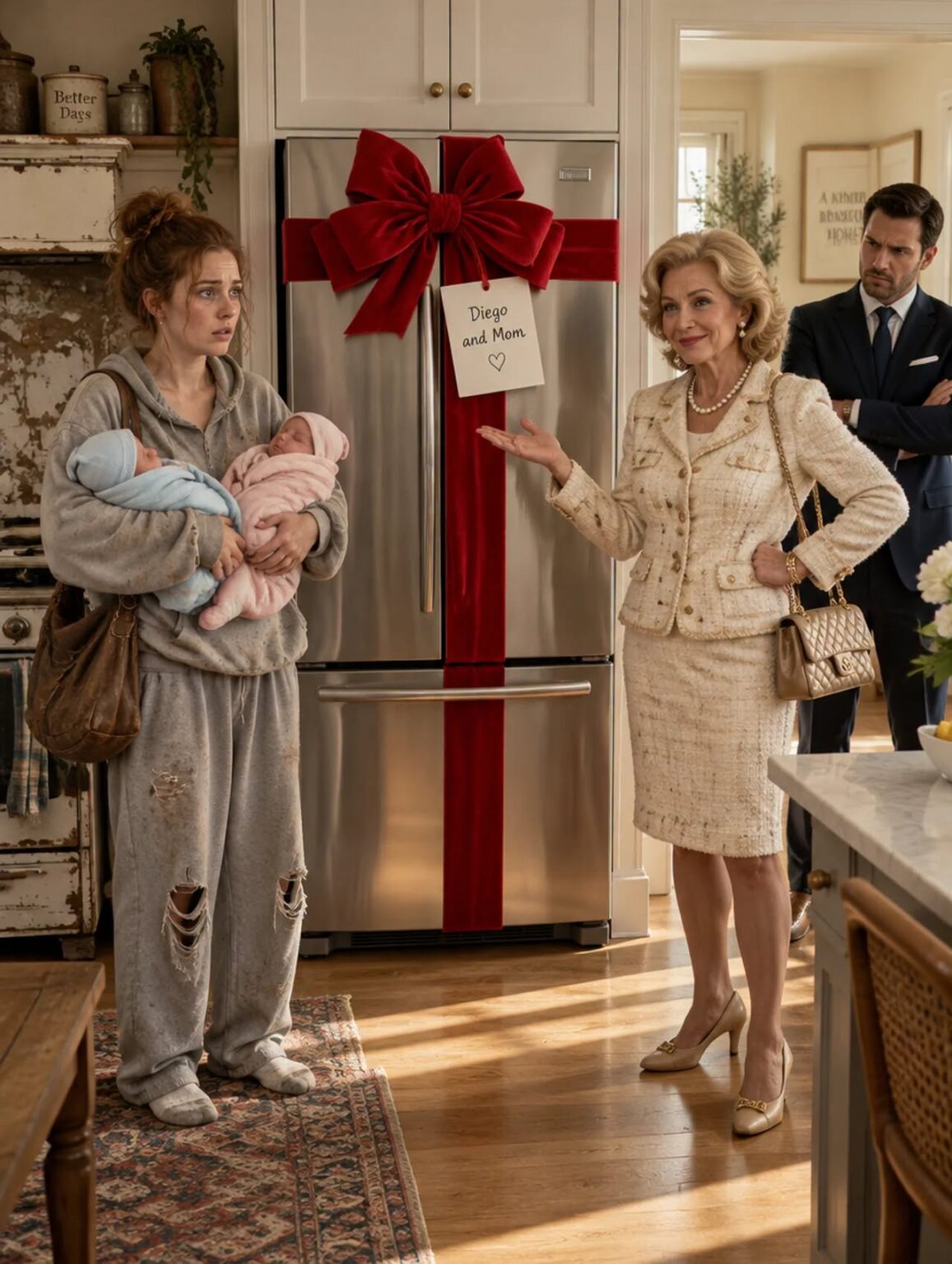
FOR BRANDON AND GWEN ONLY.
I stood in the doorway holding Chloe while my father carried Clara behind me.
My husband, Brandon, barely looked up.
“Mom and I decided it would be easier to keep our groceries separate.”
I stared at the note.
“What about mine?”
“You can buy your own,” he said.
“And the babies?”
He shrugged.
“You’re their mother. You’ll figure it out.”
I had just endured a difficult delivery.
My body ached.
I hadn’t slept properly in days.
And somehow, my husband had decided that the appropriate welcome home was to tell me I was responsible for feeding myself and our newborn children.
His mother, Gwen, emerged from the hallway.
She was carrying one of my jewelry boxes.
“I’ve reorganized the closets,” she announced. “Brandon needs someone here who knows how to run a household.”
I looked past her.
Her suitcases stood beside our bedroom.
My books had disappeared from the shelves.
Several of my coats were gone.
“Are you moving in?” I asked.
“Of course. The babies need help.”
She said it as though she were doing me a favor.
Brandon finally looked up.
“And we should talk about your job. You can’t keep chasing a career now that you have twins.”
I was a senior financial analyst.
Before maternity leave, I earned more than Brandon.
We had agreed that I would return to work gradually after the babies were born.
Now he was speaking as though our agreement had never existed.
I looked at the second refrigerator.
Then at the two people standing in my kitchen.
“I need to feed Chloe,” I said.
And walked upstairs.
What they didn’t know was that I had already seen the messages.
Several weeks before the delivery, I discovered conversations between Brandon and Gwen discussing how to persuade me to resign.
One message from Gwen said:
Once she stops earning, she’ll have to listen.
Brandon had replied:
I’ll handle it after the babies arrive.
I had hoped the conversation was an ugly expression of stress rather than a serious plan.
But I saved the messages.
I also discovered that my belongings were being packed into basement storage to make room for Gwen.
Now I understood exactly what they intended.
I was supposed to become financially dependent inside a home they increasingly treated as theirs.
The strange part was that the apartment belonged to me.
I had purchased it before marrying Brandon.
The title was in my name.
But I understood that ownership did not give me permission to ignore marital property rights or simply throw people out.
So I called a family-law attorney.
Then I called my father.
“Dad,” I said, trying not to cry. “I need help.”
He didn’t ask me to explain everything.
“I’m here,” he answered.
The following morning, Dad returned with my brothers, Mason and Lucas.
Not to threaten anyone.
I needed people I trusted to help with the babies while I had a difficult conversation.
Brandon came downstairs and stopped when he saw them.
“What’s going on?”
I placed the saved messages on the table.
Then I asked him:
“Were you planning to make me quit my job so I couldn’t leave?”
He looked toward Gwen.
She immediately began talking.
“Seraphina, motherhood requires sacrifice.”
“Yes,” I said. “From both parents.”
Brandon rubbed his forehead.
“You’re exaggerating.”
I pointed toward the kitchen.
“You installed a refrigerator and told me your food wasn’t for me or our daughters.”
He said nothing.
“You moved my belongings without asking. You invited your mother to live here without discussing it. And you planned my resignation behind my back.”
Gwen folded her arms.
“You’re turning your family against us.”
“No,” I said quietly. “I’m asking my family to help me while I recover from childbirth.”
Then I looked at Brandon.
“I want us to live separately.”
For the first time, he seemed frightened.
He blamed his mother.
Gwen blamed him.
I listened until they finished.
Then I repeated my decision.
“This isn’t about which one of you had the idea. You both participated.”
After discussing the arrangements, Brandon agreed to stay elsewhere temporarily.
Gwen collected her belongings.
The legal questions about housing, finances, and parenting would be addressed properly.
I was not going to resolve my marriage through intimidation or an improvised eviction.
And I wasn’t going to use Chloe and Clara to punish Brandon.
He remained their father.
That meant he had responsibilities toward them, whatever happened between us.
Once they left, I stood in the kitchen.
The second refrigerator hummed beside the first.
I opened it.
Imported cheeses.
Fruit.
Prepared meals.
Everything neatly arranged.
I thought about my daughters upstairs.
Then I began to cry.
Not because I wanted the expensive food.
Because I couldn’t understand how two adults could look at newborn babies and decide that feeding their mother wasn’t a shared family concern.
The following months were exhausting.
I was recovering physically while caring for two infants.
There were feeds that seemed endless.
Laundry that never stayed finished.
Nights when both girls cried and I couldn’t decide which one to comfort first.
My father visited regularly.
My brothers helped with shopping and appointments.
I arranged childcare and gradually returned to work when I was medically ready.
I was grateful for my career and savings.
But I didn’t pretend that earning my own money made single parenting effortless.
Some nights, I needed someone to hold Clara while I fed Chloe.
Some mornings, I needed to sleep.
Accepting help was not the dependency Brandon and Gwen had tried to create.
There is a difference between receiving support and surrendering your freedom to the person providing it.
Three months after the separation, child-protection workers contacted me about a report alleging that my work hours were causing neglect.
I was frightened.
I cooperated with their assessment and provided information about the girls’ medical care, feeding arrangements, and childcare.
The concerns were ultimately not substantiated.
I suspected Gwen had made the report.
But I did not know that for certain.
My attorney advised me to preserve records and avoid making accusations without evidence.
I followed that advice.
I had spent enough time dealing with people who treated assumptions as facts.
I didn’t want to become one of them.
Meanwhile, Brandon and I continued addressing parenting arrangements through legal channels.
He sometimes apologized.
Other times, he defended his mother’s behavior.
I encouraged him to take an active, responsible role in his daughters’ lives, but I did not agree to resume our marriage.
An apology did not resolve what had happened.
It would take consistent behavior to establish trust, particularly where the children were concerned.
A year later, Chloe and Clara were learning to crawl.
They had discovered that pulling every cushion off the sofa was the most entertaining activity in the world.
My apartment rarely looked tidy.
There were toys under the dining table.
Tiny socks in impossible places.
Bottles drying beside the sink.
And I was tired almost every evening.
But I was no longer afraid of coming downstairs.
No one inspected the kitchen to decide whether I had earned the right to rest.
No one treated my career as a threat.
No one divided the household groceries according to who controlled the money.
The second refrigerator had been removed months earlier.
The empty space remained.
One evening, while the girls played on the floor, I came across a photograph of Brandon with a new partner.
For a moment, I felt sadness.
Not jealousy.
I remembered the man I had married.
The excitement when we learned we were expecting twins.
The plans we’d made for our daughters.
I had believed we would raise them together in one home.
Losing that future still hurt.
But I didn’t need to resent every good thing that happened to Brandon afterward.
I wanted him to become a responsible father.
That mattered far more than whether he regretted losing me.
Clara crawled toward me and pulled herself against my knee.
Chloe followed, laughing.
I lifted them both onto my lap.
Someday, they would be old enough to ask why their parents no longer lived together.
I wanted to answer honestly, without filling their childhood with bitterness.
I wanted them to understand that families share responsibilities.
That earning money does not make one person’s needs more important.
That caring for children is work, even when no salary is attached.
And that love should never require someone to become powerless in order to receive basic kindness.
I looked toward the empty space in the kitchen.
Once, it had held a refrigerator meant to remind me that I didn’t belong on equal terms in my own home.
Now it was simply room for the girls to play.
I kissed their heads.
For a long time, I had believed keeping a family together meant enduring whatever happened inside it.
But a peaceful home isn’t defined only by the people living under one roof.
It’s defined by how those people are treated.
My daughters and I had a different life than the one I imagined.
It was imperfect.
It was tiring.
It required more help than I once expected.
But nobody in this home had to earn the right to be cared for.
{"post":116566,"page":2,"next":[{"id":116518,"title":"Secret Inheritance Reveals Ultimate Betrayal And Destroys A Greedy Family Forever","url":"https:\/\/new24.info\/116518"},{"id":116560,"title":"My Dad Charged Me $250 a Month for Five Years\u2014After His Funeral, His Best Friend Gave Me a Box That Changed Everything","url":"https:\/\/new24.info\/116560"},{"id":116522,"title":"Wynonna Judd\u0027s Tennessee Farm and Home: Aerial Views, the Gazebo Where She Married, and the Ranch Life She Shares with Her 4-Year-Old Granddaughter \u2014 30+ Photos","url":"https:\/\/new24.info\/116522"},{"id":116519,"title":"A Woman Let Her 11-Year-Old Son Walk Home from School Alone for the First Time \u2013 Twenty Minutes Later, Her Neighbor Called Her Crying, \u0027Come Outside. You Need to See What Your Son Did\u0027","url":"https:\/\/new24.info\/116519"},{"id":116514,"title":"Apologizing Seven Years After Divorce Uncovered A Son With My Exact Eyes","url":"https:\/\/new24.info\/116514"},{"id":116511,"title":"Kelly Clarkson Says a Brooklyn Store Made Her Feel Like Julia Roberts in \u0027Pretty Woman\u0027 \u2014 Here\u0027s Where the Drama Went Next","url":"https:\/\/new24.info\/116511"},{"id":116506,"title":"My Husband Ignored Seven Emergency Calls While His Corporate Betrayal Unraveled","url":"https:\/\/new24.info\/116506"},{"id":116502,"title":"My Husband Told Me To Take My Mess Somewhere Else. So I Took My Bottles, My Career, And My Self-Respect\u2014and Left Him Behind.","url":"https:\/\/new24.info\/116502"},{"id":116499,"title":"They Tried To Dine And Dash\u2014But My Boss Had A Plan I Never Saw Coming","url":"https:\/\/new24.info\/116499"},{"id":116496,"title":"My Ex-Husband Trashed My House After Our Divorce \u2013 My Father Dealt with Him During the Proceedings","url":"https:\/\/new24.info\/116496"},{"id":116491,"title":"I donated bl00d to save my boyfriend after his friends told me he had been in a serious ac:cid:ent. As I was leaving the hospital, I heard someone behind a door say, \u201cI can\u2019t believe she fell for it again.\u201d","url":"https:\/\/new24.info\/116491"},{"id":116487,"title":"My husband\u2019s family waited until after my mother was gone before deciding her $8 million estate should belong to them.","url":"https:\/\/new24.info\/116487"},{"id":116484,"title":"Man Returned from a Three-Day Fishing Trip with a Wedding Ring Mark \u2013 He Hadn\u0027t Worn One in 12 Years","url":"https:\/\/new24.info\/116484"},{"id":116481,"title":"A Man Kept Manspreading Into a Woman\u0027s Plane Seat for Hours \u2013 When He Returned From the Restroom, He Shouted, \u0027What the Hell Did You Do?!\u0027","url":"https:\/\/new24.info\/116481"},{"id":116478,"title":"My 78 Year Old Boss Took Me to a Park and Said As of Today You No Longer Work for Me I Froze Thinking He Was Firing Me After Years of Loyalty Then He Offered to Keep Me Only on One Condition What He Said Made Me Walk Away in Tears","url":"https:\/\/new24.info\/116478"},{"id":116475,"title":"My Father Made Me Pay Rent And I Never Understood Why Until That Final Day","url":"https:\/\/new24.info\/116475"},{"id":116472,"title":"With heavy hearts, we mourn the loss of the legendary Hollywood musician who gave us some of the most wonderful and unforgettable music in film history","url":"https:\/\/new24.info\/116472"},{"id":116469,"title":"Ellen DeGeneres shares news on triple diagnosis","url":"https:\/\/new24.info\/116469"},{"id":116462,"title":"The Man Who Came Home to a Sagging Porch and Discovered Love, Belonging, Gratitude","url":"https:\/\/new24.info\/116462"},{"id":116459,"title":"My Husband Lied About Going to Work\u2014Then I Saw Who He Was Meeting","url":"https:\/\/new24.info\/116459"}]}