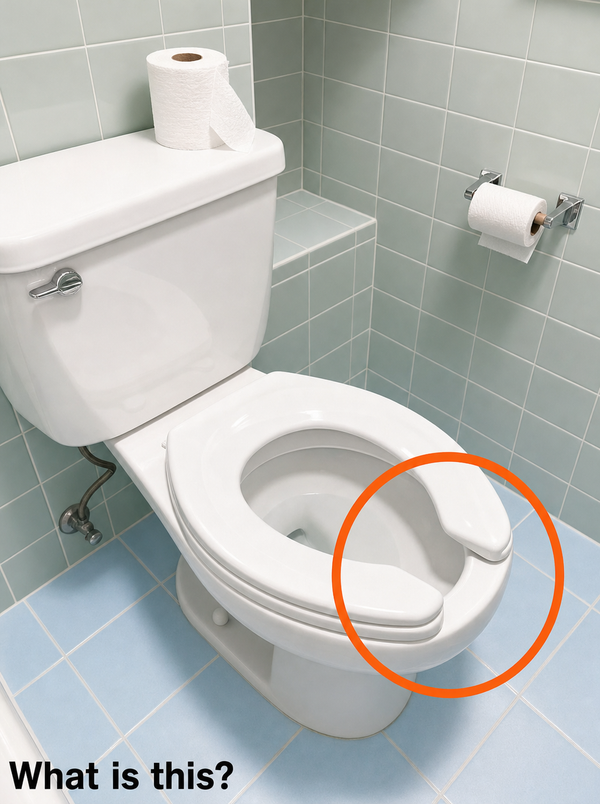
That open front is actually built that way on purpose, and it shows up often enough in American public restrooms that it’s clearly a standard design rather than a defect. The shape solves a few practical problems at once, ones most people never think to ask about.

Why the Gap Exists
The opening in the seat gives extra clearance for personal hygiene, making it easier to use the toilet without unnecessary contact with the seat itself. It also reduces contact with the front portion of the seat, which is the area most prone to soiling over repeated use by many different people.
There’s a cleaning angle too. The gap makes the surrounding area easier for custodial staff to reach and wipe down thoroughly. In facilities serving large numbers of people, these small design choices add up. Still, the open front isn’t a replacement for actual cleaning and handwashing—it’s a complement to them, not a substitute.
The Plumbing Code Behind the Design
This isn’t just a preference manufacturers landed on by accident. The International Plumbing Code generally calls for smooth, nonabsorbent, open-front seats in public or employee toilets. That guidance isn’t universal in every jurisdiction, since exceptions exist and the exact requirements depend on whatever plumbing code a local area has adopted.
That’s why the open-front style turns up so consistently in restrooms at restaurants, offices, and other public spaces. It’s less about any single building’s choice and more about a broader standard many codes point toward for shared facilities.
Public Restrooms vs. Home Bathrooms
At home, the calculation is different. Closed-front seats remain the common choice in private bathrooms, largely because homeowners tend to prioritize appearance and comfort over the specific hygiene concerns that come with high-traffic public use.
Since a home toilet is typically used by a small, known group of people rather than a constant stream of strangers, the practical advantages of an open front matter less there. Comfort and a finished look simply take priority.
So the seat that once looked like a broken or mismanufactured piece turns out to be a deliberate, practical design choice. It’s a small detail that quietly reflects plumbing codes, cleaning logistics, and basic hygiene concerns all at once—proof that even the most overlooked objects in daily life can have a reasoned purpose behind them.