My name is Jennifer.
Caleb is my only son.
Three years ago, my husband, David, died after a long illness.
People often use the word “battle” when someone is seriously sick.
I understand why.
There were appointments.
Medications.
Hospital rooms.
Good weeks that made us hopeful.
Bad weeks that made us afraid to hope again.
But toward the end, it didn’t feel like a battle.
It felt like watching someone we loved disappear a little at a time.
Caleb was nine when his father died.
At first, I thought he was handling it surprisingly well.
Too well, I eventually realized.
He cried at the funeral.
After that, almost nothing.
If someone mentioned David, Caleb lowered his eyes.
Sometimes he changed the subject.
Over time, he stopped inviting friends over.
Then he stopped going to their houses.
Some evenings, he carried dinner upstairs and ate alone.
His teachers called me twice because he had become unusually quiet in class.
Before David died, Caleb had been the child who raised his hand even when he wasn’t completely sure of the answer.
Now his teacher told me he could go an entire school day without speaking unless someone directly called on him.
I tried everything I knew.
“Do you want to talk about Dad?”
“No.”
“Are you angry?”
“No.”
“Are you sad?”
“I’m fine.”
“Caleb, you can tell me anything.”
“I know.”
Then he disappeared into his room.
“Fine” became his favorite word.
A week before Father’s Day, the school emailed parents about an assembly.
Students could sing songs.
Read poems.
Tell stories.
Give short speeches about fathers or father figures.
The moment I read it, my stomach tightened.
That evening, Caleb was standing at the kitchen counter eating cereal straight from the box.
I tried to sound casual.
“About the Father’s Day assembly…”
His shoulders stiffened.
“You don’t have to go.”
He looked at me.
“Why wouldn’t I?”
“I just thought it might be hard.”
“I want to go.”
“You do?”
“Yes.”
I studied him.
“Are you sure?”
“Why wouldn’t I be?”
“Okay. I’m just asking.”
“I’m sure, Mom.”
That was all he said.
What he didn’t tell me was that he had signed up to perform.
The morning of the assembly, he came downstairs carrying David’s guitar.
I hadn’t seen him touch it in months.
David had taught Caleb his first chords when he was seven.
He used to sit behind him on the couch, reaching around his little body to position his fingers.
“Ow,” Caleb would complain.
“Your fingertips need to toughen up,” David would say.
“They’re seven-year-old fingertips.”
“That sounds like an excuse.”
Then they would both laugh.
Seeing that guitar again almost knocked the air out of me.
“What are you doing with that?”
Caleb adjusted the strap.
“I’m playing it.”
“At school?”
“Yeah.”
“You didn’t tell me.”
He shrugged.
“I’m telling you now.”
The assembly was held in the school gym.
Rows of folding chairs covered the floor.
Paper ties and handmade Father’s Day decorations hung on the walls.
Everywhere I looked, children were sitting beside dads.
Some fathers wore suits.
Others had come straight from work in boots or uniforms.
One boy had brought both grandfathers and sat proudly between them.
There was an empty chair beside me.
Nobody had saved it for David.
It was simply unused.
Still, I couldn’t stop looking at it.
Caleb sat with his classmates near the stage.
When they called his name, my hands went cold.
He walked up carrying David’s guitar.
His music teacher lowered the microphone.
Under the bright gym lights, Caleb suddenly looked very small.
He scanned the audience.
Then he found me.
For a second, we just looked at each other.
Then he lifted his eyes toward the ceiling.
“This one’s for my dad.”
He started playing.
I recognized the song within three chords.
David used to sing it on Saturday mornings while making breakfast.
He was incapable of cooking quietly.
If music wasn’t playing, he supplied it himself.
Sometimes he deliberately changed the lyrics until Caleb shouted:
“That’s not how it goes!”
Hearing that melody again hurt.
Caleb’s voice shook during the first verse.
Then it steadied.
I covered my mouth.
A woman beside me began crying.
Across the aisle, one of the teachers wiped her eyes.
For me, it felt like someone had opened an old wound.
I missed David so fiercely that I could barely breathe.
Then, during the second verse, the double doors at the back of the gym opened.
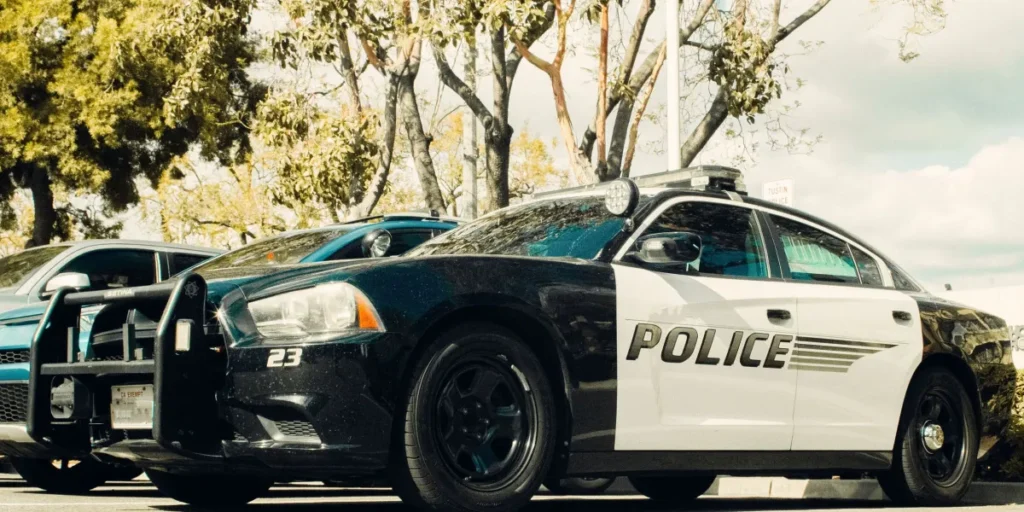
Two uniformed police officers walked inside.
Almost every adult turned.
So did I.
My first thought was that something was wrong.
One officer spoke quietly to a teacher near the entrance.
She pointed toward the principal.
The officers started crossing the gym.
Then the older one suddenly stopped.
His partner nearly walked into him.
The older officer was staring at Caleb.
Caleb kept playing.
The officer whispered something.
Then both men stood at the back of the gym and listened.
When Caleb reached the final chorus, his voice cracked.
For half a second, he stopped singing.
I thought he was done.
Instead, he swallowed.
And continued.
When the last chord faded, the gym became completely silent.
Then everyone stood.
Applause filled the room.
Caleb looked down.
His shoulders began shaking.
His teacher approached, but Caleb shook his head and wiped his face on his sleeve.
I was already moving toward the stage.
Then I noticed the two officers coming too.
Panic rushed through me.
Why were they approaching my son?
I took Caleb’s hand and guided him toward the side door.
The officers followed.
Outside the gym, the older one stopped a few feet away.
“Son, what’s your name?”
Caleb looked at me.
“Caleb.”
The officer looked at the guitar.
“And your dad was?”
Something closed in Caleb’s expression.
“David.”
The officer’s face changed instantly.
He looked at his partner.
“I knew it.”
My heart started pounding.
“You knew my husband?”
The officer removed his cap.
“I’m Officer Marcus. This is Officer Alvarez.”
He paused.
“We knew David.”
“From where?”
“The local youth center.”
Caleb looked up.
“My dad went there?”
Marcus almost laughed.
“Went there? Your dad practically lived there some Thursday nights.”
I honestly thought he had the wrong man.
David worked in IT.
He managed networks for a regional insurance company.
I knew he occasionally volunteered, but I assumed he was helping with computers.
Marcus looked at Caleb.
“Your dad taught kids how to protect themselves online.”
I frowned.
“How?”
“Passwords. Scams. Adults pretending to be kids. People asking them to send pictures they shouldn’t send.”
Officer Alvarez added:
“He talked about social media too. Especially cyberbullying.”
Caleb’s forehead wrinkled.
“He never told me.”
“I didn’t know either.”
Marcus shrugged gently.
“He was incredibly dedicated, but he was only a volunteer. Maybe he didn’t think it was something worth announcing.”
Then I finally asked:
“Why are you here today?”
Marcus glanced toward the gym.
“We’re meeting with the principal about a personal-safety workshop we’re running here in two weeks.”
He smiled.
“We heard the song and got distracted.”
Alvarez nodded.
“Your husband used to play that song.”
I stared at him.
“My dad taught me this song,” Caleb said quietly.
Marcus smiled.
“He played it at the center all the time.”
Caleb looked interested despite himself.
“The kids used to complain he only knew five songs.”
A tiny smile appeared on Caleb’s face.
“Sounds like him.”
Marcus laughed.
“They gave him a hard time about it.”
He imitated David:
“Five good songs are better than fifty terrible ones.”
I laughed.
Then I started crying.
I hated how easily tears came whenever David suddenly felt close.
Marcus immediately softened.
“I’m sorry. We didn’t mean to upset you.”
“No.”
I wiped my face.
“You didn’t.”
Caleb was still staring at him.
“My dad sang there?”
“With that guitar sometimes, unless I’m mistaken.”
Caleb held the instrument tighter.
“It was his.”
Marcus nodded.
“Then yes.”
He reached into his pocket.
“I think I might have something.”
He scrolled through his phone for a while.
Then turned the screen toward us.
The photograph was several years old.
David was sitting on a folding chair at the youth center holding his guitar.
Around him were maybe fifteen teenagers.
And David was laughing.
Healthy.
Strong.
Not pale from treatment.
Not exhausted.
Not dying.
Caleb grabbed my arm.
“Mom.”
“I see him.”
It felt like being punched and hugged at the same time.
Marcus sent me the picture.
Then he said:
“You two should come by the center sometime.”
Caleb immediately looked away.
“I don’t know.”
“No pressure,” Marcus said. “But there are people there who remember him.”
That night, Caleb looked at the photo for almost an hour.
He zoomed in on faces.
Background details.
David’s guitar.
Finally, he asked:
“Why didn’t Dad tell us?”
“I think he mentioned the center once or twice.”
“Not like this.”
“No.”
He went quiet.
Then whispered:
“I thought I knew everything about him.”
That sentence broke my heart in a completely different way.
“We never know everything about anyone.”
Caleb looked at me.
“Maybe there are still parts of Dad we can learn.”
The following Saturday, we drove to the youth center.
Caleb nearly backed out in the parking lot.
“We can leave,” I told him.
He stared at the entrance.
“No.”
“You’re sure?”
“I don’t know.”
Despite everything, I smiled.
“That’s very honest.”
He sighed.
“Let’s just go.”
Marcus was waiting inside.
He told us he had invited a few people who remembered David.
“A few” turned out to be nearly twenty.
Some were teenagers.
Others were young adults who had attended the program years earlier.
A young woman named Tasha approached us first.
She looked about twenty.
“You’re David’s son?”
Caleb nodded.
She smiled.
“He was an amazing man.”
Then she added:
“Annoying too.”
Caleb blinked.
I laughed before I could stop myself.
Tasha grinned.
“I’m serious. He would not let anything go.”
She told us she had been fourteen and constantly posted everything online.
Her school.
Where she lived.
Where she was going after class.
“Your dad kept telling me it wasn’t safe.”
“What happened?” Caleb asked.
“I told him he was old.”
Caleb smiled.
“That sounds like him.”
Tasha’s expression became serious.
“Then a grown man started messaging me pretending to be sixteen.”
My smile disappeared.
“Your dad helped me realize what was happening before I ever agreed to meet him.”
She looked at me.
“He helped my mom report it too.”
Another young man named Jordan approached.
He told Caleb that classmates had created a fake account to humiliate him.
“I didn’t want to go back to school.”
Jordan pointed toward an old couch.
“Your dad sat with me right there.”
Then he repeated words David had told him:
“Don’t let cruel people make you hide because of something they did. They’re the ones who should be ashamed.”
Caleb listened to every word.
More people came forward.
David helped teenagers secure their social-media accounts.
He helped parents understand apps their children were using.
He warned kids about edited photographs and impossible beauty standards.
He talked about anxiety.
Comparison.
Loneliness.
How a screen could make someone feel surrounded by people and completely alone at the same time.
Then Marcus brought out an old guitar.
“This was the other half of his program.”
Caleb frowned.
“Music?”
“Sometimes. Especially when everybody got tired of listening to him lecture.”
A boy in the back called out:
“He wasn’t that good.”
Everyone laughed.
And Caleb laughed too.
A real laugh.
Not polite.
Not forced.
The kind I hadn’t heard from him in months.
On the drive home, Caleb was quiet for about ten minutes.
Then he asked:
“Do you think Dad knew they’d remember him?”
“I don’t know.”
“I didn’t.”
I glanced at him.
He was watching houses pass.
“I thought when someone died, everything they did just stopped.”
I swallowed.
“They stop being here physically.”
He looked at me.
“But what they did doesn’t disappear.”
Caleb nodded slowly.
That evening, he ate dinner downstairs with me.
Three days later, I came home and found his friend Noah sitting in our living room.
I got too excited.
“Hi, Noah! It’s so nice to see you!”
Caleb glared.
“Ew, Mom.”
“What?”
“You’re being weird.”
“I said hello.”
“You said it like he came back from war.”
Noah started laughing.
After that, the changes came slowly.
Caleb did not magically become the child he had been before David died.
He still had bad days.
Sometimes the subject of Father’s Day made him close up.
Sometimes I found him holding David’s guitar without playing.
But he started talking again.
His teacher emailed me because he volunteered to lead a class project.
He joined a weekend soccer group.
He started helping me cook.
Mostly because he claimed my pasta sauce needed “serious intervention.”
One night, while we were chopping onions, Caleb said:
“Dad always burned these.”
“He burned everything.”
“He said they were caramelized.”
“He was a liar.”
Caleb laughed so hard he had to put the knife down.
Months later, the youth center planned a fundraiser.
Marcus asked Caleb if he wanted to perform.
His immediate answer was no.
Two weeks later, he changed his mind.
The night of the fundraiser, I stood near the back.
Caleb walked onto the small stage carrying David’s guitar.
Marcus was beside me.
“Think he’ll make it through?”
“I don’t know.”
Caleb adjusted the microphone.
He looked nervous.
Then he found me in the crowd.
This time, he didn’t look toward the ceiling.
He smiled.
“This was my dad’s favorite song.”
The room became quiet.
“I used to think it made me sad because he was gone.”
He paused.
“Now I think it reminds me he was here.”
Then he began to play.
His voice didn’t break.
He didn’t stop.
When the chorus came, several people in the audience quietly started singing with him.
I cried anyway.
Of course I did.
But Caleb didn’t.
He stood under those lights and played his father’s song all the way to the end.
And for the first time in three years, watching my son remember David didn’t feel like watching grief swallow him.
It felt like watching him come back.
I don’t think Caleb withdrew because he was afraid he would forget his father.
I think remembering David had simply become too painful.
Every memory reminded him of what he no longer had.
The guitar wasn’t just a guitar.
The songs weren’t just songs.
They were doors to a life that had ended too soon.
So Caleb closed those doors.
What Marcus, Alvarez, and the people at the youth center gave him was another way to remember.
They showed him that David’s story had not ended entirely in a hospital room.
His father had existed outside the illness.
He had laughed.
Played music.
Helped people.
Changed lives.
And when Caleb finally understood that, his memories stopped being only reminders of death.
They became evidence of a life.
Sometimes healing does not mean thinking about someone less.
Sometimes it means learning how to remember them without disappearing into the loss yourself.