Privacy.
Choice.
A door that belonged to me.
My mother, Nancy, had never respected boundaries.
Growing up, privacy was treated as secrecy.
A closed door was an insult.
My belongings were inspected.
My decisions became family discussions whether I wanted them to or not.
At eighteen, I left.
Over the years, I built a quiet life as a pediatric occupational therapist.
Then, during my pregnancy, my partner left.
I was frightened.
But I had savings.
So I bought the house myself eleven days before Clara was born.
I painted her nursery sage green simply because I liked it.
It felt almost revolutionary.
The delivery lasted thirty hours.
Afterward, my blood pressure remained high, and my medical team told me to rest and keep visitors limited.
I told Mom clearly:
“I need two weeks. No visitors unless I ask.”
She said very little.
That should have worried me.
A few days later, I found confirmation from a moving company.
Then an invoice for dozens of boxes.
Mom had paid for both.
My older sister Krista, her husband Pete, and their three children had recently fallen into serious financial trouble.
Apparently, Mom had decided that my new house would solve the problem.
Without asking me.
The evening I brought Clara home, she called.
“We’ll be there tomorrow morning. Krista’s family can take the spare rooms.”
“Mom, no.”
“They have nowhere else to go.”
“I just gave birth.”
“They’re family.”
Then came the sentence I had heard in different forms all my life.
“You have the space.”
As though having something meant I had forfeited the right to choose how it was used.
That night, my security system detected movement near the back door.
It was Krista.
She had an old emergency key.
She tried it once, then left.
I was frightened enough that I called a locksmith and had the locks changed.
I also contacted a property attorney recommended by colleagues.
Not because I wanted a dramatic confrontation.
Because I was exhausted, recovering from childbirth, and did not trust myself to handle a complicated family dispute alone.
I asked Victor, an old friend of my late father, to come too.
He had always been one of the few people Mom listened to.
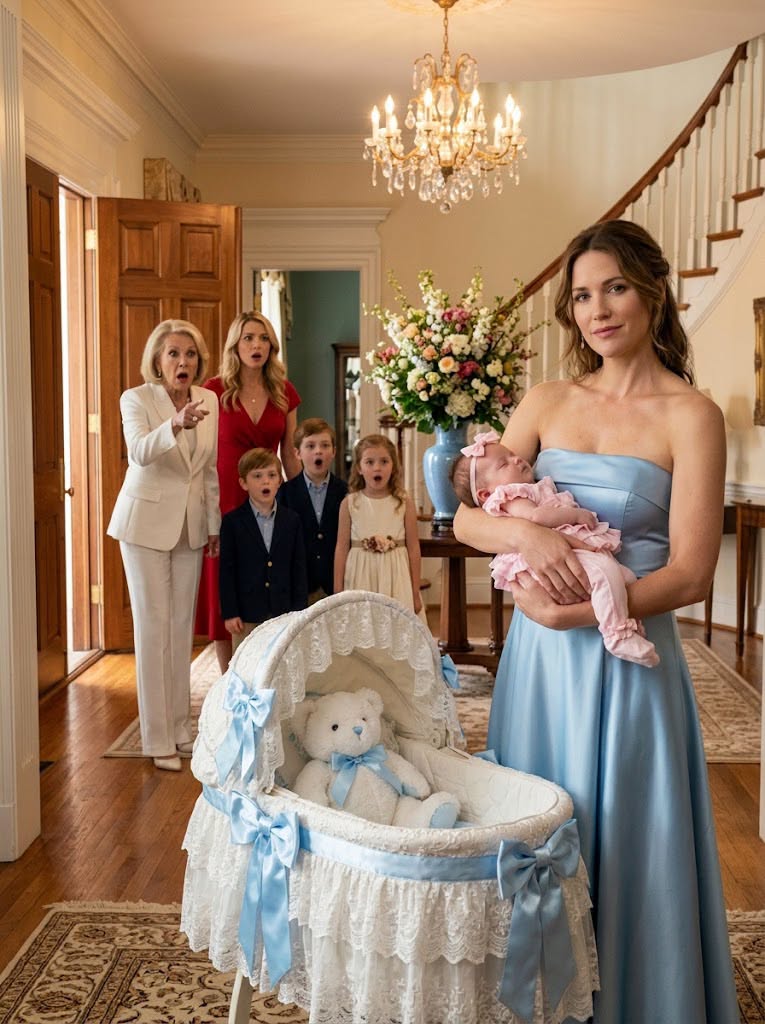
The next morning, Mom arrived with vehicles full of belongings.
She tried the old key.
It no longer worked.
When I opened the door, she immediately started telling people where boxes should go.
I stayed in the doorway.
“No one is moving in.”
She stared at me.
Then past me at the attorney sitting in the living room.
My attorney explained calmly that the house belonged solely to me and that no one had permission to occupy it.
Mom became furious.
“You would leave your own sister homeless?”
Before I could answer, Krista slipped a folded note into my hand.
Later, I read it.
Mom had been pressuring her too.
She had threatened to withdraw financial help and interfere in decisions involving the children unless Krista followed her plan.
Suddenly, my sister looked less like part of the invasion and more like someone trapped inside the same system I had spent years escaping.
Krista finally spoke.
“Mom, stop.”
Nancy turned toward her.
“We’re trying to help you.”
“No,” Krista said quietly. “You decided for everyone.”
Then she began steering Mom back toward the vehicles.
Nobody moved into my house.
The police were never needed.
No one had to be humiliated.
The door simply remained closed.
Afterward, I helped Krista with the deposit on a small apartment.
I did it privately.
Not because I owed her housing.
Because now I could help her by choice.
That difference mattered enormously.
Over the next few weeks, Clara and I settled into a rhythm.
Feedings.
Naps.
Laundry.
Long afternoons on the couch while she slept against my chest.
The house became quiet enough for me to heal.
Eventually, I contacted Mom.
I was not ready to return to the old relationship.
But I was willing to try something smaller.
One visit.
At my house.
Without anyone else.
No surprise guests.
No plans made for me.
No discussions about moving people into my home.
She arrived carrying lasagna.
For once, she did not reorganize my kitchen or criticize the nursery.
She sat at the dining table and held Clara.
We talked about ordinary things.
The weather.
Clara’s hair.
A television program she had been watching.
It was not reconciliation in the dramatic sense.
Years of control did not disappear because one afternoon went well.
But it was different.
Mom was inside my home because I had opened the door.
And when the visit ended, she left.
That sounds small.
To me, it was enormous.
For most of my life, I thought boundaries were weapons.
Something harsh people used to keep family away.
I understand them differently now.
A boundary does not necessarily mean:
I don’t love you.
Sometimes it means:
I want whatever relationship we have to be honest enough that neither of us has to disappear inside it.
I still help Krista when I can.
My mother still sees Clara.
But nobody has a permanent claim on my house, my time, or my decisions simply because we share blood.
The deadbolt matters.
Not because I live in fear.
Because it turns from the inside.
And for the first time in my life, I decide when the door opens.