Paid school fees.
Bought clothes.
Drove him to appointments.
From the outside, I probably looked like a devoted stepfather.
But there was a truth I had never admitted.
I had never fully accepted him as my own.
While my wife was alive, I kept that distance hidden because I loved her.
After she died, grief stripped away what little patience I had left.
That was when I failed him.
He grieved quietly.
Stayed in his bedroom.
Barely ate.
Sometimes I found him sitting by the window staring at nothing.
Instead of recognizing another person who had just lost the center of his world, I resented him.
He reminded me of her.
His silence irritated me.
His sadness felt like another demand when I could barely carry my own.
One night, we argued over something so unimportant that I cannot even remember what started it.
But I remember exactly what I said.
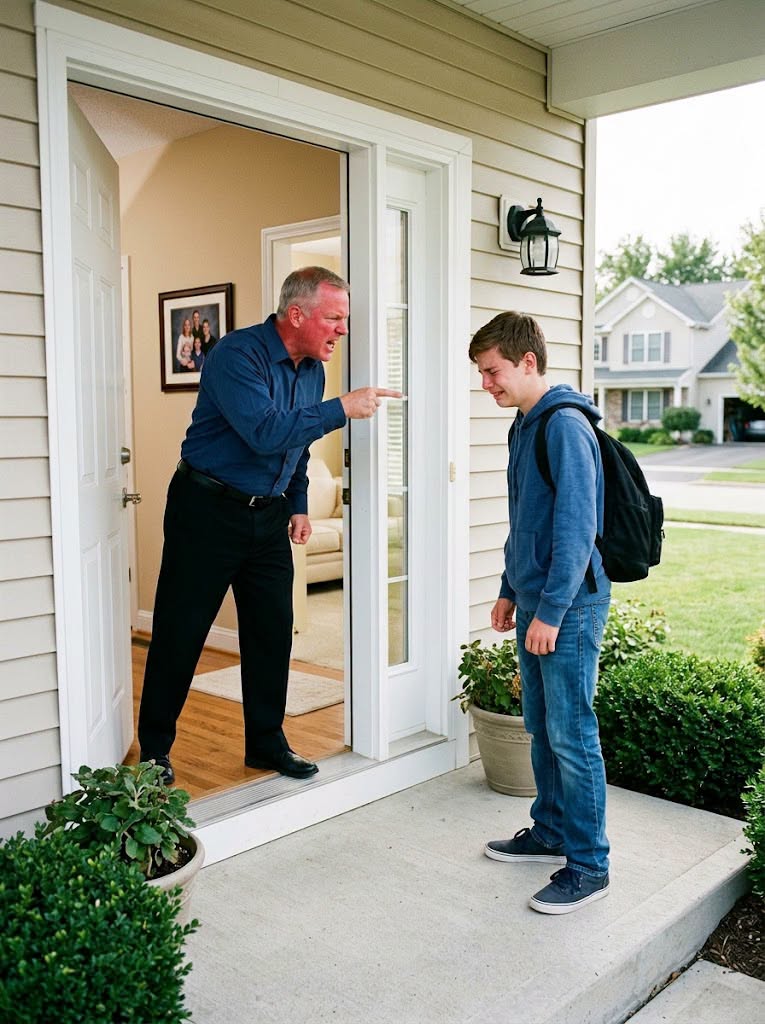
“Pack your things and leave.”
He stared at me.
Then I said something worse.
“You mean nothing to me.”
He did not shout.
He took an old backpack, put a few things inside, and walked out of the house.
He was sixteen.
It was dark.
And I let him go.
For years afterward, I told myself I had been broken by grief.
That was true.
But it was not the whole truth.
Grief explained why I was not myself.
It did not turn a child into an adult.
It did not make him responsible for surviving my anger.
And it certainly did not make what I did acceptable.
Still, I did nothing.
I sold the house.
Moved.
Started another business.
Built a quieter life.
Sometimes I wondered where he was.
I never looked.
Ten years passed.
Then a woman called me.
She invited me to an art exhibition.
I was about to decline until she mentioned the artist’s name.
He had become successful enough that even I recognized it.
Then she asked:
“Do you want to know what happened to your wife’s son?”
My hand went cold.
I went.
The first photograph stopped me.
A sixteen-year-old boy was asleep on a wooden bench near a train station.
An old backpack rested beneath his head.
I recognized it immediately.
The next photograph showed him outside a convenience store, drawing on a piece of cardboard.
Then came a shelter.
A temporary room.
A construction site.
Night shifts.
A small art workshop.
Each photograph documented another stage of a life I had never bothered to find.
A gallery employee quietly explained that after I threw him out, he spent weeks without stable housing.
Eventually, a shelter volunteer noticed that he drew constantly.
She found him old paints.
Someone else helped him enroll in classes.
He worked nights.
Studied during the day.
Kept drawing.
Years later, an established artist saw his work and began mentoring him.
That was how his career began.
Not because I abandoned him.
Because other people refused to.
That distinction became unbearable.
At the end of the gallery was a large photograph of him as an adult.
Confident.
Older.
Standing beside one of his paintings.
The plaque beneath it read:
For those who had to build a home after losing one.
I stood there for a long time.
Then the artist who had mentored him approached me.
He handed me an old backpack.
The same one.
Inside were a few small belongings and a photograph of my wife.
On the back was handwriting I recognized only faintly.
Her son had written:
You told me I meant nothing to you.
I stopped breathing.
Below it:
For a long time, I believed you.
Then:
What happened afterward does not make what you did good. I survived because strangers showed me kindness when the person who had helped raise me chose not to.
My eyes blurred.
The final lines were simpler.
I built a life. I am proud of that. But my survival is mine. You do not get to turn it into proof that abandoning me helped.
I sat down.
For ten years, part of me had quietly hoped that if he had turned out all right, then perhaps what I did had not been quite as terrible as it felt.
Standing inside that gallery, I understood how selfish that hope was.
A child succeeding after being hurt does not transform the hurt into a gift.
Resilience is not permission.
I asked the artist whether he was there.
“He is.”
My heart raced.
“Does he want to see me?”
The man looked at me for several seconds.
“No.”
That answer hurt.
But for once, I understood that my pain did not create an obligation for him.
So I did not ask again.
I did not demand forgiveness.
I did not send a message explaining how devastated I had been after his mother died.
He already knew I was grieving.
He had been grieving too.
I simply left my contact information and said:
“If he ever wants anything from me—answers, documents, his mother’s things, anything—I’ll respond.”
Then I went home.
In the weeks afterward, I began going through boxes I had carried from our old house.
Photographs.
Letters.
School records.
Things belonging to his mother that I had packed away because looking at them hurt.
For the first time, I saw them differently.
They were not only pieces of my wife.
They were pieces of his mother.
I had kept them while telling myself I was preserving my past.
I had never stopped to ask whether they also belonged in his future.
So I catalogued everything.
Through the gallery, I offered to return whatever he wanted.
No conditions.
No meeting required.
He asked for his mother’s letters.
I sent them.
Months later, another request came for several photographs from his childhood.
I sent those too.
That was the extent of our contact.
It may remain that way.
I have learned not to turn another person’s boundary into a problem I am entitled to solve.
People sometimes imagine remorse as something dramatic.
A reunion.
An embrace.
Forgiveness.
A second chance.
Sometimes remorse is quieter.
It is finally telling the truth about yourself when there is no reward for doing it.
I loved my wife.
I failed her son.
Both statements are true.
I was grieving.
And I abandoned a grieving child.
Both are true too.
His success does not reduce my responsibility.
If anything, seeing what he survived made it clearer.
He became an artist because he had talent, persistence, and because strangers offered compassion at moments when I did not.
None of that belongs to me.
The only thing that belongs to me is what I chose that night.
And what I choose now.
I cannot return to the doorway and stop a sixteen-year-old boy from walking into the dark.
I cannot make him trust me again.
I cannot demand a place in the life he built without me.
But I can stop rewriting the past to make myself easier to live with.
He did not become strong because I abandoned him.
He became strong despite it.
And perhaps the first decent thing I can do for him now is finally leave that truth exactly where it belongs.