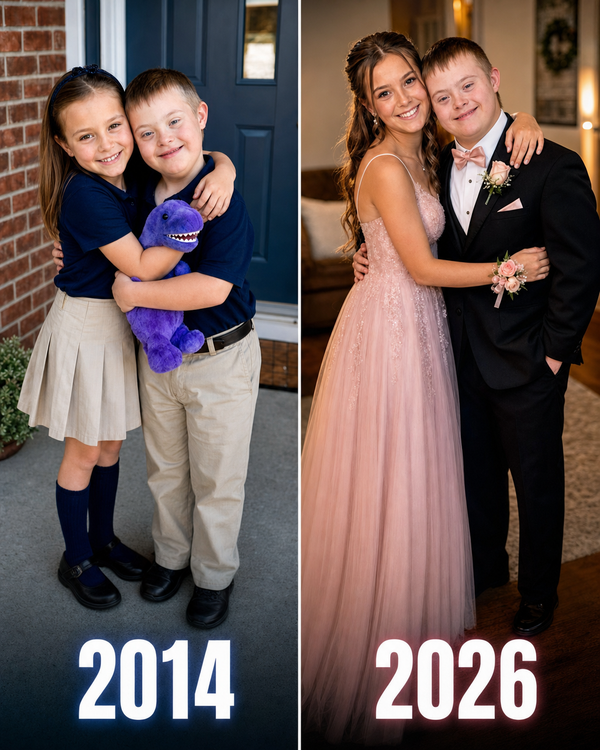
I didn’t understand what she meant yet. All I knew was that minutes earlier, Noah had been standing in our doorway in a suit and bow tie, grinning like he’d won the World Series, and now my mother wanted answers before I could go anywhere with him.
A Friendship That Began with Dinosaurs and a Promise
Noah became my best friend in first grade, after we discovered we both hated raisins and loved dinosaurs. He had Down syndrome, but it never defined what we were to each other. He was funny, stubborn, and could recall baseball statistics from years back without blinking.
He also told me exactly what he thought, once informing me that my drawings looked “like potatoes with arms.” One afternoon, our teacher announced her upcoming wedding. While the class debated cake flavors, Noah declared his own future wedding would have chocolate cake and “no slow, boring songs.”
A boy across the table laughed and said nobody would ever marry him. I watched Noah’s smile disappear. “That’s stupid,” I snapped. “Somebody will love Noah.” He looked at me and asked, “Would you?” I told him maybe, but first we had to go to prom. He held out his pinkie, and we sealed it: a promise.
Years of Growing Up Together
Twelve years later, Noah remembered every word of it. By then we’d survived different classes, my parents’ divorce, and his endless, patient attempts to teach me baseball. When I went through my first heartbreak, he showed up with ice cream and said, “I told you that guy was an idiot.”
So when senior prom arrived, going together wasn’t about honoring some childhood charity promise. Noah was simply my best friend, and there was no one else I’d rather go with.
The Secret Behind the Locked Door
That evening he arrived holding my corsage, dressed in a suit and bow tie. When my mother opened the door and saw him, her smile vanished. She stared at him for several long seconds before telling him I was almost ready, then came upstairs.
In my room, she locked the door and said I could go with Noah, but only after hearing a truth about him and about her. Her hands shook as she sat beside me and began to talk.
After my father left, I had stopped eating lunch and barely spoke to anyone. My mother told me that Noah once found her crying in a school parking lot and asked if I was broken. She said no. “Good,” he told her. “Because I don’t know how to fix people. I only know how to stay.” When she asked him to look after me, he agreed without hesitation.
I hadn’t known about that conversation, only the friendship that followed it. For six years, my mother had watched me defend Noah, wait for him, make room for him in every part of my life. She worried that loyalty had quietly become obligation, that a promise made at six was still choosing my future for me without my consent.
Standing downstairs that night was the answer to her fear: my best friend in a navy suit, holding a corsage that meant remembering. I was eighteen, and I wasn’t going with Noah because I owed him anything. I chose him.