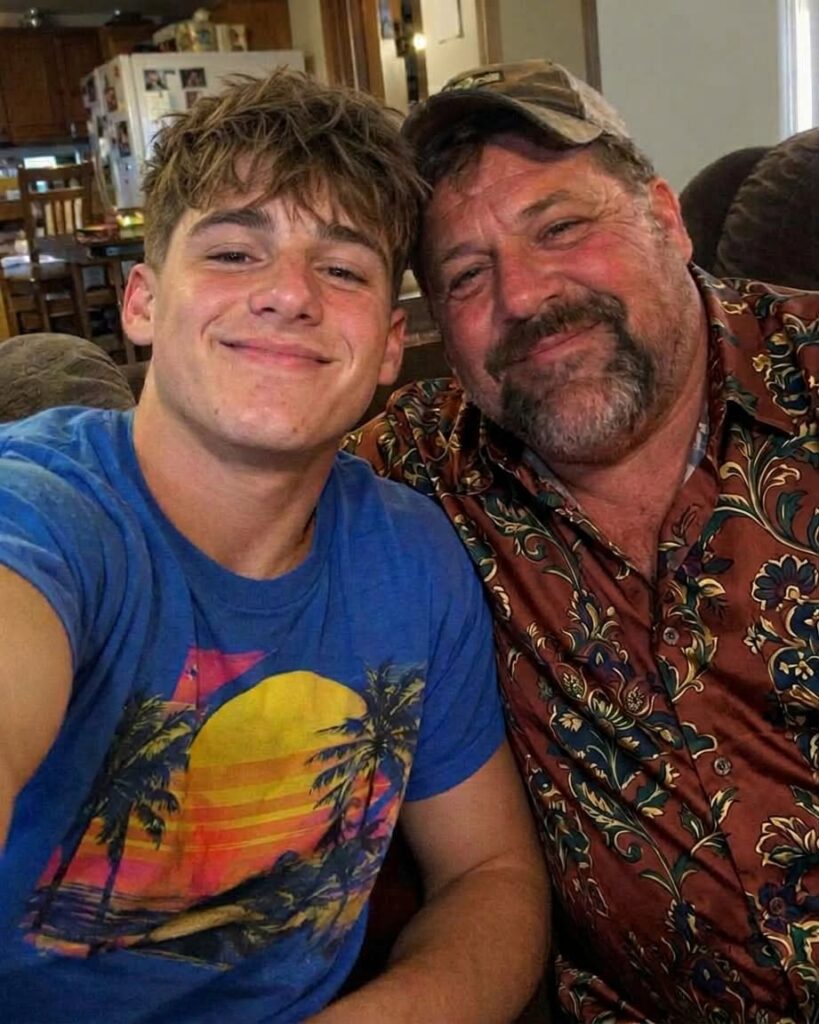
Then she died when I was nine.
Dad put the guitar away.
He worked longer hours.
Talked less.
He kept food in the refrigerator and paid the bills, but somewhere inside his grief, he stopped knowing how to be close to me.
By sixteen, I had taught myself guitar and started writing songs.
I wanted to study music production.
Dad barely looked at the brochure.
“Music doesn’t pay the bills.”
“But you played.”
“And look where it got me.”
That ended the conversation.
On my eighteenth birthday, he slid a piece of paper across the table.
“Two hundred fifty dollars a month. Rent.”
I thought he was joking.
He wasn’t.
I worked more hours.
Saved less.
And grew angrier.
Whenever I tried recording songs in my room, Dad complained about the noise.
One night I finally snapped.
“You can’t stand seeing me do something I love.”
His answer stayed with me.
“I can’t stand watching you waste your life like I did.”
After that, we drifted further apart.
For five years, I left $250 on the kitchen table every month.
Then Dad died of cancer.
Our final conversation had been about a leaking faucet.
After the funeral, his best friend Frank arrived with a cardboard box.
“Your dad wanted you to have this.”
Inside were old band photographs, backstage passes, guitar picks, and a picture of Mom smiling beside him onstage.
Then I found a key.
The address on its tag led to an old building at the edge of town.
Inside was a fully equipped recording studio.
Microphones.
Mixing equipment.
Guitars.
A drum room.
Then I saw my old guitar.
The one I thought I had lost years earlier.
Someone had repaired it.
Restrung it.
Placed it carefully on a stand.
That was when I realized the studio might not have been built for Dad.
It might have been built for me.
On the desk was a flash drive labeled:
Our Band.
The video began with old footage of Dad playing music with Frank and their friends.
I hardly recognized him.
He laughed.
Joked.
Jumped around onstage.
He looked alive in a way I had never seen after Mom died.
Then the footage changed.
Dad appeared as I remembered him near the end.
Thin.
Tired.
Cancer visible in his face.
“Hey, son.”
I froze.
He struggled for a moment.
Then said:
“I’m sorry.”
Dad explained that after Mom died, he became terrified.
He thought his job was to make sure I could survive.
Work.
Bills.
Responsibility.
Independence.
“If I could teach you to stand on your own,” he said, “I thought I was being a good father.”
Then he looked down.
“Somewhere along the way, I forgot how to be your dad.”
He had eventually returned to old recordings of his band.
They reminded him how much music had once meant to him.
And how much it clearly meant to me.
“I realized I spent years trying to protect you from the very thing that once made my own life worth living.”
He gestured toward the studio.
“It’s yours.”
But then he said something more important.
“You don’t owe me forgiveness because of this.”
That mattered.
Because a beautiful gift does not erase years of silence.
Love can explain a mistake.
It does not magically undo its consequences.
Dad knew that.
Perhaps too late.
At the end of the video, he told me to open a drawer beneath the mixing desk.
Inside were sixty envelopes.
Each contained exactly $250.
Every rent payment I had made.
Five years.
Fifteen thousand dollars.
On top was a note.
You earned every dollar of this. Don’t waste it the way I wasted my chance.
I sat there holding the money and cried.
For years, I had believed Dad was taking part of my future from me every month.
Instead, he had been saving it.
But sitting there, I understood something else too.
His intention did not make those five years painless.
He could have taught me responsibility without making me feel unwanted.
He could have encouraged music while still warning me how difficult the life could be.
He could have told me he was proud of me while he was still alive.
The studio was generous.
The money was generous.
His apology was real.
But none of it gave us back the conversations we never had.
That was the tragedy.
Dad had loved me far more than I knew.
And I had spent years believing almost the opposite.
I picked up my old guitar.
The repaired wood felt smooth beneath my fingers.
Then I looked toward the black computer screen where Dad’s face had disappeared.
“Thanks, Dad,” I whispered.
And after a moment:
“I wish you had told me.”
Because sometimes love hidden too well becomes indistinguishable from absence.
Good intentions matter.
So does saying the words while there is still time.
I could not change the years behind us.
But Dad had left me one final choice.
Not an obligation to forgive everything.
Not a command to become the musician he once wanted to be.
Just a room.
A guitar.
The money I had earned.
And permission to decide for myself what kind of life came next.