Then my father asked about the money.
Not David.
Not me.
The money.
The following day, David’s battalion commander, Major Sterling, and our casualty assistance officer came to explain what happened.
David had helped forty soldiers escape an ambush.
He had held an opening under fire so others could get through.
That was how he died.
Then the officer explained the military death benefits.
My father Richard leaned forward.
“So how much is the payout?”
My mother Martha immediately added that grief and pregnancy had left me incapable of managing finances properly.
They said they would “handle everything.”
Major Sterling’s expression hardened.
The officer calmly explained that the benefits belonged to the designated beneficiary.
Me.
My parents had no authority over them.
That should have ended the matter.
It didn’t.
Money had always been part of my relationship with them.
When I joined the Army at nineteen, Dad convinced me to send $400 every month to his struggling garage.
I did it for five years.
$24,000.
Eventually, David helped me see that supporting my parents was not the same as owing them permanent access to my paycheck.
After we married, I stopped the transfers.
They never forgave me.
Before David deployed, he gave me a green military folder.
Inside were benefit information, regulations, emergency contacts, and Major Sterling’s number.
“Your father will try to control things if something happens to me,” David said.
“Don’t let him.”
I thought he was being overly cautious.
Then David died.
And three days later, I gave birth.
The delivery became an emergency C-section.
Our daughter, Eevee, was born healthy.
I was exhausted, medicated, and barely able to sit up.
That was when Dad went through my medical bag.
He took David’s green folder.
“I’ll keep this safe,” he said.
Then he told me not to worry about paperwork.
He would manage everything.
For one exhausted moment, I almost wanted to believe him.
I had just lost my husband.
I had undergone surgery.
I had a newborn.
Part of me still wanted parents who would simply take care of me.
That illusion lasted until my brother Derek texted.
Watch your back.
He had overheard Mom and Dad discussing the insurance payment.
Dad wanted David’s benefits to rescue his failing garage.
If I refused to sign over control, they planned to leave me at the hospital without transportation and hope desperation changed my mind.
That was when the last fantasy disappeared.
They did not see a grieving daughter.
They saw leverage.
My casualty assistance officer soon told me Dad had already called the Army claiming he was my financial representative.
He had asked whether the benefits could be redirected into his business account because I was supposedly too unstable after surgery to manage them myself.
The request was refused.
Dad had the folder.
But the folder was not authority.
The law was.
I was.
When my parents returned, Dad placed a power-of-attorney form beside my hospital bed.
“Sign this.”
I looked at the line.
Then put the pen down.
“I’ll think about it.”
His warmth disappeared immediately.
“We leave tomorrow morning. Make your decision.”
So I made mine.
I arranged another ride.
Then I asked how to revoke my parents’ access to the military installation.
The next morning, I was discharged.
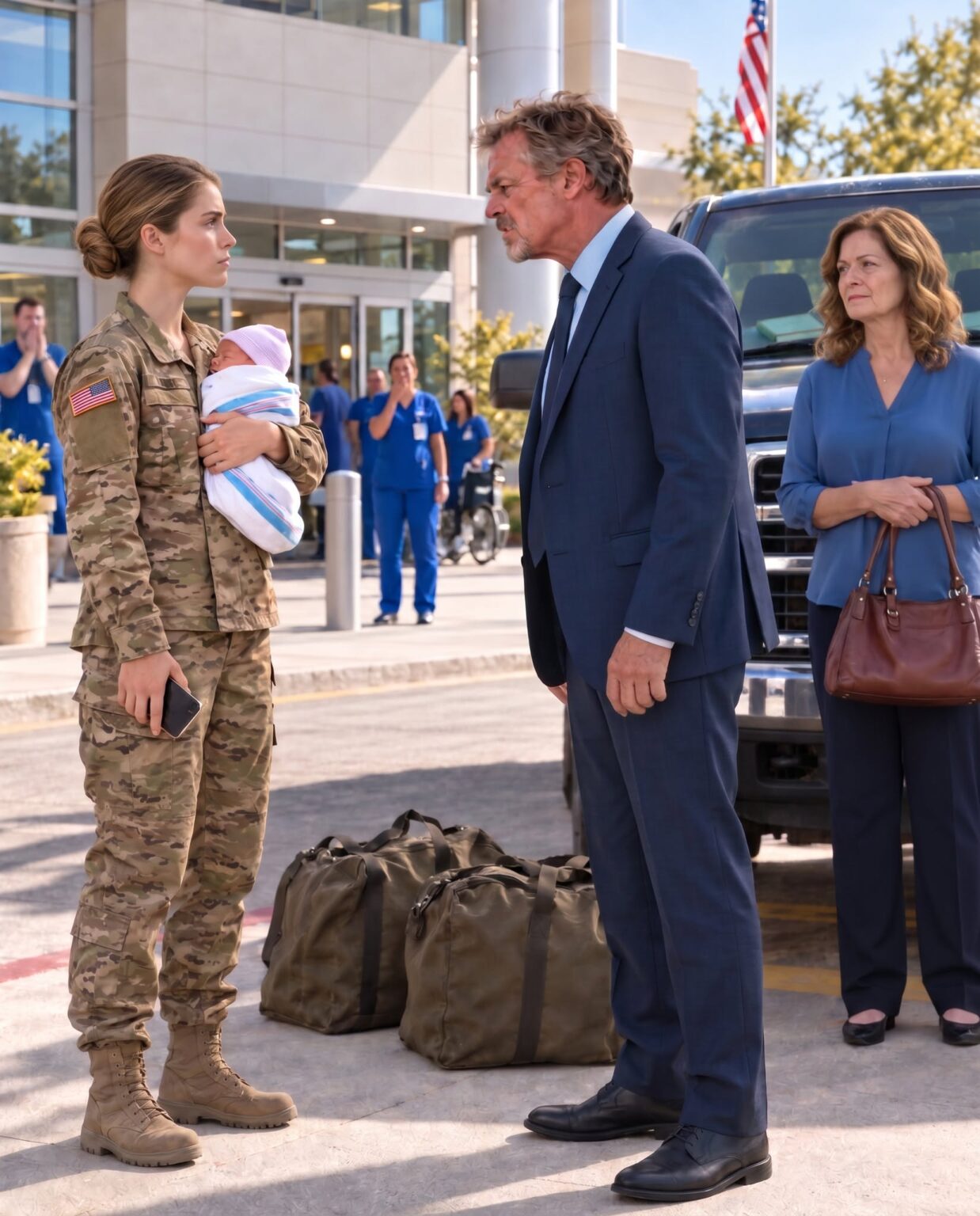
Dad carried my bags outside.
Then, when he realized I still had not signed anything, he dropped them onto the pavement.
“Take the baby and leave,” he said.
“You’re not coming home.”
Three days after abdominal surgery, I stood outside the hospital holding my newborn daughter.
Dad believed I would panic.
Instead, I called Major Sterling.
“My parents are here under my sponsorship,” I said.
“I’m revoking it.”
Then I told him Dad still had David’s military documents.
“Understood,” he replied.
Military police arrived shortly afterward.
There was no dramatic battle.
No need for one.
Dad was told that his authorization to remain on the installation had been withdrawn.
He was also instructed to return the documents.
He tried saying I was confused.
Hormonal.
Grieving.
He said he was only protecting me.
I looked at him.
“Give me David’s folder.”
Eventually, he did.
Then my parents were escorted from the installation.
My friend Sarah arrived soon afterward.
She picked my bags up from the pavement.
She did not ask why my own parents had left me there.
She simply helped.
Sometimes that is what care looks like.
Inside David’s folder, I found his final letter.
Dad had already opened it.
But the words were still David’s.
He told me the folder was never supposed to become something I depended upon forever.
Major Sterling had instructions to help me—but only after I chose to ask.
David wanted me to learn that nobody else could guard every boundary for me.
Protect our girl, he wrote.
That was when I finally cried.
Not because military police had removed my parents.
Because David had understood something I had spent years avoiding.
I kept waiting for someone else to make my family safe.
Eventually, I had to decide what safety required.
My parents were formally barred from the installation.
David was buried with military honors.
My brother Derek attended.
He had spent years disappointing me in plenty of ways.
But when it mattered, he warned me.
That counted.
Blood alone did not decide who belonged close to my daughter.
Behavior did.
Months later, Mom called.
She invited Eevee and me to Thanksgiving.
For a moment, I wanted to believe things might be different.
So I agreed to meet them once.
Public place.
One hour.
A friend nearby.
And one condition:
No discussion of money.
For twenty minutes, they behaved like ordinary grandparents.
Then Dad asked to see my insurance account statements.
That was enough.
I took Eevee back into my arms.
“We’re leaving.”
Dad accused the Army of turning me against my family.
I looked at him.
“It was me.”
Then I walked away.
No shouting.
No revenge.
Just the end of an argument I had been having since I was nineteen.
Now Eevee and I live peacefully near friends who have become part of our support system.
David’s green folder stays in a drawer.
I no longer carry it everywhere.
I know the procedures now.
I know whom to call.
More importantly, I know that documents and officials were never supposed to replace my judgment.
They helped me while grief and surgery had weakened me.
That is what support should do.
Help someone regain their footing.
Not take control of their life.
My parents may someday regret what they did.
I may someday forgive more than I currently can.
But forgiveness and access are different things.
David died protecting other people.
I cannot honor him by allowing fear, guilt, or family obligation to decide who gets access to our daughter.
The real protection he left me was not an insurance policy.
It was the reminder that I was allowed to say:
No.
Allowed to ask for help.
Allowed to close a door.
And allowed to protect the quiet life Eevee and I are still learning how to build.