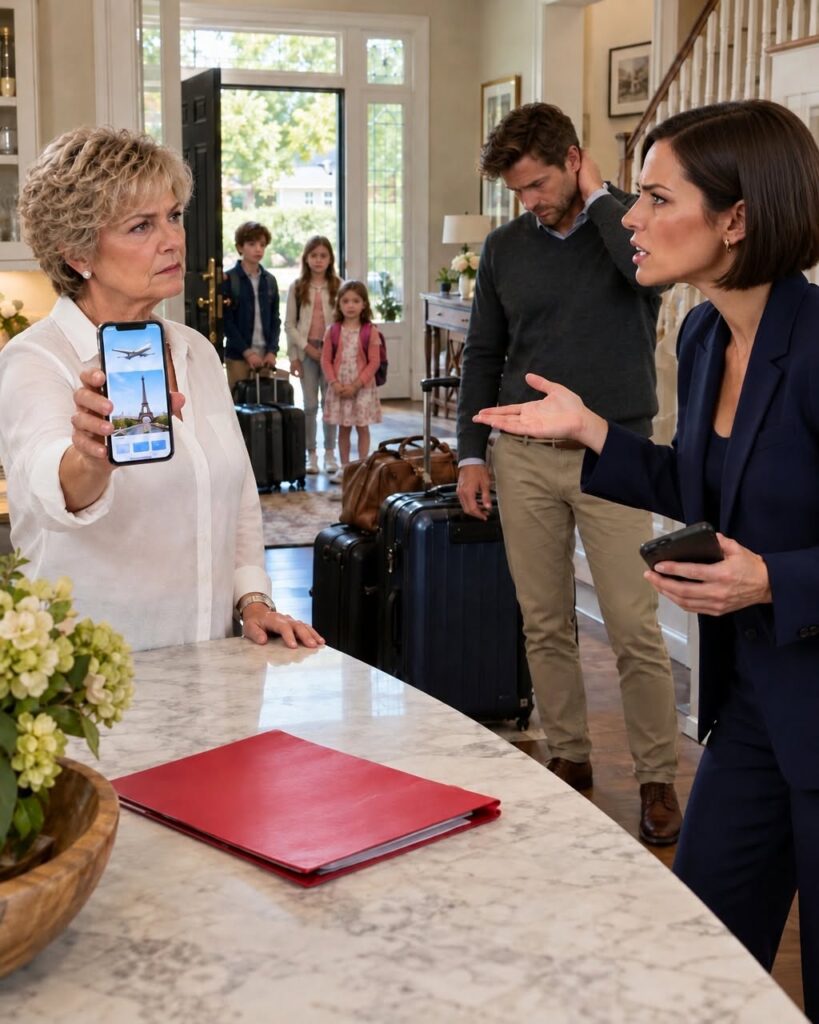
“The schedules are all in the folder.”
My son Caleb stood behind her looking uncomfortable.
He said nothing.
The children came inside.
Eli was fourteen.
Chloe was ten.
Finn was seven.
Maggie was five.
I loved all four of them.
There was just one problem.
I had a flight to Portugal that afternoon.
Caleb knew.
I had booked the trip four months earlier.
I had told him at Christmas.
Mentioned it again at his birthday.
Sent him the itinerary.
He had replied with a thumbs-up.
Now he hugged me goodbye.
“Love you, Mom.”
Ten minutes later, they were gone.
I stood in my kitchen with four grandchildren, three bags, one red folder—
and a flight I had no intention of missing.
“Grandma, are you angry?” Eli asked.
“Not with you.”
That mattered.
The children had not created this problem.
So I made pancakes.
After breakfast, I told everyone to brush their teeth and put on their shoes.
“Where are we going?” Chloe asked.
“Somewhere safe before I leave for the airport.”
Finn frowned.
“You’re going somewhere?”
“Portugal.”
Eli looked up.
“Today?”
“Yes.”
“Did Dad know?”
I chose my words carefully.
“I told him several times. But whatever happened between the adults is not something you need to solve.”
Then I loaded everyone into the car.
We drove to Patrice’s house.
Patrice was Tori’s mother.
She opened the door in a bathrobe, looked at me, then at four grandchildren standing behind me.
“What happened?”
“Tori and Caleb left them with me for two weeks.”
Her eyes widened.
“They did what?”
“I’m flying to Portugal today.”
For a moment she said nothing.
Then:
“Bring the children inside.”
“Patrice, I’m not trying to make this your responsibility.”
“I know.”
She stepped aside.
“You’re getting on that plane.”
That kindness nearly made me cry.
Then she told me something important.
“Tori said Caleb had arranged childcare with you.”
I stopped.
“She said that?”
“Yes.”
Patrice called her daughter.
Tori answered from the airport.
When Patrice asked why the children were in her kitchen, Tori sounded genuinely confused.
Then she learned about Portugal.
“What do you mean she’s going to Portugal?”
That reaction changed the situation.
Tori had still arrived at my house without asking me herself.
That was wrong.
But Caleb had apparently told her I had agreed.
I leaned toward the phone.
“Tori, Caleb knew about this trip.”
Then Caleb came on.
“Mom, can’t you move it?”
There it was.
He had not forgotten.
He had assumed I would cancel.
“Why didn’t you ask me?”
He sighed.
“I figured you’d help.”
For years, I had.
After my husband Charles died, being needed helped fill an enormous silence.
School pickups.
Sick days.
Babysitting.
Family dinners.
I rearranged my life because I loved them.
Eventually, everyone stopped noticing that I was rearranging anything at all.
My willingness had become availability.
My help had become expectation.
“I help because I love you,” I told Caleb.
“But you don’t get to turn that love into an obligation by refusing to ask.”
Tori spoke next.
“I honestly thought Caleb had talked to you.”
“I believe you.”
Then she said:
“I should have checked myself.”
“Yes.”
She should have.
Patrice agreed to keep the children for a few days while their parents arranged proper childcare.
Then she looked at me.
“Myrna. Go.”
So I did.
At the airport, Caleb texted.
I knew about the trip. I kept telling myself I’d arrange something else and never did. I should have asked. This is my responsibility.
Tori apologized too.
Neither message erased what happened.
But both acknowledged it.
I replied:
The children are safe. I’m boarding now. We’ll talk when I return.
Then I turned off my phone.
Portugal was beautiful.
But the trip meant more to me than I expected.
Charles and I had planned to go there for years.
There was always another expense.
Another responsibility.
Another reason to wait.
Then he became ill.
Someday never came for him.
At Sintra, Eli sent me a message.
Did Grandpa Charles ever visit Portugal?
I replied:
No. We always planned to.
A moment later:
Then I’m glad you finally went.
I sat with that for a long time.
For years after Charles died, I thought honoring our life together meant remaining inside the routines we had built.
But perhaps honoring him also meant refusing to postpone my own life forever.
When I came home, Caleb and Tori asked to talk.
Tori admitted she had relied on Caleb’s assurance instead of confirming with me directly.
Then Caleb said:
“When Japan came up, I knew your trip was around then.”
“Then why assume I could take the children?”
His eyes dropped.
“Because you always make things work.”
There it was.
The whole problem.
I had become so reliable that he had stopped seeing reliability as something I chose.
“Caleb, I still want to help.”
I looked at both of them.
“I want sleepovers. Pancakes. School concerts. Birthdays.”
Then:
“But childcare is something you ask about. Never something you announce. If I haven’t said yes, the answer is not automatically yes.”
They agreed.
More importantly, their behavior changed.
Tori started asking with notice.
And she made it clear that I could decline.
Sometimes I said yes.
Sometimes no.
Nothing terrible happened when I said no.
Caleb began calling just to talk.
Not because he needed something.
That mattered too.
Months later, the grandchildren stayed overnight.
After the younger ones fell asleep, Eli found me making tea.
“Grandma?”
“Yes?”
“Were you scared to go to Portugal after Mom and Dad got upset?”
“A little.”
“Then why did you go?”
I thought about it.
“Because sometimes doing something important for yourself feels uncomfortable when you’ve spent years making everyone else’s life easier.”
He nodded.
Maybe he understood.
Maybe someday he will.
For five years after Charles died, I had confused being needed with having a meaningful life.
Helping my family did give my life meaning.
But it was never supposed to become the whole thing.
I was still a grandmother.
Still a mother.
But I was also Myrna.
A woman who liked pottery.
Books.
Travel.
Quiet mornings.
A woman whose dreams did not end when her husband’s life did.
And saying no did not mean I loved anyone less.
Charles and I never reached Portugal together.
I will always wish we had.
But I finally went.
And somewhere between Lisbon and home, I understood something I should have learned much earlier:
Love is generous when it is freely given.
It becomes something else when people begin treating it as their right.
Being a loving mother and grandmother did not require surrendering ownership of my time.
Sometimes the healthiest thing you can give your family is not another sacrifice.
It is a clear answer they finally learn to ask for.