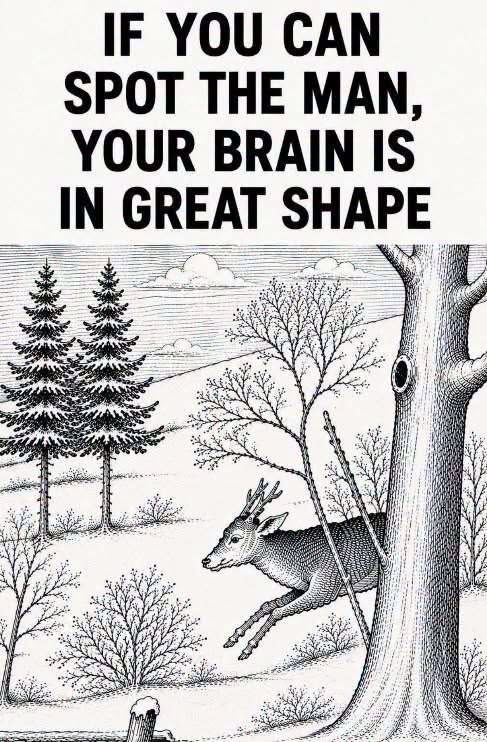
A human face.
The challenge is that your eyes naturally lock onto the deer first.
Its outline is familiar.
Its shape is easy to recognize.
So once your brain identifies it, everything around it becomes background.
That is exactly what makes the hidden face so difficult to notice.
The trick is to stop looking at the picture as a collection of objects.
Instead of asking yourself, “What do I see?”
Try asking:
“What shapes do these objects create together?”
Look closely at the tree trunks.
Study the darker patches between them.
Pay attention to the branches, shadows, and especially the empty spaces.
Sometimes the most important part of a hidden image is not an object at all.
It is the negative space between objects.
One tree may look completely ordinary by itself.
A shadow may appear meaningless.
A gap between two trunks may seem random.
But when your brain combines several of those shapes, something surprising can happen.
They may suddenly form the outline of an eye.
A nose.
A forehead.
A mouth.
And once those pieces connect, the forest may begin to look completely different.
If you still cannot see the hidden face, try changing the way you look at the image.
Move slightly farther away from the screen.
Narrow your eyes.
Stop focusing on individual branches.
Instead, look at the overall arrangement of dark and light areas.
You can even glance away for a moment and then look back.
Sometimes your brain needs to stop analyzing the details before it can recognize the larger pattern.
Then comes the satisfying moment.
One second, you are looking at nothing but snow, trees, and a deer.
The next, a face seems to appear from nowhere.
And once you see it, it can become almost impossible to unsee.
That sudden shift is what makes optical illusions and hidden-image puzzles so addictive.
The hidden face was never actually invisible.
Your eyes were seeing all the necessary shapes from the beginning.
Your brain simply classified them as separate parts of the landscape.
A tree was a tree.
A shadow was a shadow.
A gap was just empty space.
Only when those pieces were mentally combined did another recognizable image appear.
It is a perfect example of how strongly our brains rely on patterns.
We constantly search for familiar shapes in the world around us.
That is why people see faces in clouds, rock formations, tree bark, or even the fronts of cars and buildings.
Our brains are especially sensitive to faces.
But context matters.
When the scene already clearly looks like a snowy forest, the brain expects to find more forest—not a giant face hidden within it.
That expectation becomes part of the illusion.
So try again.
Ignore the deer for a moment.
Let your eyes travel slowly across the whole image.
Do not search for a perfectly drawn face.
Look instead for several unrelated shapes that might work together.
Once your brain finally makes the connection, the hidden figure may suddenly seem obvious.
And that is usually the funniest part.
After spending several minutes wondering where the face could possibly be, you may end up staring at it and thinking:
“How did I not see that before?”